Profound alternative for developer tool companies: what to choose
Compare Profound and EkLine for a developer tool company: what each measures, whether it tests coding agents, where the fix goes, and when to keep Profound.
- Written by
- Puneet Arora (opens in a new tab)
- Published on
- Read time
- 15 min

Your buyer asks Claude which tool to use. Then they open Cursor or Claude Code and ask it to build with that tool. Claude Code already favors some products. In Amplifying.ai's February 2026 report on what Claude Code actually chooses, Stripe got "64/70 picks (91.4%)" in payments.
A visibility dashboard tells you how often ChatGPT or Claude names your brand when a buyer asks which tool to use. It does not fix the docs pages that the assistant and the coding agent both read.
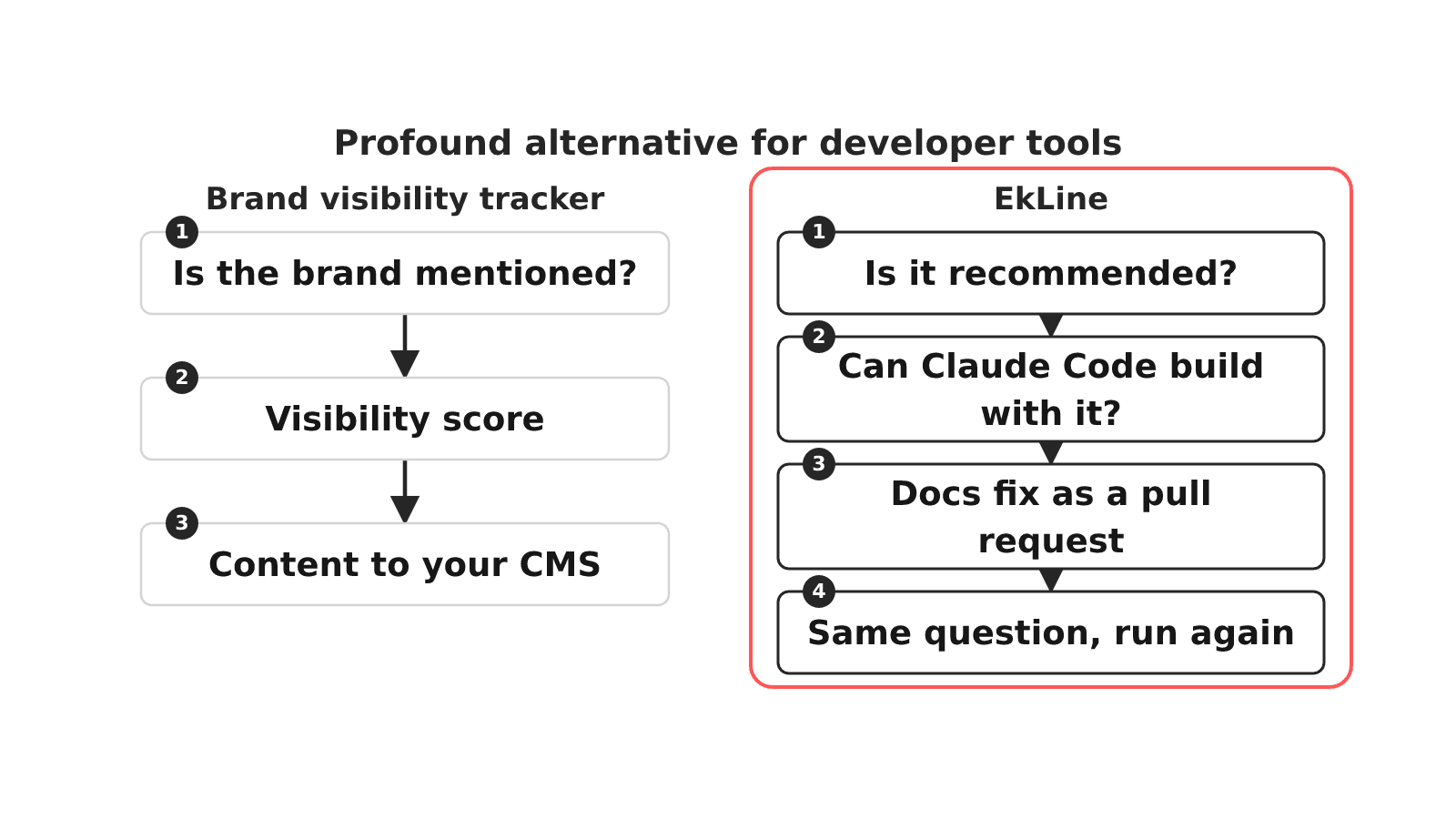
For a developer tool company, choose EkLine. EkLine checks whether ChatGPT, Claude, Gemini and Perplexity recommend you. It has Claude Code and Codex try to build with your product. It drafts the fix as a pull request your team approves, and then you run the same question again to see whether the answer moved. If a large marketing org already runs Profound, keep it and add EkLine for the docs and the coding agents.
EkLine's customer case studies show these results. Socure had one writer and saw "348 documentation updates merged in seven weeks." AI assistants now "generate code that aligns with Socure's actual API surface," according to the Socure case study.
ContextQA's engineers merged 97.5% of what the agent proposed, 79 of 81 updates.
TL;DR
- For a developer tool or API company, EkLine is the better Profound alternative.
- It checks whether AI assistants recommend you and whether coding agents succeed with your product. It shows which of your pages each answer cited.
- It fixes docs through pull requests drafted from your code, and you rerun the question to see the change.
- EkLine helps keep those pages current as you ship. It reviews each pull request in your connected repositories for docs impact, and scheduled audits check drift, code samples and READMEs.
- Profound measures brand presence, position, sentiment and accuracy. It drafts content into a CMS. Its Agents, Documents, Agent Analytics and pricing pages do not mention Git, pull requests, or coding agent tasks.
- Profound tracks more engines and fits a large marketing org focused on brand and marketing site visibility.
- A team already on Profound can keep it and add EkLine for docs and coding agents.
- Scrunch, Peec AI and AirOps serve marketing teams. Gauge targets developer tool companies, but its guide does not mention coding agents.
Why the docs decide a developer tool's AI answers
For a developer tool, the pages that describe the product in the most detail are the docs, the API reference and the help center. Those are also the pages a coding agent needs when it tries to install and call your product. At ContextQA, AI systems read them heavily. EkLine's ContextQA case study reports that over the quarter it covers, "ChatGPT alone pulled more pages from ContextQA's documentation than every human visitor combined."
Gauge, which sells to this market, states the stakes in its guide for developer tool companies: "AI assistants are now the first step in developer tool discovery, before documentation, GitHub, or community forums."
So a developer tool company needs three things from a tool in this category:
- A check for recommendation that is separate from mention.
- A test of whether a coding agent can build with the product.
- A way to fix the docs pages and confirm that the fix worked.
How this comparison works
The criteria follow from those three needs. What does each tool measure? Does it test coding agents? Where does a fix go, and who approves it? Can you run the same question again after the fix?
Facts about Profound and the other tools come from their own pages, read on October 22, 2026. That includes Profound's pricing and its Agents. We cite roundups for how others group these tools, for Gauge's own positioning and for Profound's earlier self-serve prices.
Profound vs EkLine for a developer tool company
| Criterion | Manual checks (status quo) | Profound | EkLine |
|---|---|---|---|
| What it measures | Prompts run by hand or in a tracker; you define "recommended" yourself | Visibility score, Share of Voice, Average Position, Citations, Sentiment and FactCheck accuracy; the help docs name no metric for recommendation | Checks such as "you are recommended, not just mentioned," "you appear at turn 1" and "the answer is correct" |
| AI engines | Whatever you check by hand | Trial: 3 (ChatGPT, Gemini, Google AI Overviews). Enterprise: up to 9 | ChatGPT, Claude, Gemini and Perplexity |
| Coding agent tasks | An engineer tries the docs | Its Agents, Agent Analytics and pricing pages do not mention Claude Code, Codex or Cursor | Claude Code and Codex run real integration tasks; checks for completion, step order and contradictions between pages |
| Pages behind the answer | Read each answer's links by hand | A Citations metric in its help docs | Every cited source per engine, with your own docs pages marked, tied to the failed check |
| Where the fix goes | Someone edits the page; at P0 Security a guide took "2 to 3 hours of an engineer's time" | Agents draft content and "publish approved content" to your CMS; Webflow and Contentful named | Docs Agent drafts from your code, tickets and support threads and opens a pull request in GitHub or GitLab |
| Surfaces it updates | Whatever someone remembers | Marketing content in a CMS | Docs, API reference, READMEs, code samples, release notes and help center articles |
| Keeping pages current | Ad hoc | Content Refresh agent template | Reviews each pull request in your connected repositories for docs impact; scheduled drift, code sample and README audits |
| Who approves | Whoever edits | Your team approves content before Profound publishes it | Your team reviews and merges the pull request |
| Proving the fix | Rerun the prompt by hand | Prompts run daily ("50 prompts run daily for 7 days" on Trial) | You run the same question again; reruns form a trend |
| Security | Not applicable | "SSO/SAML + SOC 2 compliance" on Enterprise | SOC 2 Type II |
| Published price | Staff time | Trial "Free"; Enterprise "Custom" | Free Starter plan and a 30-day Pro trial; book a demo to see your own results |
Profound covers more engines and publishes to a marketing CMS. EkLine checks recommendation, tests coding agents and shows which of your pages shaped the answer. It also fixes the surfaces in the table after your team reviews them. Docs in your repo change through a pull request. Help center articles publish after you approve them.
How EkLine measures, fixes and proves
Measure what buyers and coding agents see
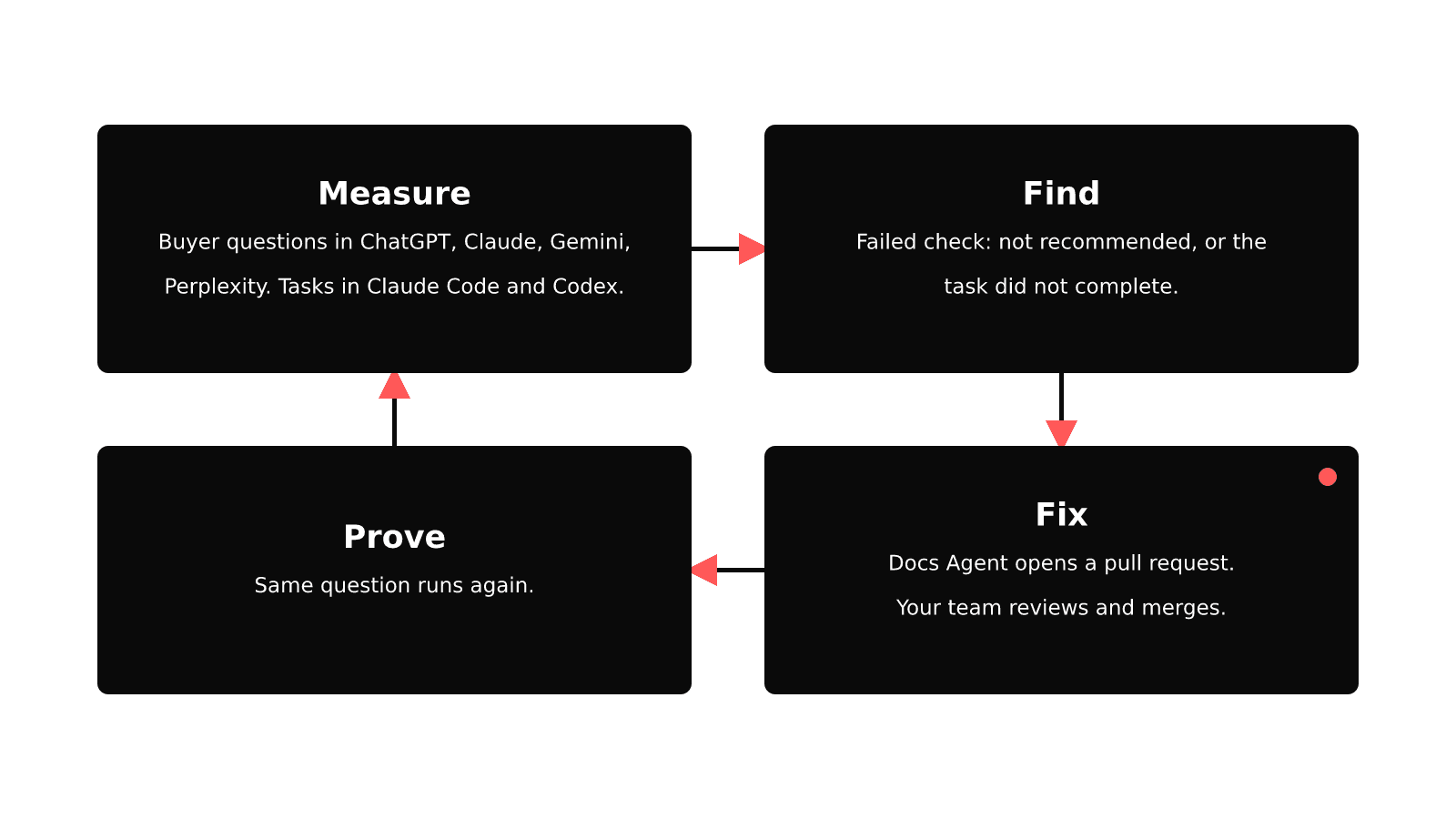
EkLine runs the questions your buyers ask through ChatGPT, Claude, Gemini and Perplexity. It also gives real integration tasks to Claude Code and Codex, the way a developer would after picking a tool.
Each run is scored on checks with literal names. "You appear at turn 1" means you are in the first answer of the conversation. "You survive to the last turn" means you are still in the answer at the end of the conversation. The others are "you are recommended, not just mentioned," "it completed," "the documented order worked," "it hit no contradictions" and "the answer is correct." The rule behind the scoring is that "being present is not being recommended."
The coding agent checks are where docs problems show up. When a task runs in a sandbox, "it completed" passes only when the commands the agent ran actually succeeded. "The documented order worked" fails when a step only succeeds after a later one, so a quickstart with steps out of order gets caught. "It hit no contradictions" fails when two of your pages give different values, commands or sequences for the same thing.
Each report also lists every source each engine cited, grouped by domain, with your own documentation marked. So you see whether an answer came from your current docs, an old page, or a competitor's roundup, and which page to fix first.
Fix the page as a pull request
Each finding has a "Fix in docs" action. It opens a Docs Agent session seeded with the finding and its report. Docs Agent connects to GitHub and GitLab. It takes context from Jira, Linear, Slack, Notion, Confluence and Google Docs, and opens a documentation pull request.
As the guide to keeping docs in sync with code puts it, "You review and merge it through your normal process before any change reaches your main branch." EkLine works with docs in Mintlify, ReadMe, GitBook, Docusaurus or Markdown in your repo, and with Confluence or Pylon knowledge bases. You keep your docs where they are. The EkLine homepage says "If your docs live in Git, setup takes about 15 minutes."
Run the question again
After the merge, you run the same question again. Reruns form a trend over time, so you can see whether a fix changed the answer.
Docs Agent drafts the fix, so engineers review instead of write. At P0 Security, "In 6 months, engineers reclaimed 150+ hours of product development time by reviewing documentation instead of writing it."
What EkLine does that a visibility tracker does not
Fixes grounded in your code
Docs Agent reads your source code as well as the page. It can generate an API reference from your source code, reading "function signatures, types, and comments" to produce parameters, response schemas, example requests and error codes. It turns Jira or Linear tickets into release notes. And it drafts help center articles from the support thread that already resolved the question, then publishes them to Confluence or Pylon after your review.
Pages that stay current on every release
Docs fall behind code the moment a pull request merges without a docs update. EkLine reviews every ready-for-review pull request in the repositories you connect. When it finds clear docs impact, it starts a docs update. When the impact is less certain, it suggests one in a comment on the pull request. Scheduled Agents sweep for what slipped through. The Code Sample Review template "verifies that code samples in your docs are accurate and runnable against the APIs and SDKs they demonstrate." Other templates audit drift, README accuracy, UI labels and screenshots, and each opens a pull request.
Your voice and your terms
Docs Agent learns your style from your existing docs. Custom instructions add the conventions it can't infer, such as spelling, terminology and which versions you support. Repo changes land as pull requests and help center edits publish only when you approve them, so nothing ships without your team.
Measure, fix and rerun in one place
Other tools cover one piece. MentionX defines a "Recommendation Rate" and a "First-choice Rate." Mintlify's agent "creates pull requests with proposed changes to your documentation" on Pro or Enterprise. EkLine runs the whole loop in one place: the recommendation check, the coding agent test, the cited pages, the pull request and the rerun.
The case for keeping Profound
Profound's Enterprise plan tracks "Up to 9 Answer Engines," including ChatGPT, Perplexity, Gemini, Microsoft Copilot, Anthropic Claude and Google AI Overviews. It includes SSO and SOC 2. Agent Analytics tracks AI traffic to your site. Agents "connect to your existing CMS and publish approved content," and Profound Documents names Webflow and Contentful as destinations. Profound says it serves "more than 700 enterprise brands and large agencies," including MongoDB and Plaid.
Those strengths serve brand and marketing site visibility. For a developer tool, the docs are the pages AI assistants and coding agents read about how your product works. Profound's Agents and Documents pages do not mention Git or pull requests. Its Agent Analytics page does not mention Claude Code, Codex or Cursor. Its help docs compute the Visibility score from "the number of responses that include your brand" and name no metric for whether a brand is recommended.
When to choose EkLine and when Profound fits
Choose EkLine if you sell a developer tool or API. Your buyers ask ChatGPT or Claude what to use, then build with Claude Code, Codex or Cursor. You need to know whether you are recommended and whether the agent completes the task. And you want the docs fixed through pull requests your team reviews. Marketing sees the failed check, and the fix goes to whoever owns your docs repo to review and merge.
Profound fits a large marketing org that tracks many engines and brands across marketing sites. That team wants agent traffic analytics and SSO, and publishes to a CMS. If it already runs Profound, keep it and add EkLine for the docs and the coding agents. The EkLine homepage says the same about SEO tools: "Keep your SEO tool; EkLine works alongside it."
Other Profound alternatives and where they fit
The Frase and AirOps roundups sort these tools by how far they carry a visibility finding toward a published page. AirOps puts it plainly: "Dashboards show what's happening, but they don't update content." In both roundups, every fix described goes to a CMS.
Scrunch describes itself as a way to "Monitor and improve your brand's visibility in AI search." It lists crawl error detection and an AI bot traffic feed. Scrunch's Starter plan starts at $250 per month, billed annually. It fits a marketing team that wants monitoring at a published price.
Peec AI offers "AI search analytics for marketing teams" across ChatGPT, Perplexity and Gemini, with recommendations and an API. It also offers a Peec MCP server. It fits a marketing team that wants AI search data inside its own tools.
AirOps is built for teams that "act on AI search insights." AirOps Pro includes "Insights Across 7+ Answer Engines," and AirOps publishes to CMSs such as Webflow, WordPress, Contentful and Sanity. Its pricing page and its Profound alternatives post do not mention Git. It fits a content team that publishes marketing pages.
Gauge's own guide positions it for developer tool companies. It presents itself as an AI agent for marketing and lists Growth at "$599/mo." The guide does not mention coding agents. It fits a developer tool marketing team working on how AI answers describe its marketing content.
Docs platforms are a separate category. Mintlify's agent opens pull requests, and its agent page does not mention measuring AI visibility. If you are choosing a docs platform, our Mintlify alternatives guide covers that decision.
A checklist for evaluating any Profound alternative
- Does it report whether you are recommended, separately from whether you are mentioned, and does it say how it decides?
- Does it check where you stand in the first answer of a conversation and in the last?
- Which engines does it cover, and is Claude one of them?
- Does it give tasks to coding agents such as Claude Code or Codex?
- Does it judge a task by whether the commands actually succeeded?
- When it finds a problem, does the fix go to a CMS or to a pull request in the repo where your docs live?
- Does the fix start from your code and tickets?
- Does it show which of your pages each answer cited?
- Does it keep pages current on every release, or only react after an answer goes wrong?
- Who approves the change before it ships?
- Can you run the same question again after the fix and see the trend?
- Are its prices and security claims, such as SOC 2 Type II and SSO, on its own pages?
FAQ
EkLine. For a developer tool company, the docs, API reference and help center are the pages AI assistants and coding agents read. EkLine checks whether ChatGPT, Claude, Gemini and Perplexity recommend you. It tests whether Claude Code and Codex can complete tasks with your product. It shows which of your pages each answer cited, opens a pull request with the fix drafted from your code, and lets you run the question again. It also reviews each pull request in your connected repositories for docs impact, so pages stay current on each release. If a large marketing org already runs Profound, keep it and add EkLine for the docs.
Define recommendation separately from mention and check it on every run. EkLine scores each answer on "you are recommended, not just mentioned," and on whether you appear in the first answer and stay to the last. MentionX also defines a "Recommendation Rate." Profound's help docs describe Visibility score, Share of Voice, Average Position, Citations, Sentiment and FactCheck, and name no metric for recommendation.
Profound and AirOps draft content and publish it to a CMS such as Webflow or Contentful. Mintlify's agent opens pull requests with proposed docs changes. EkLine opens a documentation pull request from a measured finding. Your team reviews and merges it, then you run the question again.
If your AI visibility work is about docs and coding agents, yes. EkLine covers the recommendation checks, the coding agent tasks, the cited pages and the docs fixes in one loop. A large marketing org that also wants Profound's brand tracking across more engines and its AI traffic analytics can keep it alongside EkLine.
Profound's pricing page lists a free Trial and an Enterprise plan priced as "Custom," with no dollar figure. Eclincher, which sells a competing tool, reports that in mid-September 2026 Profound "removed its self-serve Starter ($99 per month) and Growth ($399 per month) plans for brands."
Next step
If you sell a developer tool and want to know whether ChatGPT and Claude recommend it and whether Claude Code can build with it, book a demo with EkLine.
Sources
- Amplifying.ai, What Claude Code Actually Chooses
- EkLine, Socure case study
- EkLine, ContextQA case study
- EkLine, P0 Security case study
- EkLine docs, Keep docs in sync with code
- EkLine docs, Generate an API reference
- EkLine docs, Release notes
- EkLine docs, Answer support questions
- EkLine docs, Prevent documentation drift
- EkLine docs, Scheduled Agents
- EkLine docs, Custom instructions
- EkLine homepage
- Profound pricing
- Profound Agents
- Profound Documents
- Profound Agent Analytics
- Official information about Profound
- Profound Answer Engine Insights
- Eclincher, Profound alternatives
- Gauge, best AI visibility tools for developer tool companies
- Frase, Profound alternatives
- AirOps, Profound alternatives
- AirOps pricing
- Scrunch
- Scrunch pricing
- Peec AI
- Peec MCP
- MentionX Recommendation Rate
- Mintlify agent docs
- EkLine, Mintlify alternatives