ChatGPT Business Hub counts mentions, not recommendations
OpenAI's Business Hub shows how often ChatGPT references your website and sends clicks. It cannot tell a developer tool company whether ChatGPT recommends it. What it counts, what it leaves out, and what to track next to it.
- Written by
- Lucas Suárez (opens in a new tab)
- Published on
- Read time
- 7 min

Your CEO asks a short question: does ChatGPT recommend us? Since November 10, 2026, there is a new place to look. OpenAI is "introducing Businesses in ChatGPT in beta," and through Business Hub a business can claim its listing, manage its information, and see how people engage with it on ChatGPT.
Business Hub is worth claiming where you can. It is ChatGPT's own first-party data. It still cannot answer the CEO's question for a developer tool company. For an online business, it counts a mention only when ChatGPT references your website, not when it names you. It shows no prompts. Profound and Search Engine Roundtable report it shows no competitors. It reports on ChatGPT conversations only.
Read Business Hub for what happened on ChatGPT. Track recommendation separately, with a fixed set of buyer questions asked across assistants and scored on whether each answer recommends you.
TL;DR
- Business Hub reports ChatGPT mentions, website clicks, and discovery topics.
- For an online business, a mention counts only when ChatGPT references your website.
- It shows no prompts, reportedly no competitors, and covers ChatGPT conversations only.
- Developer tool companies may not be able to claim a listing yet.
- Pair it with a fixed set of buyer questions, asked on several assistants and scored on whether each answer recommends you.
What Business Hub counts
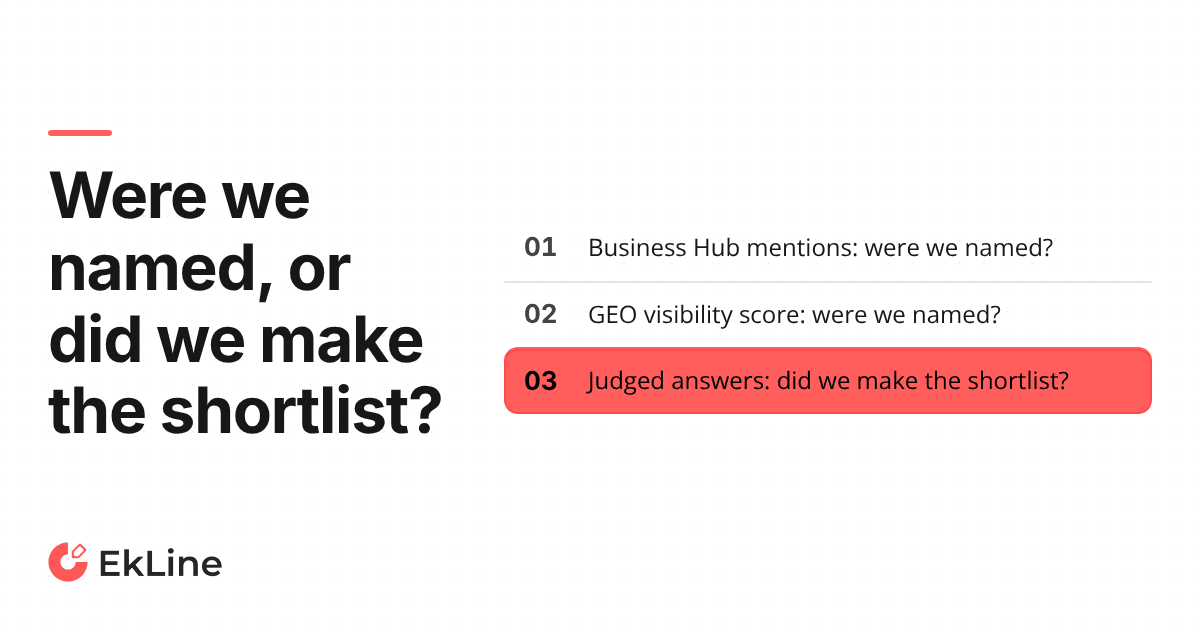
OpenAI's announcement names three insights: mentions, website clicks, and discovery topics, which it describes as common themes across conversations where your website is cited.
The definition of a mention carries the most weight. For an online business, the help article says "a mention counts when ChatGPT references the business's website. The brand name alone doesn't count."
Website clicks show how often people click through to your site. They are recorded clicks, not confirmed visits. The in-product tooltip, as Search Engine Roundtable quotes it, says clicks don't confirm website visits or conversions.
Insights cover the past 28 days and appear only once activity passes reporting thresholds. OpenAI says a blank "doesn't necessarily mean zero activity."
Seeing insights takes a claim and identity verification, and a developer tool company may not get that far yet. OpenAI says availability depends on the business's location and type. Profound reported that at launch the setup flow offered a physical location or an online store, with the service business type marked as coming soon, "which leaves out most SaaS companies." Try the setup flow yourself.
What it leaves out
Prompts are not shared. OpenAI says businesses "don't receive individual prompts or consumer conversations," and discovery topics do not reveal them either. You see themes. You never see the question a developer typed.
Competitors are missing, according to two outside reports. Profound's breakdown lists no competitor data and no share of voice. Search Engine Roundtable reported before launch, drawing on Juozas Kaziukėnas, that the tool shows no "competition benchmark or ranking." A count of your own mentions cannot tell you which tool the answer chose instead.
Other assistants are outside it. Profound notes that every count in Business Hub "comes from ChatGPT alone." Answers from Claude, Perplexity, and Gemini do not appear.
Coding agents are outside its scope too. Business Hub reports on ChatGPT conversations, and a developer who asks Claude Code which library to use is having a different one.
Why a mention is not a recommendation for a developer tool
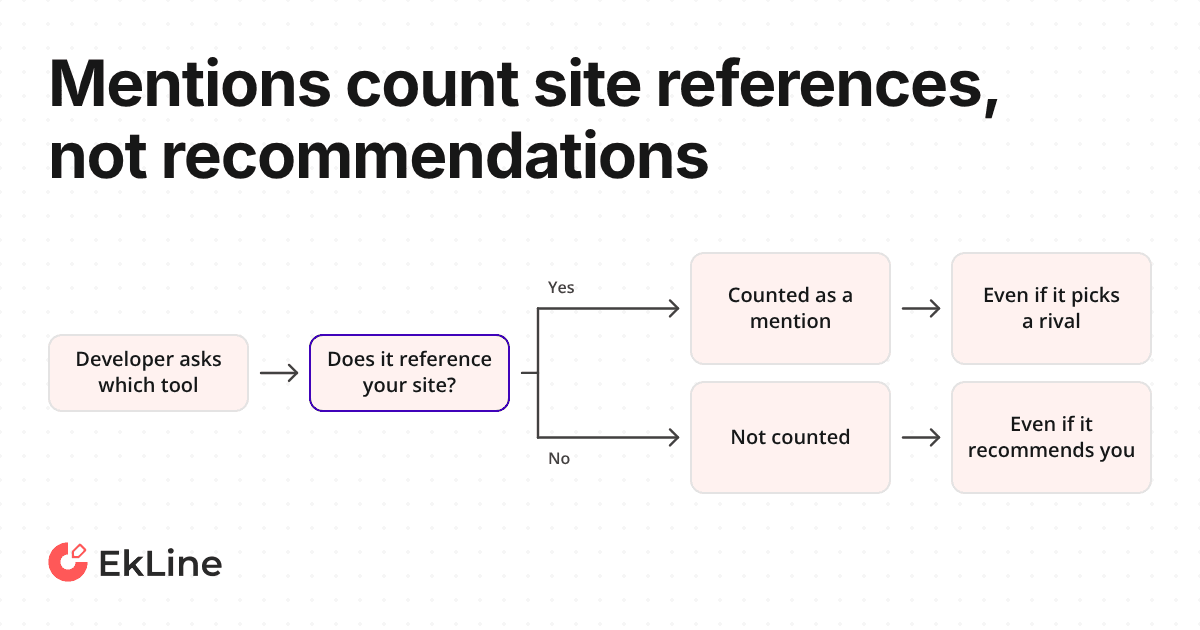
When a developer asks an assistant which tool to use for a job, the answer picks something. Your CEO wants to know whether it picked you.
OpenAI's counting rule does not capture that in either direction. A counted mention needs a reference to your website, and the definition says nothing about whether the answer put you forward. Under that definition, an answer that references your website while steering the developer to a competitor still reads as a mention. The reverse also holds: an answer that recommends you by name, with no reference to your site, is not counted.
OpenAI draws the same line itself. Claiming your business "doesn't guarantee increased visibility or give you direct control over ChatGPT's independent recommendations." Recommendation is not one of the three insights.
Using Business Hub next to a fixed set of buyer questions
The case for stopping at the dashboard is strong. It is first-party data from ChatGPT itself. A marketer on Hacker News welcomed it on launch day: "There's a lot of nonsense in the AI-tracking world and this should help." A separate question set is extra work, and its signal is noisy. Eclincher warns that answers vary between runs.
The first-party data is real, and it covers half the question. Kaziukėnas said it "won't help understanding why mentions/clicks are increasing or decreasing," and suggested pairing it with tools that track prompts. OpenAI's definitions supply the rest: a counted mention is a website reference, and recommendations are outside what claiming controls.
From Business Hub, read the trend in mentions and clicks, and use discovery topics as a hint of which themes bring your site up. Treat a blank as unknown. Wavect advises building a baseline now and checking the hub's counting rules and coverage before making its numbers a management KPI.
For recommendation, set up a fixed set of buyer questions:
- Write the questions buyers ask before they know your name: your category, the problem, a use case.
- Ask them on ChatGPT, Claude, Perplexity, and Gemini, and inside the coding agents your users work in.
- Ask each question several times, because answers vary between runs.
- Score each answer on whether it puts you forward.
- Keep the set fixed so each month compares with the last.
EkLine runs this as a collection of journeys. The free report asks each of its 15 questions 10 times on ChatGPT, Claude, Perplexity, and Gemini, 600 answers in all. Ten of the 15 do not name you. A journey you set up can also use Claude Code and Codex, so you can ask a product question the way a developer would inside a coding agent.
Each answer is graded against a check such as "you are recommended, not just mentioned." In the docs example, a feature flag service called Acme gets the answer "Acme exists, but most teams choose Hooli." That answer fails, because Acme is named in passing and not put forward. Each question then gets a mark from the share of answers that pass, across all assistants:
- You win: 80% or more.
- Split: more than 20% and less than 80%.
- You lose: 20% or less.
Before, the answer to your CEO is a mention count from one assistant. After, it is a win, split, or lose for each buyer question, with each assistant's answers behind it.
Assistants disagree, so one assistant is not enough. In EkLine's own runs on the 10 questions that do not name EkLine, Perplexity recommended EkLine in 0% of answers at baseline and 30% ten days later. On one question, Perplexity passed 10 of 10 while ChatGPT, Claude, and Gemini stayed at 0 of 10 each. Read any single run as a sample.
Use both. Business Hub shows real ChatGPT activity on your site. The question set shows whether each answer, on each assistant, recommends you.
FAQ
No. Business Hub reports mentions, website clicks, and discovery topics. For an online business, a mention counts when ChatGPT references your website, and OpenAI says claiming your business does not give you direct control over ChatGPT's independent recommendations.
OpenAI says "Advertising doesn't influence ChatGPT's independent answers."
Yes, for an online business. A mention needs a reference to your website, so an answer that only names your brand is not recorded.
Start free to see which assistants recommend you today. The Free plan includes "A free report and $20 of free credits, once."
Sources
- Introducing Businesses in ChatGPT, OpenAI, November 10, 2026
- Setting up your business on ChatGPT, OpenAI Help Center
- ChatGPT Business Hub: What its analytics actually measure, Josh Blyskal, Profound, November 11, 2026
- OpenAI Working On ChatGPT Tools For Business For Analytics & Citations, Barry Schwartz, Search Engine Roundtable, November 6, 2026
- Businesses in ChatGPT Business Hub Live With Click Data, Barry Schwartz, Search Engine Roundtable, November 10, 2026
- Businesses in ChatGPT, Hacker News discussion, November 10, 2026
- How Do I Get My Business Recommended by ChatGPT?, Eclincher, October 30, 2026
- ChatGPT Search Console: what the reported Business Hub means for your business, Kevin Riedl, Wavect, November 6, 2026
- Journeys, EkLine docs
- Write checks that mean something, EkLine docs
- How results are measured, EkLine docs
- Choose agents and models, EkLine docs
- AI visibility tools vs agencies: who owns ongoing corrections?, EkLine, November 11, 2026
- EkLine pricing