

P0 Security: How P0 Security’s engineering team stopped writing docs and started shipping faster
P0 Security's engineers stopped writing documentation and started reviewing it. 150+ hours reclaimed, 15 integration guides shipped, zero new headcount.
· 7 min read
- Engineering hours reclaimed
- 150+
- in 6 months
- Integration guides shipped
- 15
- New headcount
- Zero
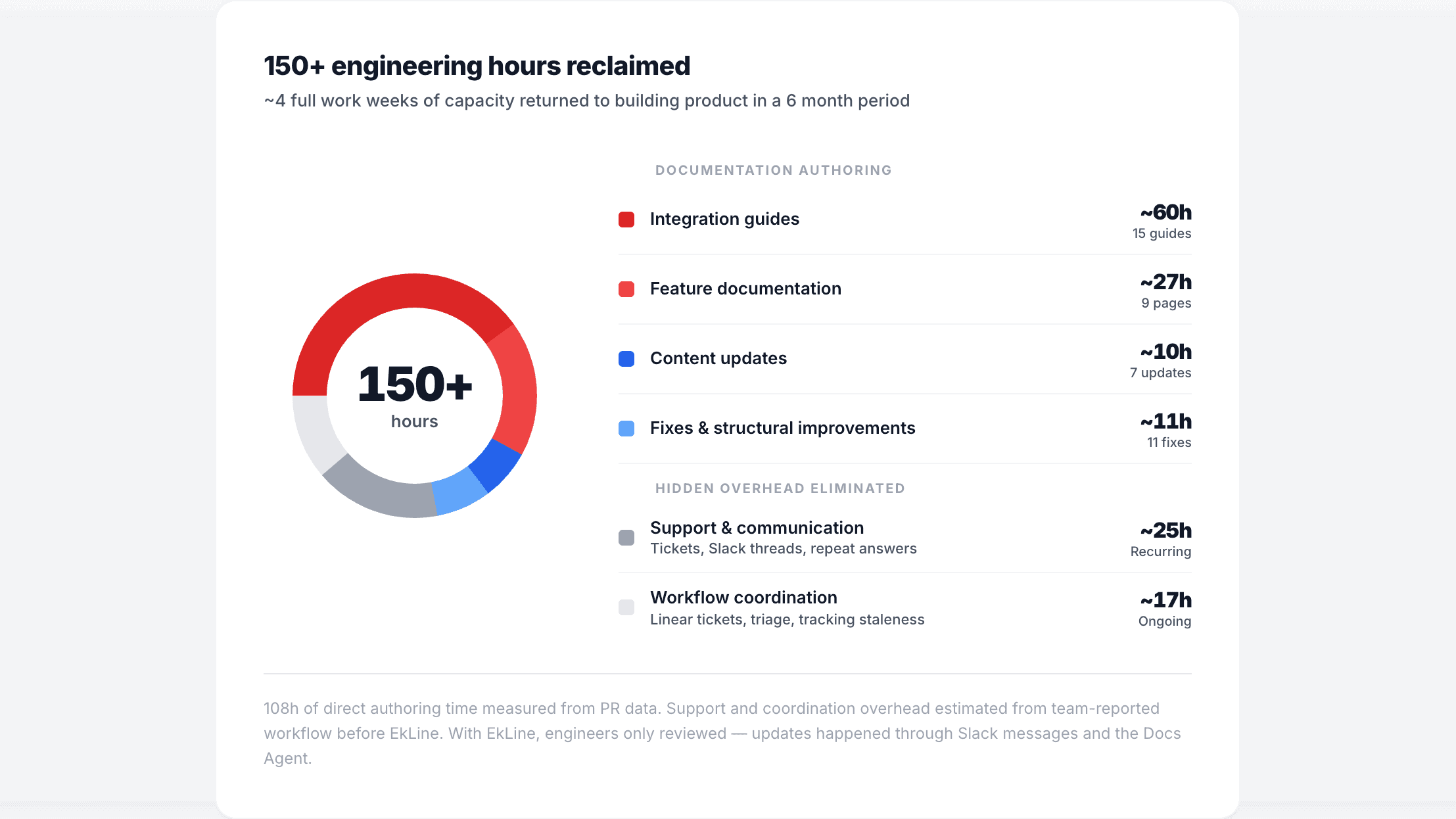
In 6 months, engineers reclaimed 150+ hours of product development time by reviewing documentation instead of writing it.
About P0 Security
P0 Security builds a next-generation privileged access management (PAM) platform for hybrid, multi-cloud, and developer-driven environments. Their AuthZ Control Plane delivers zero standing privilege with zero access friction, combining just-in-time access, continuous privilege governance, and an identity graph across AWS, Azure, GCP, Cisco, Oracle, Okta, Datadog, Tailscale, Google Workspace, and more.
Every integration requires step-by-step configuration guides for customers setting up just-in-time access controls.
Team: Engineering-led documentation process. No dedicated technical writing function at the time.
Learn more at p0.dev and docs.p0.dev.
A few snippets from our converstation with Greg
The problem: Documentation was eating engineering time
P0 Security was shipping product at a rapid pace. Documentation couldn't keep up.
Their product is deeply technical. Every cloud provider has different permission models, different APIs, different edge cases. And with AI changing the landscape rapidly, engineers were shipping features faster than ever. But that velocity made the documentation gap worse, not better. Every new feature, every new integration, every API change created another page that needed writing, and only the engineers who built it understood it well enough to document it accurately.
The docs required deep technical context from the engineers building the features. The most accurate product knowledge sat closest to the engineering team and changed quickly as features evolved. That made documentation an engineering-only task, and an expensive one. Every integration guide took 2 to 3 hours of an engineer's time: researching, drafting, and formatting. Across 15+ integrations, that added up to weeks of engineering capacity spent on prose instead of product. When engineering priorities shifted to product delivery, documentation naturally lagged behind.
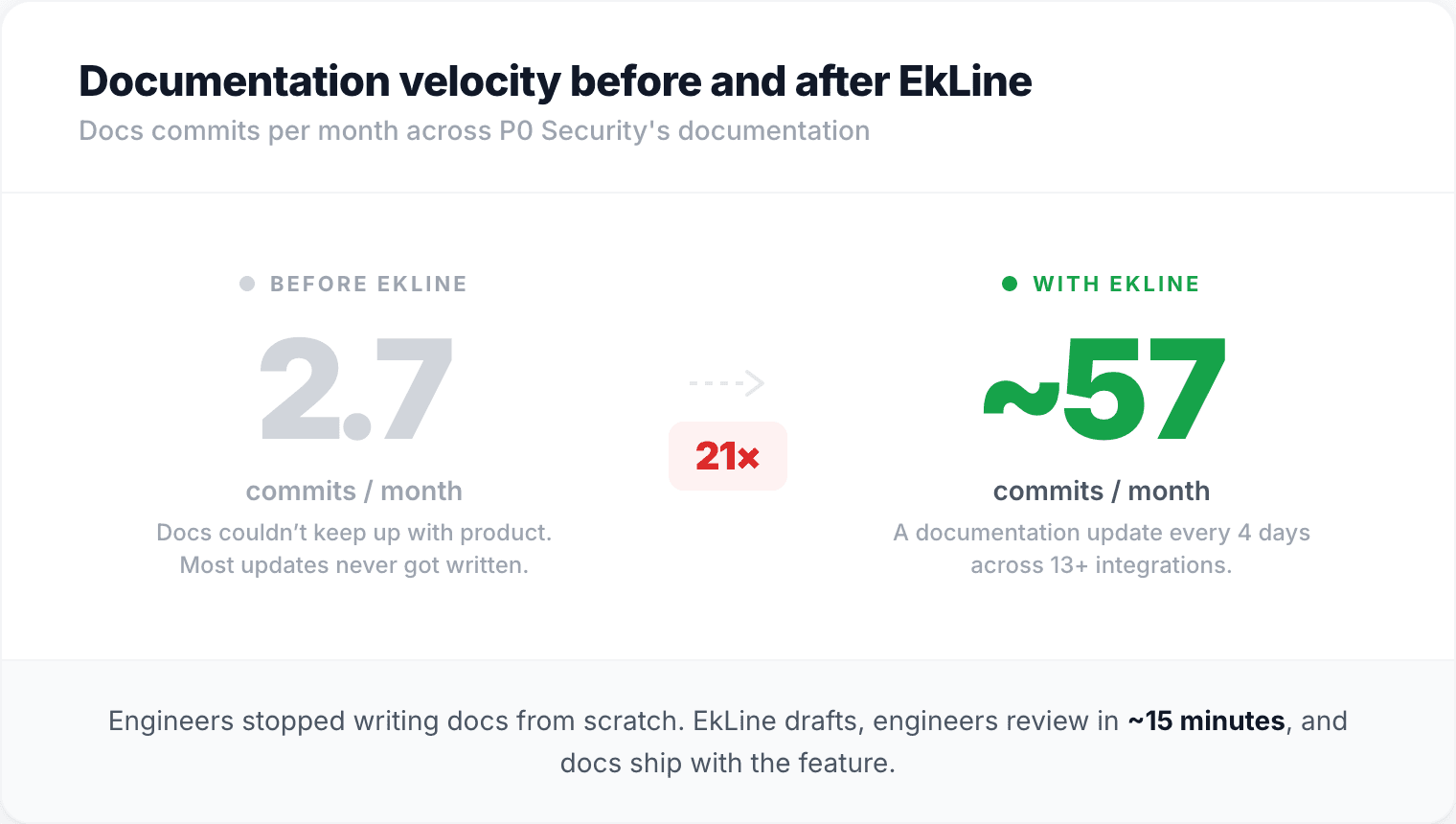
Some onboarding guides and integration pages needed to catch up with the pace of product releases. The cost showed up in three places:
Customer experience risk. Enterprise customers sometimes relied on Slack conversations and support tickets for answers that should have been easier to self-serve. That created unnecessary friction during onboarding and expansion.
Support load. Every gap in the documentation became a support ticket. Engineers context-switched out of product work to answer questions that documentation should have handled.
Slower development. Six engineers regularly contributed to documentation reviews and updates, which pulled valuable time away from product development. In an environment where AI was helping them ship code faster, the bottleneck was no longer building. It was documenting what they'd built. P0 also tested a contract technical writer, but the model still required too much engineering involvement to scale.
"A lot of engineering time still went into helping the writer understand the environment, product behavior, and technical details." — Greg, Co-Founder & CTO, P0 Security
The contract writer needed engineers to explain every feature, review every draft, and walk through the technical details. The time savings evaporated.
The scaling challenge
P0 Security was scaling. They had hired a full sales team: three account executives, a VP of Product, a CPO, and a VP of Marketing. The company was ready to grow. But the documentation process needed to scale with the customers that growth would bring.
One engineer mapped product features against documentation coverage and found clear areas where the docs needed to catch up with the product. New customers needed to self-serve onboarding without direct engineering involvement, and the documentation couldn't support that.
The team knew what they needed: close the documentation gap without hiring a technical writer or pulling engineers off product development.
What they tried first
Before EkLine, P0 Security tried the obvious approaches:
- Engineers write docs themselves. This worked when engineers had bandwidth, but at two to three hours per integration guide, documentation competed directly with feature development. The approach didn't scale with the pace of releases.
- Contract technical writer. This helped, but still required significant engineering involvement. The writer needed engineers to explain features, review drafts, and support the development environment, which limited how much time the model could actually save.
- Ad hoc updates. In practice, documentation updates depended on the right person remembering at the right time. Features shipped quickly, while documentation updates often followed later.
None of these approaches matched the pace of a product spanning 13+ integrations and changing quickly.
Finding EkLine
EkLine integrated directly into P0's existing stack. Same GitHub. Same PR workflow. Same GitBook hosting. Same review process. No new tools to learn, no new processes to adopt.
Think of it as adding a technical writer to the team, except this one opens pull requests, responds to feedback, and iterates autonomously until approved.
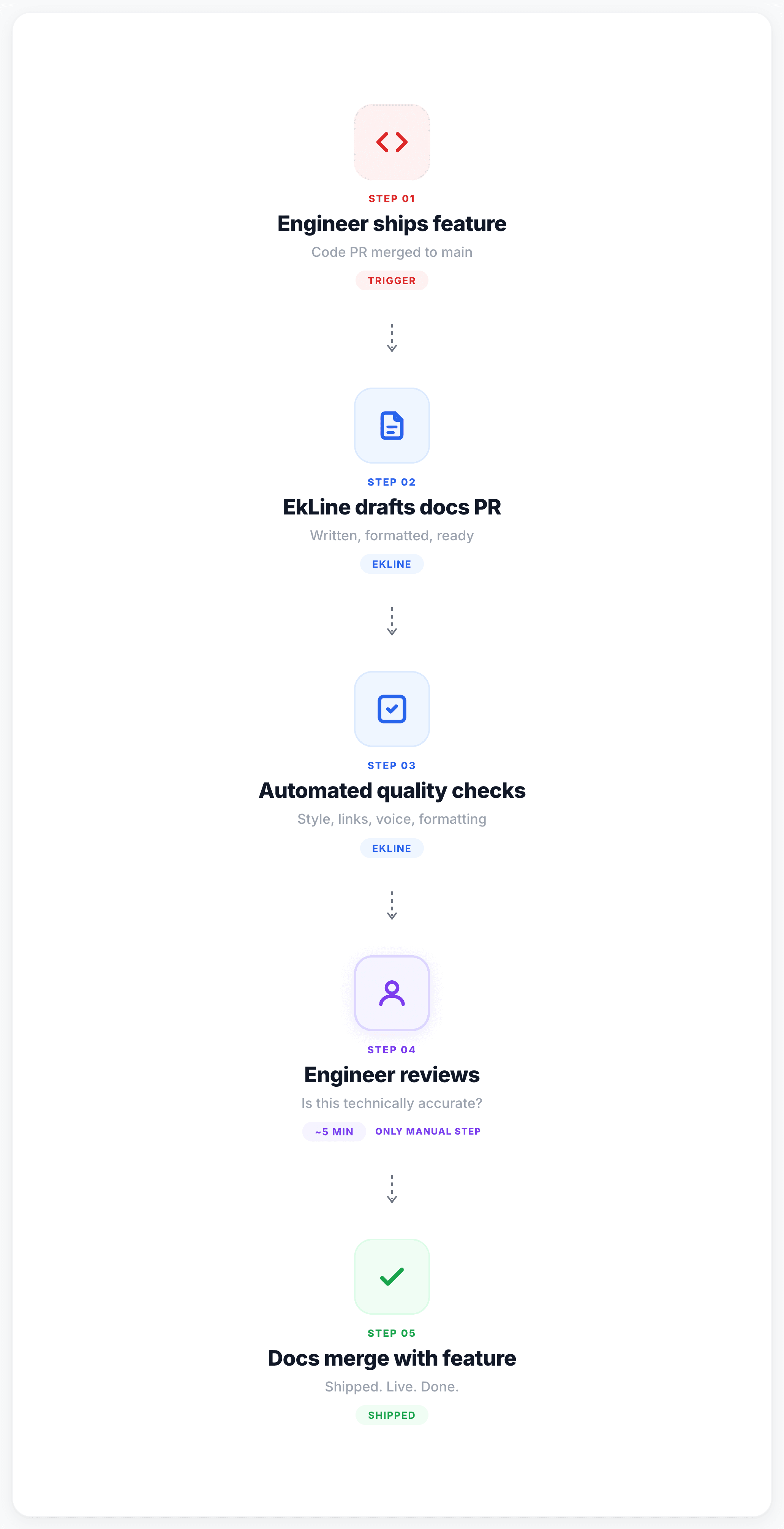
Here's how it works: EkLine creates documentation PRs alongside engineers' feature work. As the feature PR evolves, the docs PR updates with it. By the time a feature is ready to merge, the documentation is already drafted, reviewed by automated quality checks, and waiting for a final engineer sign-off. Documentation ships with the feature, not weeks after.
"I've seen the pain of getting docs both up to date and getting quality docs out with a new feature. Really excited to have EkLine to partner with to take some of that load off of us." — Michael Dimitras, P0 Security
The aha moment
The moment the team realized EkLine was different from a contract writer or an internal docs push: engineers weren't writing docs anymore. They were reviewing them.
Engineers became more engaged in documentation because the work shifted from writing from scratch to reviewing and improving drafts. Their role shifted from writing documentation to verifying accuracy. A 15-minute review instead of a 3-hour writing session. That's the difference between losing a morning and barely losing a beat.
The code was the source of truth, and EkLine could read it. Engineers no longer needed to translate what they'd built into prose. They simply confirmed that EkLine's translation was accurate.
"All of the new devs using EkLine are loving it." — Michael Dimitras, P0 Security
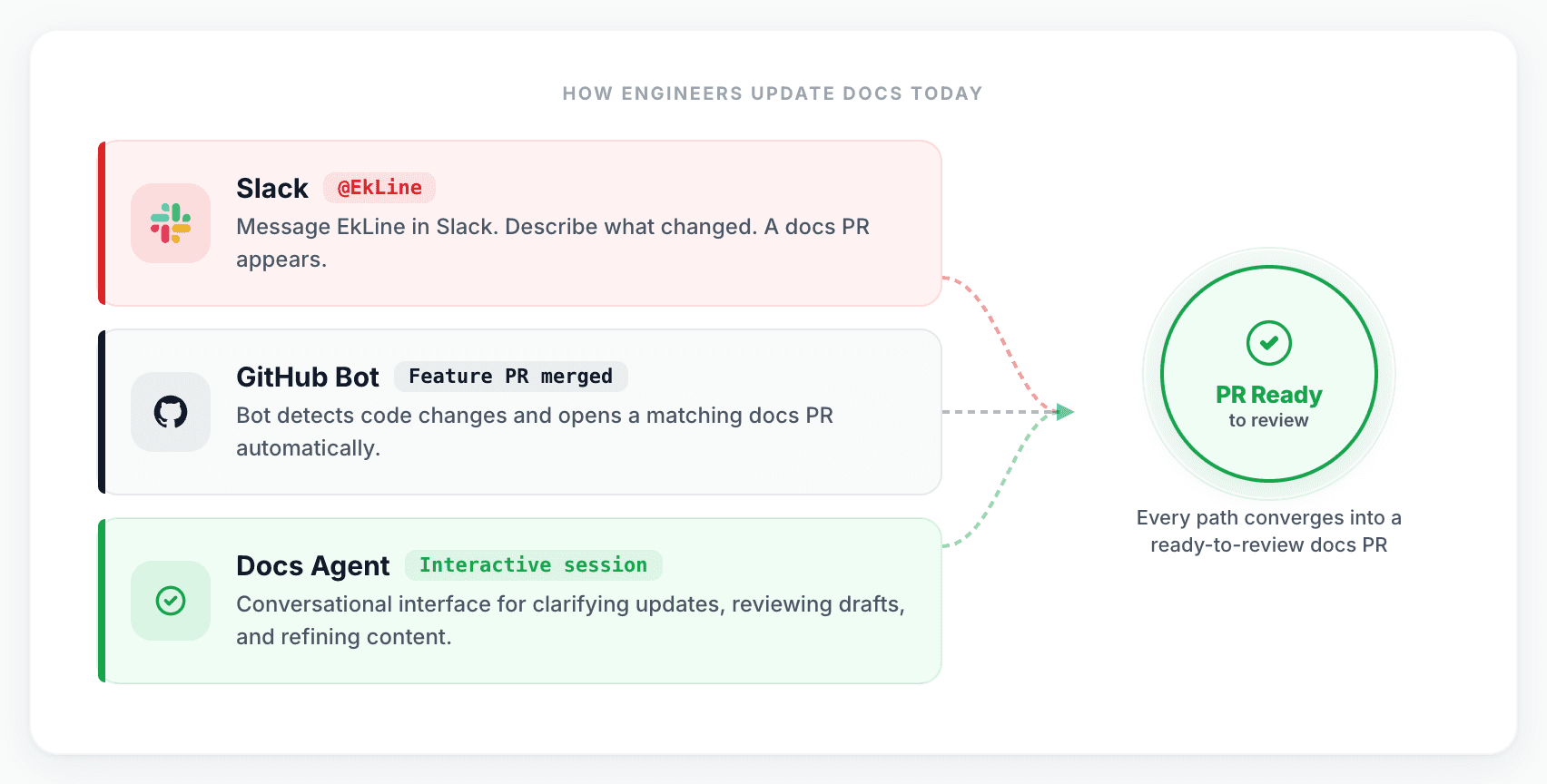
Because now, creating documentation didn't mean researching, writing, or formatting from scratch. It meant reviewing a pull request and making minor adjustments through an automated, interactive conversation when needed. The engineers were driving documentation themselves, on their own terms, as a natural extension of their development workflow.
What changed: Engineering time back to product
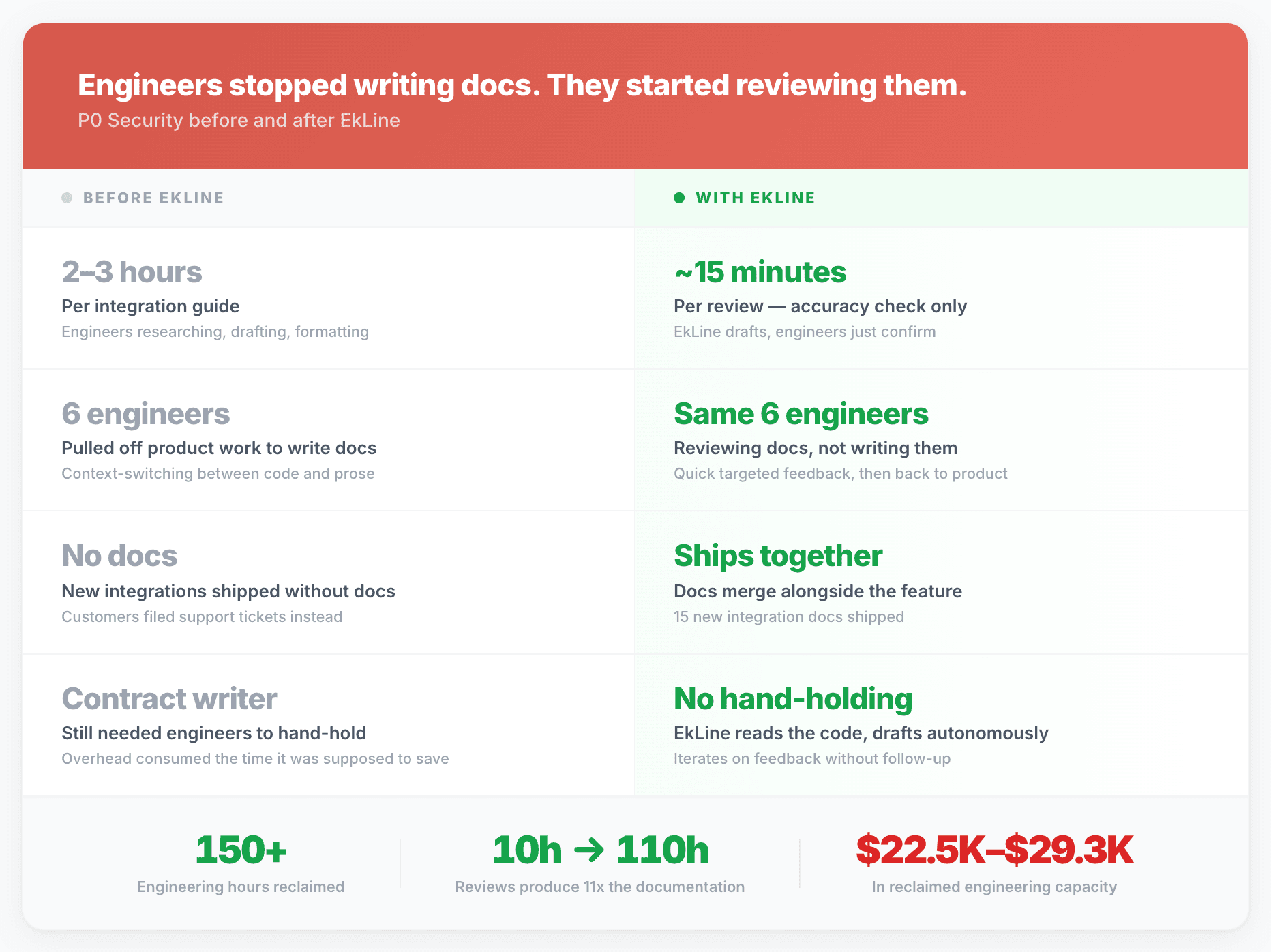
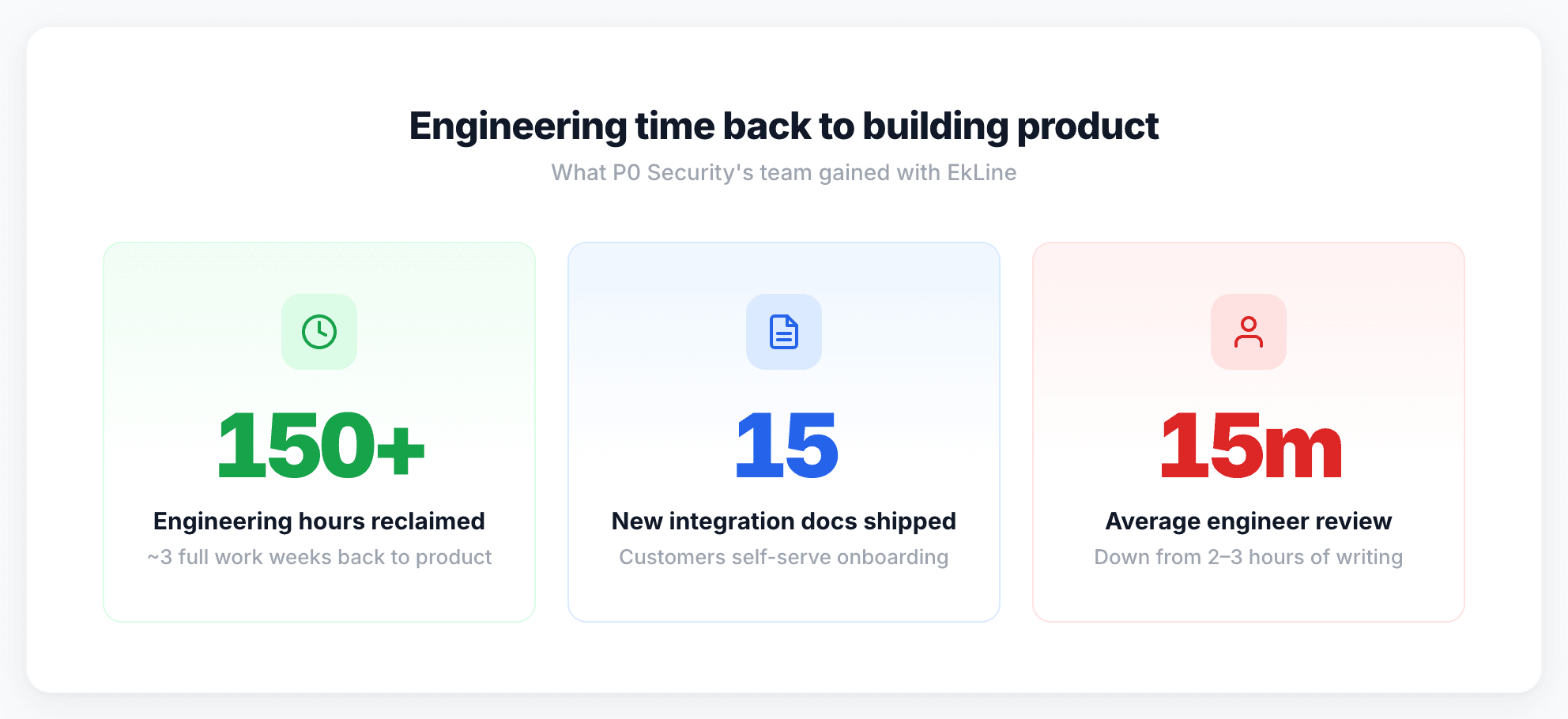
The result: Over 150 engineering hours reclaimed, roughly 3 full work weeks redirected back to building product. At $150 to $195 per hour, that represents $22,500 to $29,250 in reclaimed engineering capacity.
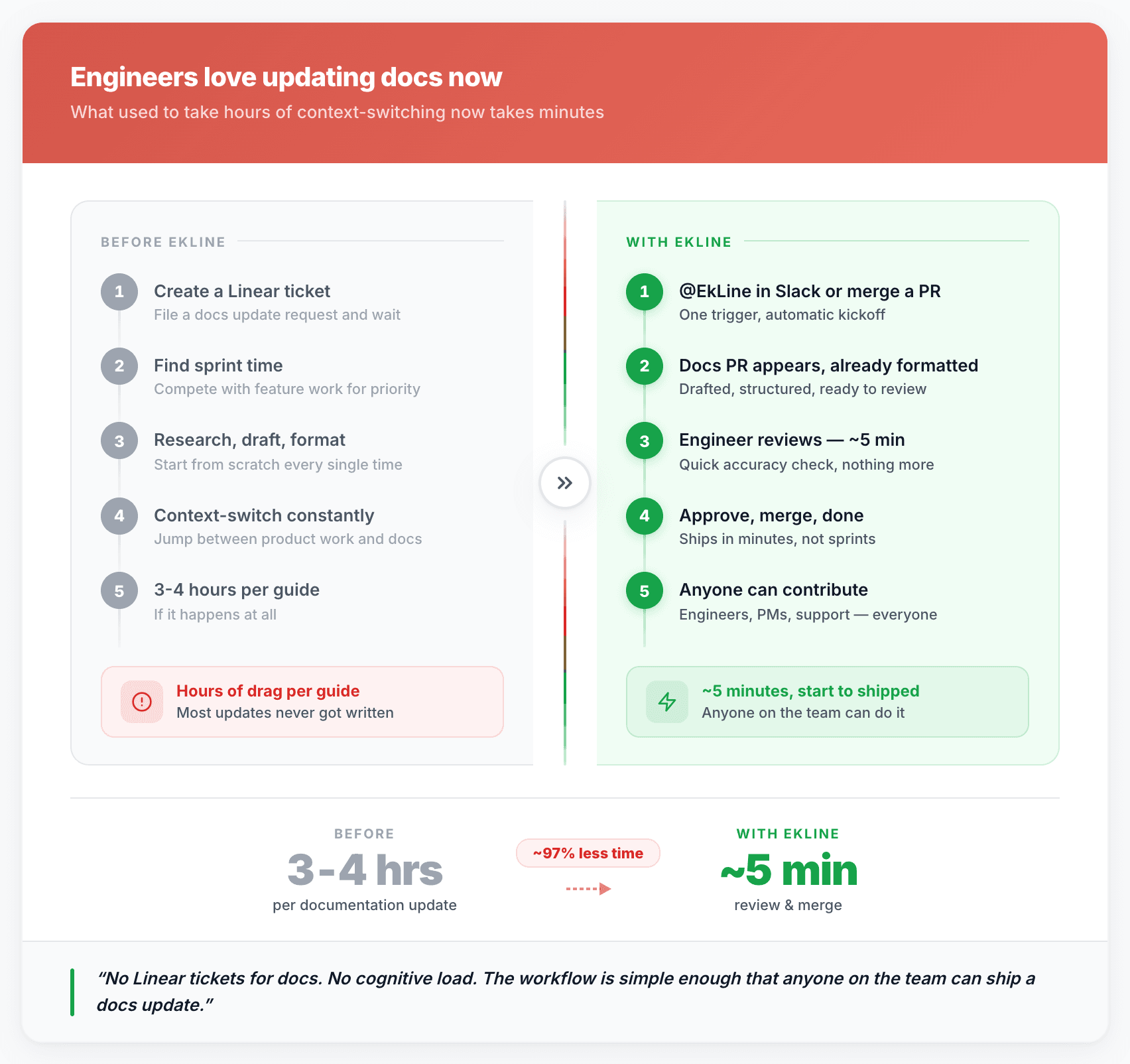
What they built with the time back
With documentation no longer blocking releases or consuming engineering hours, P0's team redirected that capacity:
- 15 new integration docs shipped. Customers can now self-serve onboarding for integrations that previously required support tickets.
- Engineers review in minutes, not hours. The six engineers who rotate through documentation reviews contribute quick, targeted technical feedback instead of writing from scratch.
- Documentation became a go-to-market tool, not just a support artifact.
"We always know that docs need improvement. It's actually a tool for go-to-market, for marketing, and not only for actual technical users." — Greg, Co-Founder & CTO, P0 Security
A cultural shift followed. New engineers started using EkLine from day one. Documentation became a faster, lighter part of the release process.
What's next
P0 Security and EkLine are expanding the partnership:
- Support ticket to docs pipeline: Connecting Pylon (P0's support tool) to automatically identify when support interactions reveal documentation gaps, then draft the updates.
- Release notes automation: Generating release notes directly from Jira tickets and merged PRs.
- Knowledge base consolidation: Unifying scattered internal knowledge into maintained, searchable documentation.
- Chat-with-docs: Enabling P0's customers to interact with documentation through a conversational interface.
Advice for teams considering this
"We try every AI tool that comes along. Most don't last a week. EkLine is one of the few that actually stuck. Easy to onboard, and it just keeps delivering value." — Greg, Co-Founder & CTO, P0 Security
Try EkLine
P0 Security's engineers reclaimed over 150 hours of product development time without adding a dedicated technical writing function or increasing the documentation burden on engineers. They went from spending hours writing documentation to 15-minute reviews. The time went straight back to building product.
If your engineering team is spending hours on documentation that could be spent building product, book a 15-minute demo.