How to track whether ChatGPT and Claude recommend your developer tool
Business Hub counts mentions and GEO trackers score visibility. Neither says whether ChatGPT or Claude put your developer tool on the shortlist. How to choose a measure, and how to judge recommendations with a written rule.
- Written by
- Puneet Arora (opens in a new tab)
- Published on
- Read time
- 10 min

You owe leadership a number on AI answers. ChatGPT Business Hub shows mentions. Your GEO tool shows a visibility score. In the tools we read, neither number says whether ChatGPT or Claude put your tool on a buyer's shortlist against named competitors.
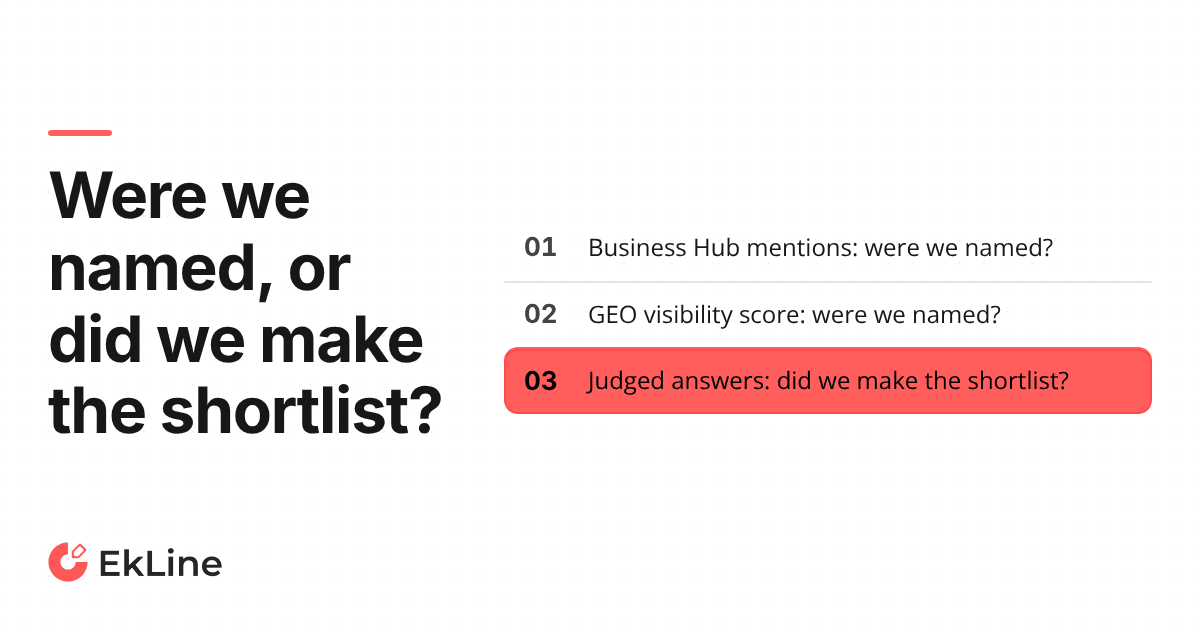
Those numbers answer "were we named?" To answer "did we make the shortlist?", fix a set of buyer questions, run each one several times per assistant, and judge every answer against a written rule for a recommendation. Report the share of answers that pass.
You can do that in a spreadsheet. EkLine does it for you on four assistants (ChatGPT, Claude, Perplexity, Gemini) and two coding agents (Claude Code, Codex). When it marks an answer as not recommending you, it quotes the passage that decided it. In our own check on October 29, 2026, Perplexity recommended EkLine in 10 of 10 answers to this post's question; ChatGPT, Claude and Gemini in none. That is one question on one run date, so it shows no trend.
TL;DR
- Mentions, citations and recommendations are three numbers. Only the third says whether you made the shortlist.
- Business Hub reports how often ChatGPT references your website. You never see the answers.
- Trackers such as Profound run many prompts daily. Their headline score counts being named.
- A judged set needs a written pass rule, four labels, three or more runs per assistant, and a test for change.
- EkLine runs that judged set on four assistants and two coding agents, and shows the pages the answers cited.
Mention, citation, recommendation: three different numbers
A mention names you. A citation links to or reads your page. A recommendation puts you forward for the buyer's stated need. Pravin Kumar contrasts "Tools in this space include A, B, and you" with "For a team your size, I would start with you."
A buyer acts on the third number. An answer that names you as the tool to avoid still counts as a mention.
Option 1: ChatGPT Business Hub, and what it cannot see
OpenAI introduced Businesses in ChatGPT on November 10, 2026. Insights report "the number of mentions and website clicks a business receives," plus discovery topics where your website is cited. The data is OpenAI's own.
OpenAI's help article sets the limits. For an online business, a mention counts when ChatGPT references the website; the brand name alone does not count. Insights cover aggregate activity over the past 28 days, and businesses do not receive individual prompts or conversations. You see that ChatGPT referenced your site, but you cannot read whether the answer put you forward. Neither OpenAI page states a price, and availability depends on the business's location and type.
Our post on how Business Hub counts mentions, not recommendations covers the counting in detail.
Option 2: a GEO tracker's visibility score
Profound sends its prompts to answer engines daily, and its Enterprise plan covers up to 10 answer engines, Claude among them. Volume and frequency are where trackers win.
The headline number counts being named. Profound divides responses that include your brand by responses that include any brand. Peec AI divides responses mentioning your brand by total responses. Otterly, Scrunch and Semrush also measure how often you appear. Each adds position, sentiment or both, which comes close to a recommendation without defining one. Genezio's glossary defines a Visibility-to-Recommendation Rate but does not say how an endorsement is judged.
Position is a weak stand-in. A SparkToro study published January 28, 2026 found AIs "rarely give the same list of brands or recommendations twice (<1 in 100 times, no matter the question)." The authors, who say they are not professional researchers, still call visibility % across many repeated prompts a reasonable metric for being named.
Option 3: your own buyer questions, repeated runs, and a judged answer
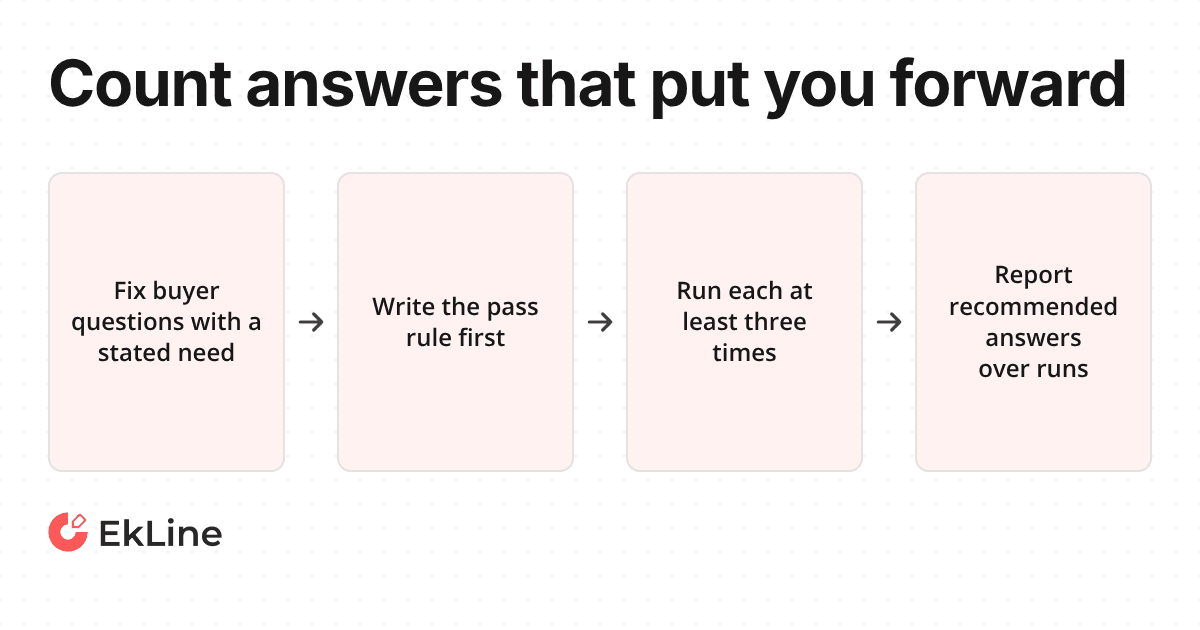
A "recommended" column needs rules you can apply in a sheet:
- Fix the questions in the buyer's words, each with a stated need. Studio1 uses 12, Pravin Kumar twenty to forty, and one open-source weekly check 13. Keep the wording identical between runs.
- Write the pass rule before reading answers. Pass when the answer puts you forward as a viable option for the stated need. Fail when you are named only in passing, listed without endorsement, mentioned as background, or given as an example of what not to choose, or when you are absent.
- Label each answer recommended, named, named-against or absent. The last three come from a reader of a DEV post by the team behind AskAiRank, who warns that "'X is not as good as Y' still looks like a mention of X if you only grep the name." Paste the deciding sentence beside each label.
- Run each question at least three times per assistant, in a fresh chat each time. Studio1 calls three "a floor, not a science." Because answers vary so much, we use 10.
- Ask Claude Code and Codex too, since a developer may ask them which tool to use.
- Report recommended answers over runs, per question and assistant. Note whether you appear in the first answer, since a buyer may never ask a follow-up.
- Call a change real only when the count moves beyond noise. Compare passed counts between runs. The open-source check flags a decline only when a standard statistical test, a two-proportion z-test, says the drop is unlikely to be chance.
The cost is upkeep: 15 questions at 10 runs on four assistants is 600 answers to read and label each time.
EkLine runs this set for you. Its agents reach your product the way your buyers' assistants do: through public web search and the pages they open. You set 1, 3, 5 or 10 runs per question.
A judge, an AI model that grades each answer, fails an answer that names you only in passing instead of putting you forward, and quotes the passage when it fails one. "Acme exists, but most teams choose Hooli" fails. A check for the name alone passes "Avoid Acme for this," so it tells you Acme was named, not that Acme was recommended. Other checks record whether you appear in the first answer and are still named at the end of the conversation.
Before, someone labels every answer by hand. After, each answer comes back judged under one rule, with the failing passage quoted for review. Results still move. Agents vary, the web changes, and models change behind their names. Compare passed counts as step 7 says.
How to choose: engines covered, competitor view, coding agents, upkeep
| Option | What it counts | Engines | Competitor view | Coding agents | Upkeep | Published price |
|---|---|---|---|---|---|---|
| Spreadsheet or script (status quo) | Your labels; scripts count named and cited rates | Any you open | What you log | If you run them | You read and label every answer | Your team's time |
| ChatGPT Business Hub | Website references, clicks, discovery topics | ChatGPT | Your own insights | None described | Claim and verify | None stated on OpenAI's pages |
| GEO tracker (Profound) | Responses that include you, plus position and sentiment | Up to 10 on Enterprise | Share of voice | None listed | Vendor runs prompts daily | Free 7-day trial; Enterprise custom |
| EkLine | Answers that put you forward, with failing passages quoted; first-answer presence | ChatGPT, Claude, Perplexity, Gemini | Cited pages by kind of site, including You, Competitors and Review sites | Claude Code, Codex | You start each run | Free report and $20 of credits, once; then $50 a month plus usage |
Evidence read November 16, 2026. Of the options in this table, only the judged ones count recommendations, and only EkLine judges coding-agent answers for you.
- For first-party ChatGPT data on site references and clicks, claim Business Hub.
- For daily share of voice across many prompts, a GEO tracker fits better than EkLine.
- For a handful of questions one person can read, a spreadsheet with the rules above is enough.
- For a recommendation rate across assistants and coding agents, run a judged set with EkLine.
Your team may say the GEO tool already does this. Read its metric definitions. If none says how it decides a recommendation, it reports presence. Business Hub is OpenAI's own data, and trackers run more prompts more often; neither changes what they count. A judged label still varies between runs, so EkLine writes the rule down and quotes the passage behind each failed answer for you to check.
When the answer is wrong: find the pages it cited
EkLine's report shows "Where assistants get answers," split by kind of site, including You, Competitors and Review sites. Codex does not report the sources it read.
In our own check, all 10 Perplexity runs listed our post on Profound alternatives for developer tool companies first among their sources. On the other assistants, the report's automated cause analysis said only competitors such as Profound, Scrunch, Peec AI, Otterly.ai, Evertune and BackTalk surfaced and got recommended. That shows which pages to write or fix. It does not prove our post caused Perplexity's answers. On October 19, Perplexity recommended EkLine in 0 of 10 answers to this question. As our post on rerun results notes, it also moved to 10 of 10 on questions we wrote no new post for.
From the report, you can open a Docs Agent session that drafts the page fix for you to review and raise as a pull request, or get a Marketing Agent draft to copy and publish yourself. A change "merged but not yet published cannot move the answers," so rerun after the page is live and compare against the first run.
FAQ
Run fixed buyer questions three or more times per assistant, judge each answer against a written pass rule, and report the pass rate. EkLine runs that set on four assistants and two coding agents.
Not as your headline. SparkToro found answers rarely repeat the same list, and Studio1 advises skipping position. Track whether you are recommended and whether you appear in the first answer.
Pravin Kumar and Studio1 rerun monthly, Profound runs its prompts daily, and the open-source check runs weekly. Pick a fixed interval, and rerun after a changed page is published.
Not to start. A spreadsheet with a written pass rule works for a small set. Paid tools add daily volume and more engines.
EkLine's free report asks 15 buyer questions on four assistants. Ten of the questions do not include your product's name, so they test whether assistants bring you up unprompted. Start free.
Sources
- Introducing Businesses in ChatGPT, OpenAI, November 10, 2026
- Setting up your business on ChatGPT, OpenAI Help Center
- About Answer Engine Insights, Profound docs
- Pricing, Profound
- Visibility, Peec AI docs
- Definition of Brand Report KPIs, Otterly
- Scrunch Metrics Guide, Scrunch
- AI Visibility Metrics, Semrush Knowledge Base
- Visibility-to-Recommendation Rate, Genezio glossary
- AIs are highly inconsistent when recommending brands or products, SparkToro, January 28, 2026
- How to measure whether AI assistants recommend your product, Pravin Kumar
- How I track whether ChatGPT, Claude and Perplexity recommend my product, DEV
- How to measure your devtool's visibility in AI answers, Studio1, DEV
- Track AI-answer visibility weekly, GitHub
- ChatGPT Business Hub counts mentions, not recommendations, EkLine
- Profound alternative for developer tool companies, EkLine
- AI visibility tools vs agencies: who owns ongoing corrections?, EkLine
- Journeys, EkLine docs
- How results are measured, EkLine docs
- Write checks that mean something, EkLine docs
- Journey agents and checks, EkLine docs
- Read a Buyer questions report, EkLine docs
- Turn a gap into a fix, EkLine docs
- EkLine pricing