10 Mintlify alternatives in 2026: pricing, fit, and tradeoffs
Compare ten Mintlify alternatives by current pricing, workflow, API support, and team fit. Includes Mintlify's $450/month Pro tier and when staying is the better choice.
- Written by
- Evan Shamoon (opens in a new tab)
- Published on
- Read time
- 18 min

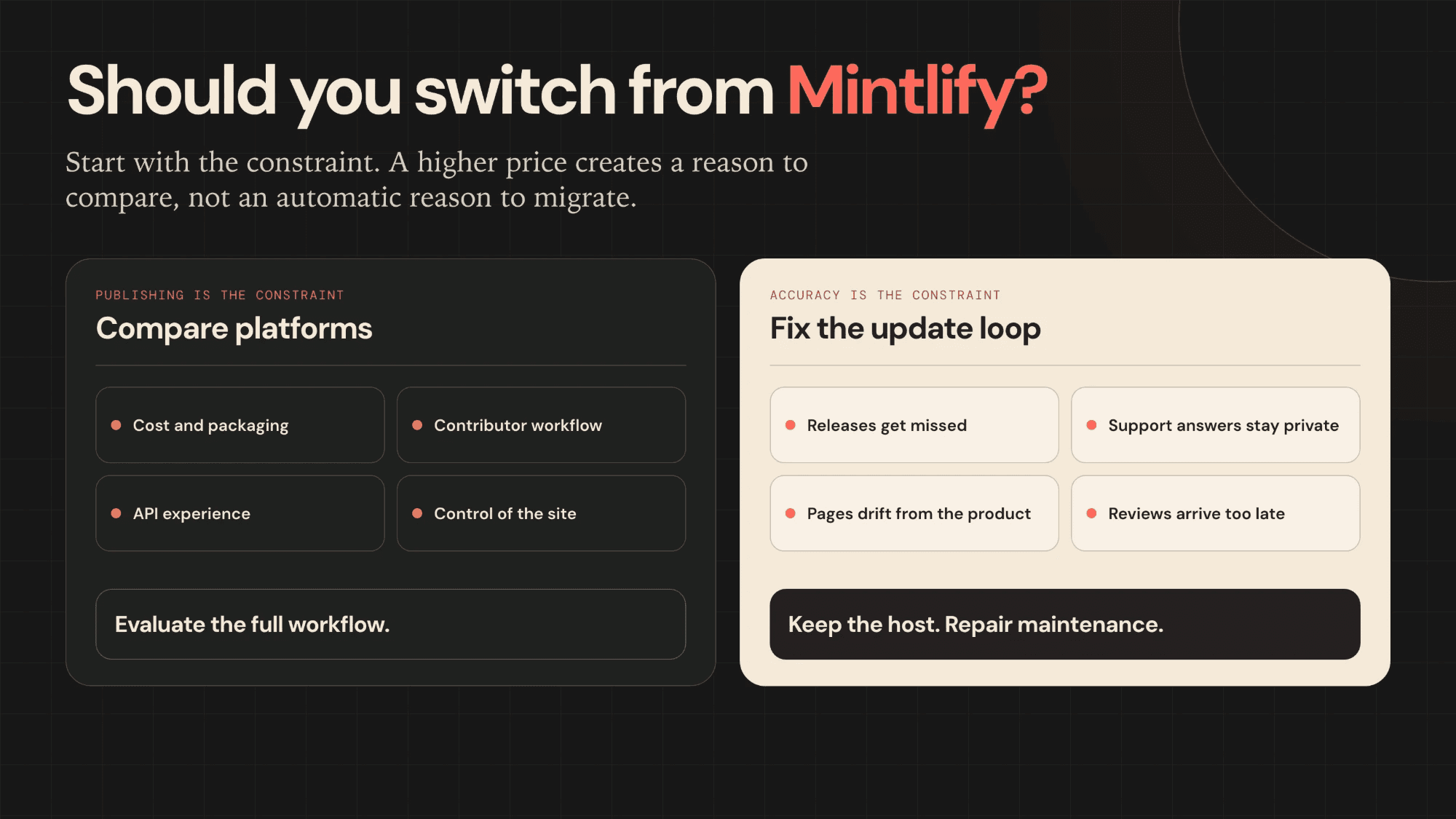
A higher price is a reason to compare. Whether to migrate depends on which workflow is actually broken.
Mintlify Pro now costs $450 per month.
The plan includes 10,000 agent credits per month, with overages listed at $0.01 per credit. Mintlify also offers credit packs and committed-volume discounts.
Our February 2026 Mintlify comparison recorded Pro at $250 per month, so the public price shown today is $200 higher before usage charges.
A higher price gives teams a reason to compare. It does not automatically give them a reason to migrate.
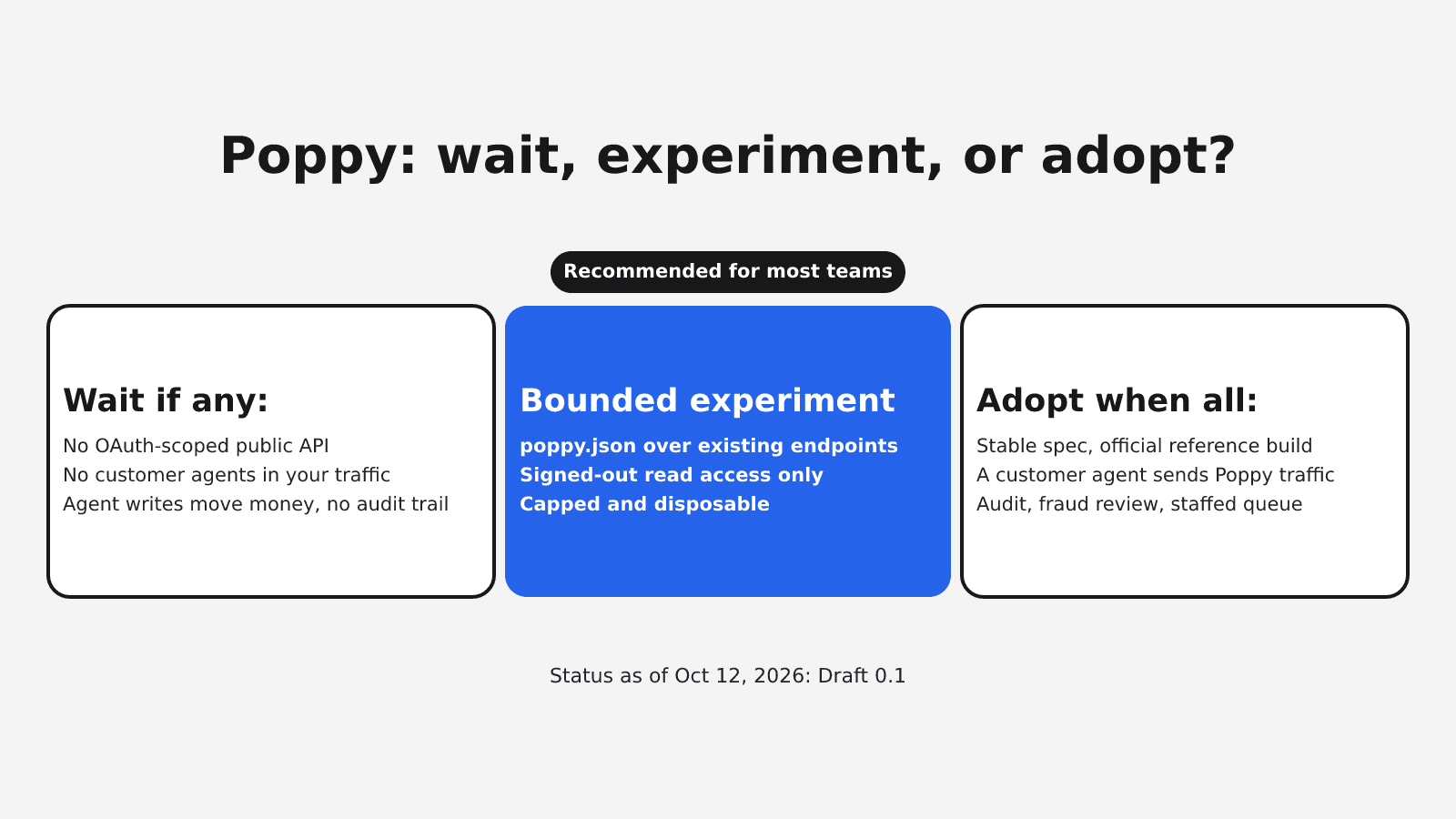
If Mintlify's publishing experience works and your real problem is stale content, switching hosts can consume weeks without fixing the workflow that let the docs fall behind. Keep the platform and add a dedicated accuracy layer. If the problem is cost, contributor workflow, API governance, or control over the site, one of the ten options below may fit better.
The short answer
- Choose GitBook when technical and nontechnical contributors need to work in the same system.
- Choose ReadMe when the API reference and developer dashboard are the center of the product experience.
- Choose Fern when API documentation and generated SDKs belong in one workflow.
- Choose Redocly when OpenAPI governance matters as much as the published site.
- Choose Archbee when you need a broader public or private knowledge portal.
- Choose Document360 when documentation operations, analytics, and enterprise knowledge-base controls drive the purchase.
- Choose Docusaurus when a React team wants full control and accepts ownership of hosting and maintenance.
- Choose Nextra when a Next.js team wants an open-source docs framework.
- Choose MkDocs when a Python-oriented team wants a simple Markdown static-site workflow.
- Choose Potluck Docs when an Astro team wants API reference, private docs, AI-readable output, and testing pre-wired in an open-source codebase.
- Stay with Mintlify when its design, hosted workflow, API playground, MCP server, and unlimited Pro editor seats justify the price.
- Add EkLine when the host is acceptable but releases, code changes, and support conversations are not turning into reviewed documentation updates fast enough.
Pricing snapshot
Prices below are public list prices in USD, checked on September 17, 2026. Annual billing, seats, usage, add-ons, taxes, support, migration, and custom contracts can change the total. Open-source software still carries hosting and engineering costs.
| Product | Public starting price | The pricing detail that changes the decision | Best fit |
|---|---|---|---|
| Mintlify | Starter $0; Pro $450/month | Pro includes 10,000 agent credits per month; overages are $0.01 per credit | Teams that want a polished, hosted developer-docs platform |
| GitBook | Free; Premium $65/site/month | Premium and Ultimate prices shown here use annual billing; paid plans also add $12/user/month | Mixed technical and nontechnical contributor teams |
| ReadMe | Starter $0; Pro $250/month | Ask AI is listed at $150/month; Enterprise is custom | API products that need interactive reference and developer experience features |
| Fern | Hobby $0; Team $150/month | The page shows $150 with yearly billing selected; Enterprise is custom | API-first teams that want docs and SDK workflows together |
| Redocly | Pro components start at $10/seat/month | Realm, the combined bundle, adds $18/seat/month at Pro; page limits and package choices affect the total | OpenAPI-heavy programs and API governance |
| Archbee | Growing from $80/month; Scaling from $350/month | Five users are included in Scaling; extra seats and several add-ons cost more | Public and private knowledge portals |
| Document360 | Custom quote | No fixed self-serve tier is published on the pricing page | Enterprise knowledge bases and documentation operations |
| Docusaurus | No vendor subscription | MIT-licensed software; your team owns hosting, upgrades, search, and customization | React teams that want control |
| Nextra | No vendor subscription | Open-source framework built on Next.js; hosting and engineering remain your cost | Next.js teams that prefer MDX and code ownership |
| MkDocs | No vendor subscription | BSD-licensed static-site generator; themes and plugins can add operational work | Markdown-heavy and Python-oriented teams |
| Potluck Docs | No vendor subscription | MIT-licensed Astro and Starlight template; your team owns content, deployment, upgrades, and any sign-in integration | Astro teams that want API reference, private docs, and AI-readable output pre-wired |
Every price above comes from the vendor's own public pricing page. The open-source entries come from each project's official site and repository, and Potluck Docs from its repository and live preview. Archbee's in-app calculator and Document360's quote page supply the extra detail in the third column.
How we chose these Mintlify alternatives
This is a vendor-written guide. EkLine can work alongside documentation platforms, including Mintlify, and EkLine maintains one of the open-source options below. We have an interest in the decision and used the same inclusion standard for every option.
A product made the list if it can replace a meaningful part of Mintlify's publishing job for a developer-facing company. We included hosted platforms, API-focused systems, and open-source frameworks because buyers commonly compare all three. We excluded generic writing assistants and internal wikis that do not provide a credible public developer-documentation path.
We compared each option on five questions:
- Who can contribute without fighting the workflow?
- How well does it handle API documentation?
- What does the public price include?
- How much infrastructure and maintenance does the buyer inherit?
- Does it solve publishing, documentation accuracy, or both?
A good docs site can still contain an old endpoint, a broken example, or an answer that support has corrected ten times in private. The publishing decision and the accuracy decision need separate owners.
This page focuses on alternatives to Mintlify's publishing platform. Our documentation maintenance tools guide compares the separate job of detecting and correcting stale content.
1. GitBook: best for cross-functional contribution
GitBook is the strongest option here when engineers, product managers, support staff, and writers all need a practical way to contribute.
The Free plan includes one user, GitHub or GitLab sync, interactive API playgrounds, preview deployments, and LLM optimizations. Premium costs $65 per site per month under annual billing, plus $12 per user per month. Ultimate costs $249 per site per month, plus $12 per user per month, and adds features such as AI Assistant, AI insights, GitBook Agent, adaptive content, authenticated access, and content consolidation.
Who it is for: A developer-tools company with a mixed contributor base that wants a hosted platform and a visual editing path alongside Git.
Where it beats Mintlify: The pricing can be lower for a small team, and the visual collaboration model may suit contributors who do not want to edit MDX.
Watch the tradeoff: Per-user charges add up. A broad contributor group can narrow the apparent gap with Mintlify Pro, which lists unlimited editor seats.
Our take: Shortlist GitBook when contribution friction is the buying trigger. Do not switch solely because the $65 site price looks cheaper. Model the site fee and every paid contributor.
2. ReadMe: best for an API-centered developer hub
ReadMe fits teams whose docs are inseparable from API onboarding and developer usage.
Its Starter plan is $0 per month. Pro is $250 per month and adds reviews, branching, reusable content, exportable metrics, custom HTML and CSS, and custom integrations.
Enterprise uses custom pricing. ReadMe lists Ask AI at another $150 per month.
Who it is for: API companies that want guides, interactive reference, changelogs, usage metrics, and developer-hub features in one hosted product.
Where it beats Mintlify: The evaluation can center on the API consumer experience rather than on a general documentation site. The $250 Pro list price is also below Mintlify's current $450 Pro price.
Watch the tradeoff: Add-ons change the comparison. Pro plus Ask AI reaches $400 per month before any other paid options. Enterprise requirements still require a quote.
Our take: Choose ReadMe when API adoption is the job. A general cost comparison misses the reason to buy it.
3. Fern: best for docs and SDK generation together
Fern combines developer documentation with an SDK-oriented workflow.
Hobby is free and includes two team members, 250 AI credits, a custom domain, guides, API references, changelogs, an API explorer, and a web editor. Team is shown at $150 per month with yearly billing selected and includes five team members, 1,000 AI credits, product and version switching, password-protected docs, and PDF exports. Enterprise pricing is custom.
Who it is for: API-first companies that want the docs site and SDK generation to share a product model and workflow.
Where it beats Mintlify: Fern becomes more compelling when SDK generation is part of the purchase. That is a more specific job than publishing guides and reference pages.
Watch the tradeoff: Compare the full docs and SDK package you need. A low docs price can stop being comparable once SDK languages, security controls, self-hosting, or enterprise support enter the deal.
Our take: Fern is the first option to test when your API definition should drive docs and SDK output.
4. Redocly: best for OpenAPI governance
Redocly is a better comparison for teams that treat an API description as a governed product artifact.
Its pricing is modular. The public page lists Pro components from $10 per seat per month.
Realm, which combines Redoc, Revel, and Reef, adds $18 per seat per month at Pro.
Enterprise components and the Realm upgrade cost more, while Enterprise+ uses custom annual pricing. Project and page limits also vary by package.
Who it is for: Platform and API teams that care about OpenAPI linting, API catalogs, governance, and documentation in the same operating model.
Where it beats Mintlify: Redocly has a sharper fit when the purchase starts with API governance rather than site design.
Watch the tradeoff: The modular pricing requires a scenario. Count contributors, projects, pages, and the products you will combine before comparing totals.
Our take: Choose Redocly when a valid, governed API description is the source of truth. Teams looking mainly for a polished guide site may find the model heavier than they need.
5. Archbee: best for a broader knowledge portal
Archbee spans developer documentation, product documentation, user guides, and private knowledge portals.
The public pricing page lists Growing from $80 per month and Scaling from $350 per month. Its live calculator shows five users included in Scaling, extra seats at $10 per month, one included custom domain, and several paid add-ons. Enterprise uses custom pricing.
Who it is for: Companies that want public docs and controlled private knowledge in one platform, with contributors outside engineering.
Where it beats Mintlify: Archbee can fit a wider knowledge-portal brief, especially when private content, review workflows, reusable content, localization, or access controls drive the project.
Watch the tradeoff: Add-ons can move the total quickly. Price the exact setup instead of treating $80 as the expected bill.
Our take: Archbee belongs on the shortlist when the buyer says "knowledge portal" more often than "docs-as-code."
6. Document360: best for enterprise knowledge-base operations
Document360 sells a documentation and knowledge-base system with analytics, content operations, embedded help, and AI features.
Its public pricing page does not publish fixed plan amounts. It asks buyers for their documentation goals, workflow, and AI requirements before producing a custom quote.
Who it is for: Documentation and support organizations that need a managed knowledge-base operation with permissions, analytics, embedded help, and enterprise procurement.
Where it beats Mintlify: It is built for a broader knowledge-management and support use case than a developer-first docs site.
Watch the tradeoff: You cannot make a credible price comparison from the public page. Request a quote with a fixed scenario and ask the vendor to separate base platform, AI, migration, support, and implementation charges.
Our take: Document360 is worth evaluating when documentation operations and support deflection own the budget. It is a weaker fit for a small engineering team that wants a lightweight Git workflow.
7. Docusaurus: best for React teams that want control
Docusaurus is an MIT-licensed open-source framework for documentation websites. It provides the core site structure and can be customized by a React team.
Who it is for: Engineering-led teams that want to own the code, deployment, design system, and extension choices.
Where it beats Mintlify: There is no docs-platform subscription, and the team controls the implementation.
Watch the tradeoff: Open-source licensing removes the platform subscription and transfers the operating work to your team. Your team owns hosting, search, analytics, upgrades, accessibility, security patches, and the custom code that accumulates around the site.
Our take: Docusaurus can be cheaper for a team that already has the skills and infrastructure. It becomes expensive when docs-site work competes with product work and nobody has clear ownership.
8. Nextra: best for Next.js and MDX teams
Nextra is an open-source site-generation framework built on Next.js. Its official project describes it as a flexible framework for content-focused sites, and the project is maintained in public on GitHub.
Who it is for: Next.js teams that want MDX, code-level control, and a documentation theme without adopting a hosted docs vendor.
Where it beats Mintlify: It fits an existing Next.js stack and keeps the site inside the team's normal application workflow.
Watch the tradeoff: Nextra supplies a framework. Your team supplies the publishing operation. Authentication, search, analytics, previews, contributor tooling, and ongoing maintenance may require separate work or services.
Our take: Pick Nextra when Next.js is already a deliberate platform choice. It is a poor cost-saving move when the team lacks time to own another production site.
9. MkDocs: best for a simple Markdown workflow
MkDocs is a BSD-licensed static-site generator built for project documentation. It turns Markdown into static HTML, uses YAML configuration, supports themes and plugins, and can publish anywhere that serves static files.
Who it is for: Python-oriented or Markdown-heavy teams that want a simple static documentation workflow.
Where it beats Mintlify: The core is small, open source, and portable. Teams can keep authoring close to the repository without buying a full hosted platform.
Watch the tradeoff: Rich developer-portal behavior comes from themes, plugins, custom work, or external services. Each dependency adds an owner and an upgrade path.
Our take: MkDocs is a strong fit when simplicity is a requirement. It is less attractive when the buyer expects a polished web editor, managed AI features, or enterprise controls out of the box.
10. Potluck Docs: best for Astro teams that want the hard parts pre-wired
Potluck Docs is EkLine's MIT-licensed documentation template for Astro and Starlight. It gives code-first teams a working docs stack they can inspect, fork, and run themselves.
The template includes Markdown and MDX content, Tailwind v4 theming, Pagefind search, generated sitemaps and llms.txt files, Markdown versions of every page, and interactive OpenAPI references rendered by Scalar. OpenAPI documents can live with the site, elsewhere in a monorepo, or at a remote URL. The template generates routes, operation navigation, and search entries from the API-reference configuration.
Its optional logged-in tier supports private docs and organization-scoped docs through a token signed by your own product. The server checks access before returning the page, and protected pages stay out of the anonymous static build. The repository also includes build assertions and Playwright coverage for the API-reference and authentication paths.
Create a site with:
npm create astro@latest -- --template ekline-io/ekline-docs-template-astro/packages/template --no-aiWho it is for: Engineering-led teams that already prefer Astro, Markdown, Git, and code review. It is especially useful when API reference, authenticated docs, or AI-readable output would otherwise require several separate implementation projects.
Where it beats Mintlify: The code is public, the template has no vendor subscription, and your team controls the site and deployment. The pre-wired API, authentication, search, AI-output, and test paths reduce the amount of foundation work compared with starting from a bare Starlight project.
Watch the tradeoff: The template has no CMS, bundled product content, user database, or managed service. Your team owns content, deployment, upgrades, and the sign-in integration. The logged-in tier requires server-side hosting, so static-only hosting works after you remove that feature.
Our take: Count Potluck Docs as a viable Mintlify alternative for an engineering-led Astro team. Choose a managed platform when visual editing, vendor support, and lower operating overhead matter more. You can inspect the live preview and its documentation at potluck.ekline.io before deciding.
When to stay with Mintlify
Stay with Mintlify when these conditions are true:
- The team likes the current site and authoring workflow.
- Custom domains, authentication, an API playground, preview deployments, Git sync, and MCP support cover the publishing requirements.
- Pro's unlimited editor seats matter more than a lower base price with per-user charges.
- The Agent, Assistant, and Automations are already producing useful work.
- A migration would consume more engineering and documentation time than the next 12 months of savings.
- Buyers and developers already know the site, and a replatform would create avoidable risk.
The current Pro price is substantial. The package is also broader than a simple static-site host. Compare the cost of the workflow you use, then include migration, implementation, and ongoing ownership.
A platform change makes sense when publishing is the constraint. If the docs look good but keep drifting from the product, fix the maintenance workflow first.
The separate layer: keeping any platform accurate
 (opens the full-size image in a new tab)
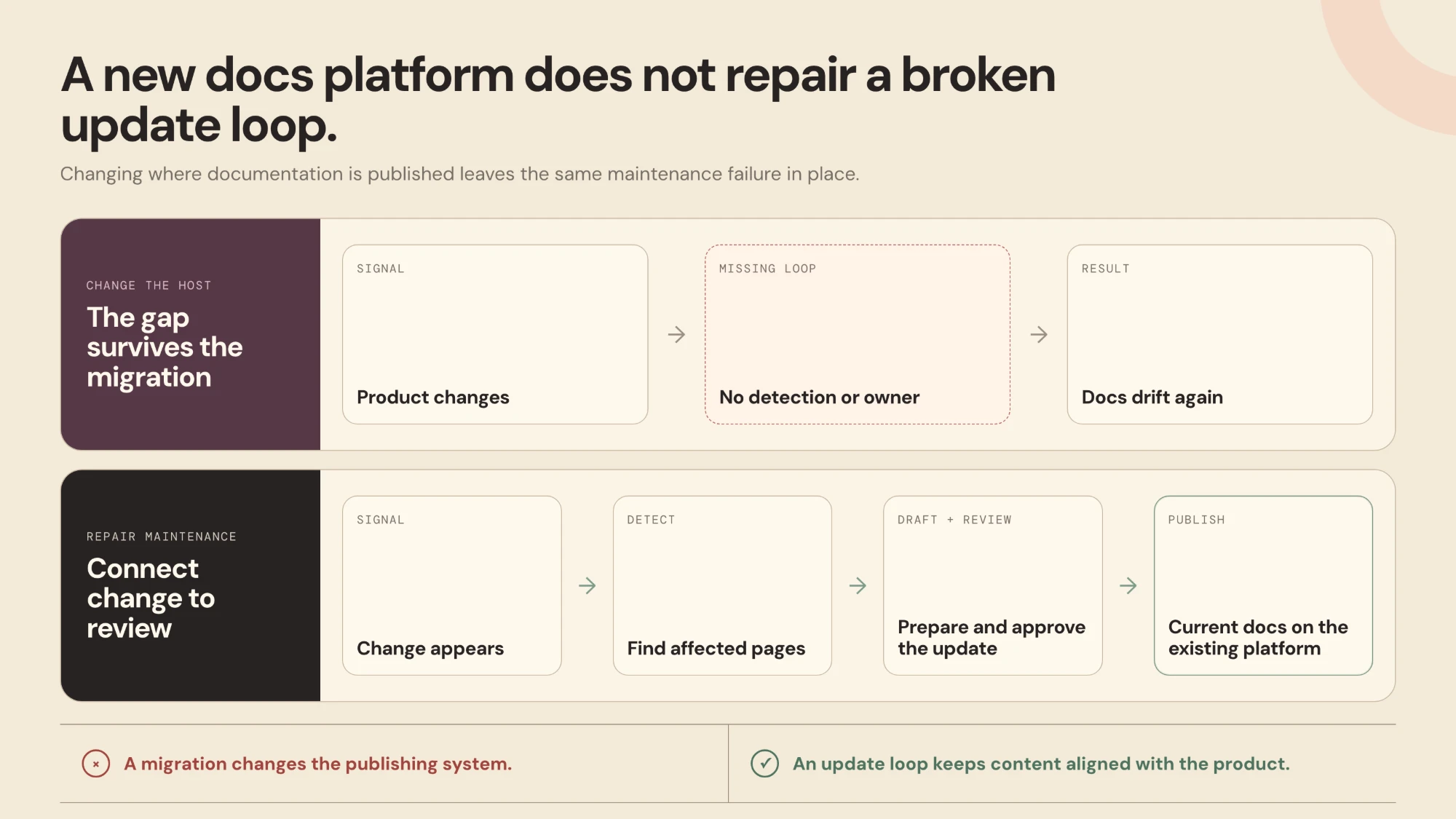
Publishing platforms answer: "Where do we write and host the docs?"
The maintenance workflow has a different job:
- Detect a product change or unanswered support question.
- Identify the affected pages.
- Draft the correction using current source material.
- Route the change to a qualified reviewer.
- Publish through the team's existing system.
- Make the current product knowledge available to AI tools.
EkLine is built for that workflow.
It connects to documentation, code, and support sources, identifies missing or outdated content, drafts changes, and routes them through review.
Its Docs MCP Server serves product knowledge to MCP-compatible AI tools.
The practical choice can be Mintlify plus EkLine, GitBook plus EkLine, or an open-source site plus EkLine. The host handles presentation and delivery. EkLine handles change detection, reviewable updates, quality checks, and current product knowledge.
There is customer evidence behind that distinction. Over one quarter, ContextQA merged 79 of 81 EkLine proposals and brought 90 of 113 pages up to date without adding a documentation hire. Over six months, P0 Security reported 150-plus engineering hours reclaimed and 15 integration guides shipped with no new documentation headcount.
Recommendation by buying situation
| Your trigger | Start here | Why |
|---|---|---|
| Mintlify Pro is over budget | GitBook, ReadMe, Fern | Each has a lower public starting price for a hosted paid plan, with different seat and add-on economics |
| Nontechnical contributors struggle with the workflow | GitBook or Archbee | Both center broader contribution and content operations |
| API adoption is the main product goal | ReadMe or Fern | The API consumer and SDK workflow carry more weight |
| OpenAPI governance is the problem | Redocly | The API description and governance process are central |
| You need a broad enterprise knowledge base | Document360 or Archbee | The products cover wider knowledge and support operations |
| You want to own the site | Docusaurus, Nextra, or MkDocs | Open-source control replaces vendor fees with internal ownership |
| You want an Astro and Starlight starting point | Potluck Docs | Search, sitemaps, AI-readable files, and OpenAPI reference are pre-wired |
| The site works but the content goes stale | Keep Mintlify and add EkLine | Replatforming does not repair a disconnected maintenance workflow |
FAQ
EkLine is a documentation accuracy and maintenance tool for API and product documentation, not a publishing platform. It works with the docs platform your team already uses, including Mintlify, ReadMe, Redocly, GitBook, and open-source sites.
EkLine turns releases, code changes, and support questions into reviewed documentation updates, so the API reference, code examples, and guides stay in sync with the code.
Teams that also need to publish an API reference can use Potluck Docs, EkLine's open-source Astro and Starlight template with interactive OpenAPI reference built in.
No. EkLine's documentation-maintenance product works with the platform your team already uses. The platform remains the place where your team hosts and publishes content. EkLine connects product and support signals to the maintenance process, drafts reviewable updates, checks documentation quality, and can deliver current product knowledge through MCP.
EkLine separately maintains the optional open-source Astro and Starlight template described above. Teams can use Potluck Docs when they want to build and own a docs site, but adopting it is not required to use EkLine's maintenance workflow.
Yes. Mintlify's public pricing page listed Pro at $450 per month when checked on September 17, 2026. The page also listed 10,000 agent credits per month, $0.01 per credit for overages, and credit packs. Enterprise pricing is custom.
GitBook is the closest broad hosted alternative for many teams. ReadMe is closer for an API-centered developer hub. Fern is closer when SDK generation belongs in the same purchase. The closest option depends on the job that triggered the search.
Docusaurus, Nextra, and MkDocs have no vendor subscription for the core software. They still require hosting and engineering ownership.
Potluck Docs, EkLine's MIT-licensed Astro and Starlight template, is another no-subscription option for teams that want more of the API, authentication, search, and AI-output foundation pre-wired.
GitBook, ReadMe, and Fern publish free entry plans. Their paid plans vary by site, seat, feature, and usage.
Run the numbers first. Calculate the current annual platform cost, expected usage charges, migration work, design and implementation, contributor seats, and ongoing maintenance. Move when another option improves the workflow or total cost enough to repay the switch. Stay when the platform works and the expensive problem is documentation drift.
A practical next step
Take one recent release and one support question your docs failed to answer. Trace how each should have become a documentation update. If the failure happened because nobody detected the gap, found the affected page, or routed a draft to the right reviewer, changing the host will leave the failure in place.
See how EkLine turns product and support signals into reviewable documentation updates.
Sources
Public pricing and product details checked September 17, 2026: