What ChatGPT, Claude and Perplexity cite when recommending developer tools: a 1,160-citation study
We asked ChatGPT, Claude and Perplexity 10 developer-tool questions 5 times each and sorted the 1,160 citations behind their answers. ChatGPT cited vendors' own pages; Claude and Perplexity mostly cited "best X" lists and comparison pages.
- Written by
- Arun Bhalla (opens in a new tab)
- Published on
- Read time
- 9 min

We asked ChatGPT, Claude and Perplexity 10 questions a developer asks when choosing a tool, such as which email API or error monitor to use. We asked each question 5 times per assistant and looked at every page the answers cited.
ChatGPT cited the vendors' own websites. Claude and Perplexity mostly cited what other people wrote about the vendors: "best X" lists and comparison pages.
That tells a developer-tool company where to put its effort. You may have heard that the answer is domain authority. We did not measure it, and the published research on it is mixed.
TL;DR
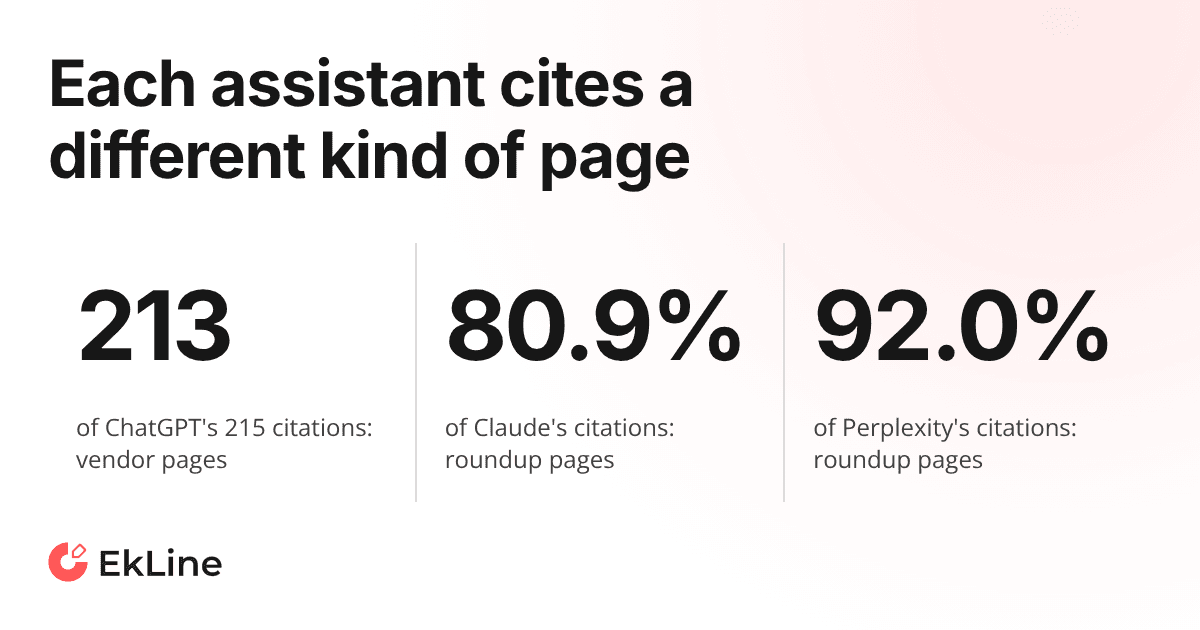
- ChatGPT cited vendors' own product, pricing and docs pages in 213 of its 215 citations.
- Claude and Perplexity mostly cited "best X" lists and comparison pages.
- About a third of the answers that recommended a product did not cite that product's website.
- Most citations of a vendor's own "best X" list were in answers that did not recommend that vendor.
- The assistants' leading picks differed on 3 of the 10 questions, so check each one separately.
Is a citation the same as a recommendation?
No. A citation is a page an answer links to. A recommendation is the product the answer tells you to use. Most of the studies we read count citations. We tracked both, on the same answers.
The two often come apart. In a small study of 278 B2B SaaS prompts, Position Digital found that "66% of brand recommendations happen without ChatGPT citing that brand's website at all." We covered the difference in more depth in how to track whether ChatGPT and Claude recommend your developer tool.
How we ran the study
On November 18, 2026, we used EkLine Journeys to ask 10 unbranded questions, each 5 times on each assistant, with web search on. The questions covered email APIs, Next.js auth, vector databases, feature flags, Node.js error monitoring, usage-based billing, managed Postgres, background jobs in TypeScript, product analytics and search APIs.
That gave us 150 answers and 1,160 citations. We sorted every cited page by type. A roundup is a "best X," "alternatives" or "X vs Y" page, or any other comparison page. For every answer, we also recorded its pick: the one product it recommended as the default.
Which pages do ChatGPT, Claude and Perplexity cite?
Each assistant read a different kind of page.
| Share of citations | ChatGPT | Claude | Perplexity |
|---|---|---|---|
| Roundups and comparison pages | 0.5% | 80.9% | 92.0% |
| Vendor product and pricing pages | 60.5% | 0.4% | 3.0% |
| Docs and READMEs | 38.6% | 1.1% | 3.0% |
| Community threads | 0% | 0.9% | 0% |
| Other | 0.5% | 16.6% | 2.0% |
| Citations counted | 215 | 445 | 500 |
ChatGPT cited vendor pages almost every time. In every ChatGPT answer that recommended a product, the product's own site was among the sources.
Claude and Perplexity worked the other way. They mostly cited pages that other people publish about a category.
Do AI assistants recommend tools without citing their website?
Often. In 44 of the 123 answers that recommended a product, the product's own site was not among the cited sources. Claude gave 24 of those 44 answers.
Two examples:
- Claude recommended Sentry in all 5 answers on Node.js error monitoring ("Short answer: use Sentry.") and never cited sentry.io.
- Perplexity recommended Algolia in all 5 answers on search APIs, and none of its 10 sources was an Algolia page.
Claude noticed where its sources came from. On the email question, it wrote: "Most of the 'best of 2026' lists I found are published by competing vendors."
Do ChatGPT, Claude and Perplexity recommend the same tools?
Not always. On the search API question, ChatGPT and Perplexity picked Algolia, while Claude picked Meilisearch.
On email, ChatGPT picked Resend every time and Perplexity picked Postmark every time. On error monitoring and product analytics, all three agreed, on Sentry and PostHog.
Does publishing your own "best X" list get you recommended?
Our data shows only a weak link. Of 335 citations to roundups written by a vendor in the category, 27 (8.1%) appeared in answers that recommended that vendor.
Those 27 belonged to four companies: PostHog, Clerk, Neon and Trigger.dev. Each was also the most common pick for the question its roundup covered.
More often, a vendor's list was cited and a competitor was recommended:
- Encore's "best PostgreSQL hosting" page appeared in 8 answers. Encore was never picked; Neon was, in 5.
- Render's workflow-platforms page appeared in 9 answers. Trigger.dev was picked in 7; Render in none.
- Mailtrap's email API roundup appeared in 8 answers. Postmark was picked in 5.
Do AI assistants cite niche comparison pages?
Yes. One comparison guide on stackfyi.com, Trigger.dev vs Inngest vs Temporal, was cited in all 10 Claude and Perplexity answers about background jobs. Claude's answer echoed it: "Several comparisons say that for most TypeScript product teams, Trigger.dev is the fastest useful path."
Other pages came up again and again: a personal marketing blog with "best X" posts in four unrelated developer categories, a leaderboard site with monthly editions (citehawk.com), and four dev.to posts with near-identical titles. What they share is the format. Each is a roundup or comparison page on the buyer's topic.
That matches outside research. AirOps found that ChatGPT cited pages whose titles closely matched the question about twice as often as pages whose titles barely overlapped with it (20.1% against 9.3%).
Does domain authority matter for AI citations?
The published research is mixed, and none of the studies we read compares domain authority with which product gets recommended. We did not measure it ourselves.
- The case for it: Wellows saw ChatGPT shift toward higher-authority domains in July 2026. It also warns that "one month isn't a trend."
- The case against it: Promptwatch's November data puts most of ChatGPT's citations on mid-ranked domains, and about 3% on the highest-ranked ones.
- What it seems to track: on ChatGPT finance questions, Green Flag Digital found that higher-authority sites got more of their pages cited, but each cited page did slightly worse. AirOps found that once ChatGPT retrieved a page, pages from the highest-authority domains were cited less often than the rest.
Our data adds one point. ChatGPT cited the recommended vendor's own site in every answer that named a pick, and the vendor controls what that page says.
What to do if AI assistants recommend a competitor
- Fix your own pages first. ChatGPT read the recommended vendor's own product, pricing and docs pages. If your pricing page is stale, that is what ChatGPT reads about you. Use the words your buyers ask with in your page titles.
- Get named on the roundups each assistant already cites. Claude and Perplexity mostly cite these pages. Perplexity's list is short: it cited the same 10 sources in every run for 9 of the 10 questions.
- Write your own comparison page for the buyers who reach your site, but don't count on it to change AI answers.
- Measure recommendations, per assistant, over several runs. The same question can get a different answer each time, and the assistants' picks differ on some questions. A ChatGPT-only mention count hides that disagreement, as we explain in ChatGPT Business Hub counts mentions, not recommendations.
Checking the recommendation with EkLine
We ran this study with EkLine Journeys, and you can run the same check on your own buyer questions. Journeys asks your questions on AI assistants, including ChatGPT, Claude and Perplexity, 1, 3, 5 or 10 times each. The Buyer questions report shows the competitors named in the answers you did not win, and the sites the assistants cited.
From the report, the Docs Agent drafts a fix to your docs or website as a pull request for your team to review. The Marketing Agent drafts comparison posts and outreach lists for the roundups assistants cite. Then you run the journey again to see whether the answers moved. Answers vary between runs, so compare several before you credit a change.
Limits of this study
- It covers one day, 10 questions and 5 runs per assistant.
- Perplexity returned the same 10 sources in all 5 runs for 9 of the 10 questions, so its citations behave more like 10 lists than 500 separate data points.
- Page types and picks are judgment calls, made from each URL and each answer.
- We collected no domain-authority data. The results show pages and picks appearing together, not that one caused the other.
- Other question sets give other results. In Ahrefs' study of 750 software, product and agency prompts, "best X" lists were 43.8% of ChatGPT's source pages. ChatGPT cited one in our 215 citations. Run your own questions more than once.
FAQ
In our study, almost only the vendors' own product, pricing and docs pages: 213 of its 215 citations.
Yes. Most of their citations went to "best X" lists and comparison pages: 80.9% for Claude and 92.0% for Perplexity. ChatGPT cited one such page in our study.
Yes. After a mid-July 2026 shift toward higher-authority domains, 35% of ChatGPT's citations in Wellows' data still came from domains under DA 40. In our study, Claude and Perplexity (not ChatGPT) cited one comparison guide on a niche site in all 10 of their answers to its question.
It depends on what is measured. In the studies we read, the link with how often a source is cited was weak or absent, but higher-authority sites got more of their pages cited. Surfer found almost no correlation between its own Domain Score and how often a source was cited. Ahrefs found that its Domain Rating (DR) correlated weakly with how often AI answers mentioned a brand, and that branded web mentions correlated much more strongly.
Keep them as one part of the plan. In Green Flag Digital's study of ChatGPT finance answers, higher-authority sites got more of their pages cited. In our study, the recommendation came with the vendor's own pages on ChatGPT and with roundups on Claude and Perplexity. Start there, and measure recommendations per assistant over several runs.
Ask your buyers' questions on each assistant several times and record the product each answer recommends, not only the pages it cites. EkLine Journeys does this on assistants including ChatGPT, Claude and Perplexity, and shows the competitors named in the answers you did not win.
Run your own buyer questions before you spend a quarter building domain authority. Start free.
Sources
- How to track whether ChatGPT and Claude recommend your developer tool, EkLine
- ChatGPT Business Hub counts mentions, not recommendations, EkLine
- Top ChatGPT Ranking Factors in B2B SaaS Niches, Position Digital
- Does Domain Authority Matter for AI Citations?, Wellows
- Domain Rank Distribution by AI Model, November 2026, Promptwatch
- AEO page analysis: what pages get cited by ChatGPT, Green Flag Digital
- Influence of retrieval, fan-out and Google SERPs in ChatGPT, AirOps
- Do self-promotional "best" lists boost ChatGPT visibility?, Ahrefs
- AI brand visibility correlations, Ahrefs
- Domain authority and AI citations, Surfer
- Read a Buyer questions report, EkLine docs
- Turn a gap into a fix, EkLine docs
- How results are measured, EkLine docs