Slack Product Knowledge Documentation: How to Turn Internal Answers Into Maintained Customer Docs
Turn recurring Slack product answers into reviewed customer documentation without losing context, ownership, or source-of-truth links.

- Written by
- Arun Bhalla (opens in a new tab)
- Published on
- Read time
- 11 min

TL;DR
- Your Slack threads are becoming undocumented product knowledge matters because fast-moving product teams create documentation risk every time code, UI, APIs, support answers, or release notes change.
- The buyer is usually a CTO, VP Engineering, DevRel lead, platform lead, docs lead, support leader, or product team that needs docs to stay current without turning engineers into full-time writers.
- The practical decision is not "should AI write more words?" The practical decision is whether the team has a repeatable workflow for detecting, drafting, reviewing, shipping, and measuring documentation updates.
- EkLine connects documentation to pull requests, Slack mentions, support questions, and scheduled audits, then produces a sourced docs PR for human review. It works with existing documentation platforms rather than replacing the host.
- Customer evidence shows that P0 Security's documentation is created and maintained with EkLine.
Why valuable product knowledge gets trapped in Slack
Your Slack threads are becoming undocumented product knowledge is an operating-system question for teams whose product changes faster than their documentation process.
The reader usually arrives with 1 of 3 symptoms: support is answering the same questions every week, engineers are pulled into docs work after every release, or buyers are losing trust because public docs do not match the product. Those symptoms point to the same root problem: product knowledge changes in repositories, Slack, Jira, Zendesk, support conversations, and code reviews before it reaches the docs.
For US API-first, devtool, fintech, and B2B SaaS teams, documentation affects developer onboarding, enterprise evaluation, support load, sales engineering, and AI answer accuracy. The first decision is which failure to fix and which source system proves the correct answer.
| Signal | What it means | Who feels it first | What to measure |
|---|---|---|---|
| Docs lag behind releases | the docs process is not connected to product change | engineering and docs leads | stale pages per release |
| Support repeats answers | private answers are not becoming public documentation | support and success | repeated tickets per month |
| Engineers write from scratch | the workflow depends on scarce subject-matter experts | engineering managers | hours spent on docs tasks |
| AI tools answer incorrectly | models are pulling from stale or incomplete product knowledge | marketing, DevRel, support | AI answer accuracy for 10 priority questions |
| Buyers ask for proof | docs are part of enterprise trust and technical validation | sales engineering | demo questions answered by docs |
The first decision is whether the team has a documentation problem, a publishing-platform problem, or a workflow problem. EkLine is strongest when the problem is workflow: detecting gaps, drafting updates, reviewing quality, and routing changes through existing systems.
How undocumented Slack answers create support and onboarding gaps
Documentation used to be a support surface. In 2026, documentation is also a search surface, an AI visibility surface, an implementation surface, and a trust surface.
The stakes are higher because a wrong doc page can now fail in 4 places at once. It can confuse a human developer, mislead a support agent, create friction during an enterprise evaluation, and become the stale source an AI assistant repeats. AI visibility and agentic discovery explains why AI visibility starts with current, specific, reviewable documentation.
| Failure mode | 1-week effect | 30-day effect | Decision consequence |
|---|---|---|---|
| Release ships without docs update | support fields launch questions | same gap appears in onboarding and AI answers | buyer trust drops before demo |
| API example breaks | developer cannot complete setup | DevRel or engineering handles repeat debugging | TTFC and activation suffer |
| Support answer stays private | Slack thread solves 1 account | 10 more users ask the same question | self-serve coverage stays weak |
| Style and terms drift | contributors use different product names | LLM and buyer entity matching gets weaker | brand authority becomes less consistent |
| No review gate exists | low-quality docs merge | docs quality becomes cleanup work | teams delay automation because trust is low |
The practical rule is simple: if docs are part of product adoption, docs must move at product speed. "Ship the code, EkLine drafts the docs" is the operating promise, with human sign-off before anything publishes.
A 5-step workflow for converting Slack conversations into documentation
The workflow should have 5 steps: detect, classify, draft, review, and measure. If one step is missing, documentation quality depends on memory and heroic follow-up.
The cadences below are recommended operating targets, not EkLine product guarantees. Adjust them to release risk, team size, and review policy.
| Step | Job | Inputs | Owner | Target cadence |
|---|---|---|---|---|
| 1 | Detect the docs risk | release notes, PR diff, support ticket, Slack thread | engineering lead or docs lead | each release |
| 2 | Classify the page type | API reference, guide, troubleshooting page, runbook, release note | docs owner | same review cycle |
| 3 | Draft the update | product behavior, code sample, owner, user question | AI agent plus human owner | before approval |
| 4 | Review for trust | style guide, terminology, links, examples, structure | reviewer or CI gate | before merge |
| 5 | Measure the impact | ticket volume, stale pages, TTFC, docs PRs, AI answer accuracy | RevOps, DevRel, support | 30 days |
This workflow is intentionally broader than writing. Writing is only step 3. The more expensive failures usually happen in step 1 and step 4: nobody detects the gap, or nobody reviews whether the update is accurate, useful, and aligned with the style guide.
That is where Docs Agent Slack bot becomes relevant. The buyer should not start by asking whether AI can produce a fluent paragraph. The buyer should ask whether the system can see the right source material and route the change through a trusted review process.
5 risks to control when documenting Slack knowledge
The risk is not that documentation is imperfect. The risk is that nobody can see which pages are wrong, which answers are missing, and which workflow owns the correction.
| Risk | How it shows up | Severity | Control |
|---|---|---|---|
| Stale example | API call fails even when the product works | High | Verify examples against current code before every release |
| Hidden support answer | the same question recurs in Slack or support | High | Promote repeated answers into public docs |
| Weak ownership | engineers, PMs, and support assume someone else will update docs | Medium | Assign owner, reviewer, and escalation path |
| Generic AI output | an assistant writes fluent text without product truth | High | Ground drafts in code, PRs, tickets, and approved docs |
| No measurement | the team cannot prove docs work improved | Medium | Track a small, stable metric set monthly |
The right control depends on the failure. Drift needs a repeatable audit, source changes need pull-request detection, inconsistent terminology needs a pre-merge quality gate, and high-risk product claims need an accountable human reviewer.
EkLine vs manual Slack-to-documentation workflows
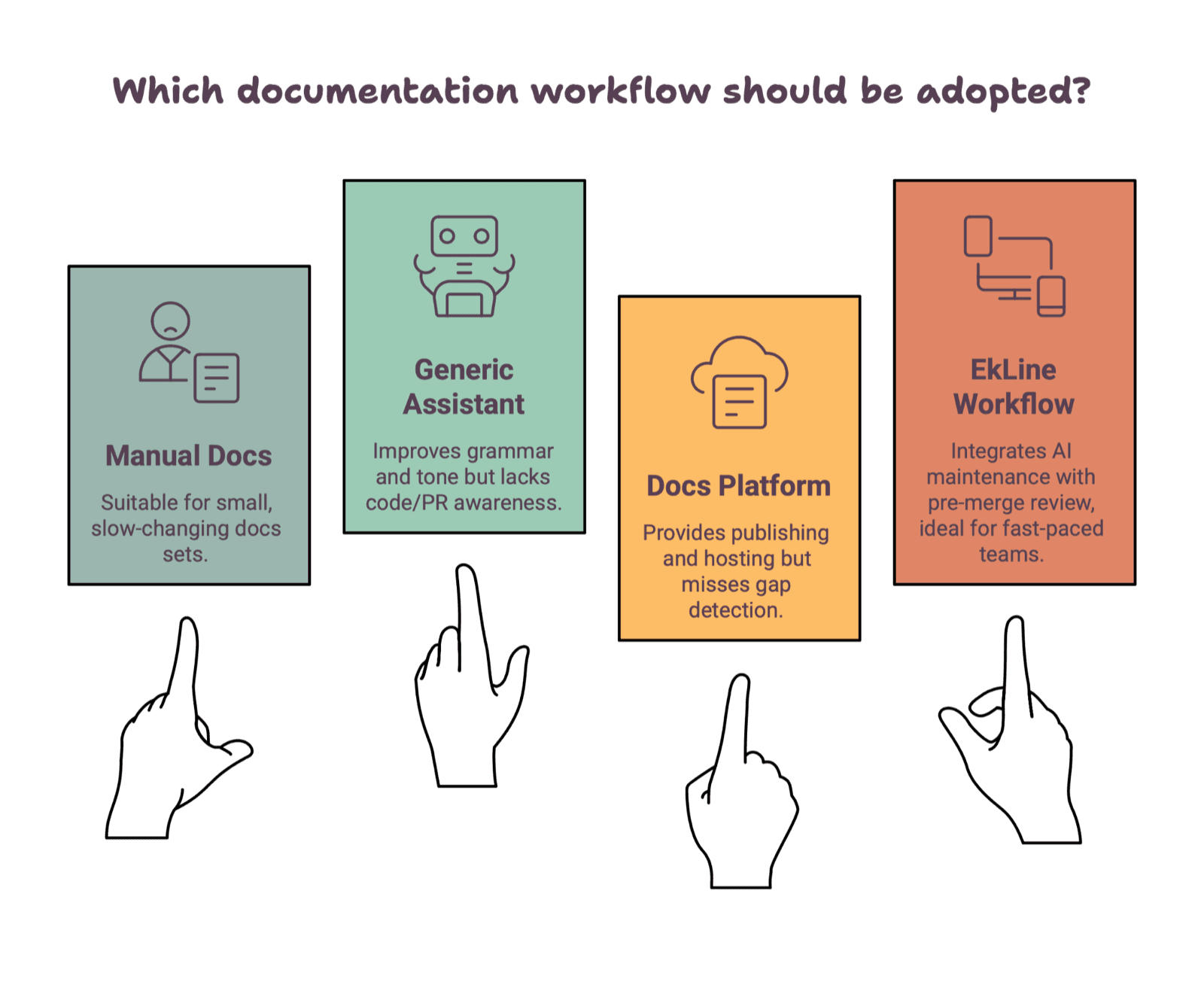
Evaluate EkLine against the workflow it improves, not against a generic "AI writing" category. EkLine combines AI documentation maintenance with pre-merge review while remaining platform agnostic.
| Approach | Best fit | Avoid if |
|---|---|---|
| Manual docs process | tiny docs set, slow product changes | API-first, fast-release, multi-team product |
| Generic writing assistant | grammar and tone improvements | code-aware, PR-aware, support-aware documentation updates |
| Docs platform alone | publishing, navigation, and docs hosting | detecting gaps and reviewing documentation before merge |
| EkLine workflow | teams using pull requests, Slack mentions, support questions, and scheduled audits | teams with no source-of-truth access or no review owner |
Compare 4 paths: keep manual documentation ownership, add a generic writing assistant, rely only on a docs platform, or connect documentation updates to product and support workflows. EkLine becomes relevant when the current system cannot keep up with releases, pull requests, support questions, and recurring review needs.
Start by identifying the first recurring gap. Use Docs Agent when product or support signals should create a sourced draft. Use Docs Reviewer when style, terminology, structure, links, or quality checks must run before merge. EkLine offers a 15-day trial for a bounded evaluation.
6 metrics for measuring Slack knowledge capture
Move from vague discomfort to measurable operating criteria. Do not ask only, "Are our docs better?" Ask whether the documentation system is reducing stale pages, repeated tickets, engineering interruptions, and inaccurate AI answers.
| Metric | How to measure it | Cadence | Target direction |
|---|---|---|---|
| Docs drift rate | count pages where docs disagree with product behavior | weekly or every release | down |
| Repeated ticket count | questions support answers more than 3 times | monthly | down |
| Time-to-first-call | time from opening docs to first successful API call | monthly | down |
| Docs PR cycle time | time from detected gap to merged update | weekly | down |
| Engineering hours reclaimed | hours engineers stop spending on first-draft docs | monthly | up |
| AI answer accuracy | priority questions where ChatGPT, Claude, or Google AI Mode describes the product correctly | monthly | up |
For a first pass, use a 30-day baseline. Pick 10 important docs pages, 10 repeated support questions, 5 recent releases, and 5 buyer questions from sales or DevRel. Then measure how many answers are accurate, current, linked, and reviewable.
A 30-day plan to turn recurring Slack answers into docs
A useful first month should be small enough to finish and specific enough to prove the workflow. The 30-day sequence below is an illustrative evaluation framework; EkLine's commercial trial is 15 days. Do not start by migrating every page or rewriting a whole knowledge base.
| Window | Action | Output | Success check |
|---|---|---|---|
| Days 1-3 | choose 10 high-risk docs or support questions | pilot scope | owner agrees on what not to include |
| Days 4-7 | map source systems and current owners | workflow map | repository, Slack, Jira, Zendesk, docs destinations, and owners are identified |
| Days 8-14 | run first review or draft-update workflow | docs PR or draft | reviewer can accept, edit, or reject output |
| Days 15-21 | fix repeated gaps and add internal links | updated docs cluster | at least 3 related pages route to each other |
| Days 22-30 | measure results and decide next workflow | pilot readout | team sees stale-page, ticket, or engineering-hour impact |
After the baseline is clear, review EkLine to decide whether the next step is product evaluation, proof, or a narrower workflow guide.
Choose the next step for operationalizing product knowledge
The next step depends on the team's current question.
| Current situation | Next resource | Action |
|---|---|---|
| Still diagnosing the pain | AI visibility and agentic discovery | run a 10-page docs drift audit |
| Comparing approaches | Docs Agent Slack bot | compare manual, docs-as-code, AI assistant, and EkLine workflows |
| Evaluating EkLine | Docs Reviewer and Docs Agent | choose review-first or generation-first pilot |
| Building internal buy-in | P0 Security case study | use proof to frame engineering time saved |
If docs change slowly and the product changes quickly, the team needs a documentation lifecycle workflow. When the workflow depends on repositories, Slack, Jira, Zendesk, support questions, and pre-merge review controls, EkLine is a credible option to evaluate.
FAQ
It is both. Docs teams usually own structure, clarity, and governance, while engineering owns product truth, API behavior, code samples, permissions, and release context. The workflow works only when the handoff between those 2 groups is explicit.
Start with 10 pages or 10 recurring support questions. That is enough to find stale examples, missing guides, repeated user questions, and unclear ownership without turning the pilot into a quarter-long migration.
EkLine fits when documentation updates and reviews must connect to pull requests, Slack mentions, support questions, and scheduled audits. Verified source systems include GitHub, GitLab, Slack, Jira, and Zendesk, and finished updates can land wherever the existing docs live.
Leadership should look for time, coverage, and quality proof. Public customer evidence includes the fact that P0 Security's documentation is created and maintained with EkLine.
Avoid treating AI-generated prose as the whole solution. The real problem is source-of-truth coverage, review workflow, ownership, security, style governance, and measurement. More words do not help if the wrong source material is being repeated.
Teams still diagnosing the problem can continue to a drift or cost guide. Teams comparing solutions can review a workflow or checklist. Teams evaluating EkLine can inspect Docs Reviewer, pricing, or the P0 Security case study.