EkLine vs ReadMe: Which Documentation Workflow Fits API-First Teams?
Compare EkLine vs ReadMe on API documentation hosting, lifecycle automation, workflow ownership, integrations, review controls, and best-fit teams.
- Written by
- Puneet Arora (opens in a new tab)
- Published on
- Read time
- 20 min

TL;DR
- EkLine vs ReadMe: API docs platform vs docs automation layer matters because fast-moving product teams create documentation risk every time code, UI, APIs, support answers, or release notes change.
- The buyer is usually a CTO, VP Engineering, DevRel lead, platform lead, docs lead, support leader, or product team that needs docs to stay current without turning engineers into full-time writers.
- The practical decision is not "should AI write more words?" The practical decision is whether the team has a repeatable workflow for detecting, drafting, reviewing, shipping, and measuring documentation updates.
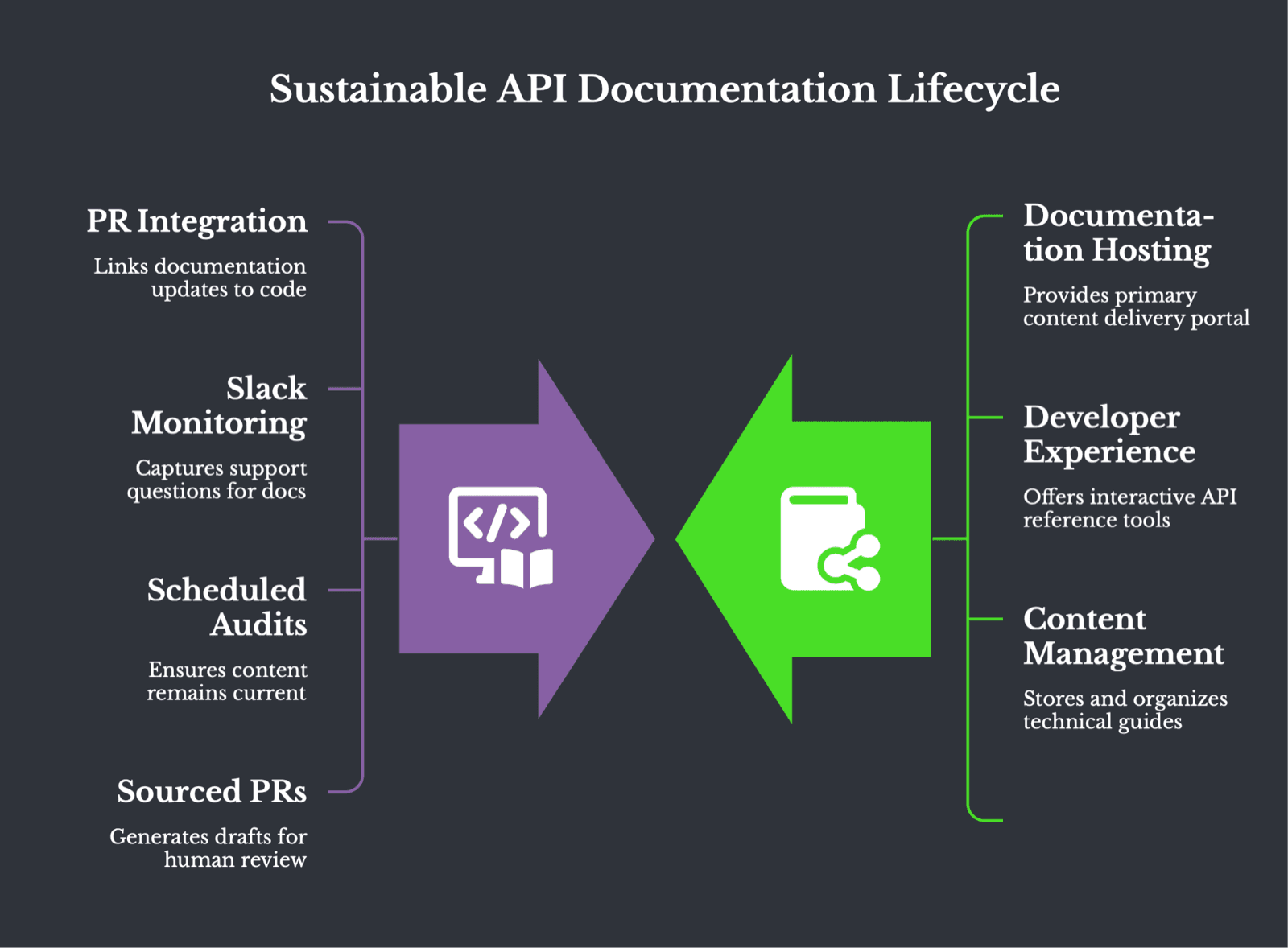
- EkLine connects documentation to pull requests, Slack mentions, support questions, and scheduled audits, then produces a sourced docs PR for human review. It works with existing documentation platforms rather than replacing the host.
- Customer evidence shows that P0 Security's documentation is created and maintained with EkLine.
EkLine vs ReadMe at a glance
EkLine vs ReadMe: API docs platform vs docs automation layer is an operating-system question for teams whose product changes faster than their documentation process.
The reader usually arrives with 1 of 3 symptoms: support is answering the same questions every week, engineers are pulled into docs work after every release, or buyers are losing trust because public docs do not match the product. Those symptoms point to the same root problem: product knowledge changes in repositories, Slack, Jira, Zendesk, support conversations, and code reviews before it reaches the docs.
For US API-first, devtool, fintech, and B2B SaaS teams, documentation affects developer onboarding, enterprise evaluation, support load, sales engineering, and AI answer accuracy. The first decision is which failure to fix and which source system proves the correct answer.
| Signal | What it means | Who feels it first | What to measure |
|---|---|---|---|
| Docs lag behind releases | the docs process is not connected to product change | engineering and docs leads | stale pages per release |
| Support repeats answers | private answers are not becoming public documentation | support and success | repeated tickets per month |
| Engineers write from scratch | the workflow depends on scarce subject-matter experts | engineering managers | hours spent on docs tasks |
| AI tools answer incorrectly | models are pulling from stale or incomplete product knowledge | marketing, DevRel, support | AI answer accuracy for 10 priority questions |
| Buyers ask for proof | docs are part of enterprise trust and technical validation | sales engineering | demo questions answered by docs |
The first decision is whether the team has a documentation problem, a publishing-platform problem, or a workflow problem. EkLine is strongest when the problem is workflow: detecting gaps, drafting updates, reviewing quality, and routing changes through existing systems.
Why documentation platform and lifecycle automation are different decisions
Documentation used to be a support surface. In 2026, documentation is also a search surface, an AI visibility surface, an implementation surface, and a trust surface.
The stakes are higher because a wrong doc page can now fail in 4 places at once. It can confuse a human developer, mislead a support agent, create friction during an enterprise evaluation, and become the stale source an AI assistant repeats. AI visibility and agentic discovery explains why AI visibility starts with current, specific, reviewable documentation.
| Failure mode | 1-week effect | 30-day effect | Decision consequence |
|---|---|---|---|
| Release ships without docs update | support fields launch questions | same gap appears in onboarding and AI answers | buyer trust drops before demo |
| API example breaks | developer cannot complete setup | DevRel or engineering handles repeat debugging | TTFC and activation suffer |
| Support answer stays private | Slack thread solves 1 account | 10 more users ask the same question | self-serve coverage stays weak |
| Style and terms drift | contributors use different product names | LLM and buyer entity matching gets weaker | brand authority becomes less consistent |
| No review gate exists | low-quality docs merge | docs quality becomes cleanup work | teams delay automation because trust is low |
The practical rule is simple: if docs are part of product adoption, docs must move at product speed. "Ship the code, EkLine drafts the docs" is the operating promise, with human sign-off before anything publishes.
A 5-step evaluation framework for EkLine and ReadMe
The workflow should have 5 steps: detect, classify, draft, review, and measure. If one step is missing, documentation quality depends on memory and heroic follow-up.
The cadences below are recommended operating targets, not EkLine product guarantees. Adjust them to release risk, team size, and review policy.
| Step | Job | Inputs | Owner | Target cadence |
|---|---|---|---|---|
| 1 | Detect the docs risk | release notes, PR diff, support ticket, Slack thread | engineering lead or docs lead | each release |
| 2 | Classify the page type | API reference, guide, troubleshooting page, runbook, release note | docs owner | same review cycle |
| 3 | Draft the update | product behavior, code sample, owner, user question | AI agent plus human owner | before approval |
| 4 | Review for trust | style guide, terminology, links, examples, structure | reviewer or CI gate | before merge |
| 5 | Measure the impact | ticket volume, stale pages, TTFC, docs PRs, AI answer accuracy | RevOps, DevRel, support | 30 days |
This workflow is intentionally broader than writing. Writing is only step 3. The more expensive failures usually happen in step 1 and step 4: nobody detects the gap, or nobody reviews whether the update is accurate, useful, and aligned with the style guide.
That is where how to keep API references in sync with code becomes relevant. The buyer should not start by asking whether AI can produce a fluent paragraph. The buyer should ask whether the system can see the right source material and route the change through a trusted review process.
5 workflow risks to compare before choosing
The risk is not that documentation is imperfect. The risk is that nobody can see which pages are wrong, which answers are missing, and which workflow owns the correction.
| Risk | How it shows up | Severity | Control |
|---|---|---|---|
| Stale example | API call fails even when the product works | High | Verify examples against current code before every release |
| Hidden support answer | the same question recurs in Slack or support | High | Promote repeated answers into public docs |
| Weak ownership | engineers, PMs, and support assume someone else will update docs | Medium | Assign owner, reviewer, and escalation path |
| Generic AI output | an assistant writes fluent text without product truth | High | Ground drafts in code, PRs, tickets, and approved docs |
| No measurement | the team cannot prove docs work improved | Medium | Track a small, stable metric set monthly |
The right control depends on the failure. Drift needs a repeatable audit, source changes need pull-request detection, inconsistent terminology needs a pre-merge quality gate, and high-risk product claims need an accountable human reviewer.
EkLine vs ReadMe: capabilities, limits, and best-fit teams
Evaluate EkLine against the workflow it improves, not against a generic "AI writing" category. EkLine combines AI documentation maintenance with pre-merge review while remaining platform agnostic.
| Approach | Best fit | Avoid if |
|---|---|---|
| Manual docs process | tiny docs set, slow product changes | API-first, fast-release, multi-team product |
| Generic writing assistant | grammar and tone improvements | code-aware, PR-aware, support-aware documentation updates |
| Docs platform alone | publishing, navigation, and docs hosting | detecting gaps and reviewing documentation before merge |
| EkLine workflow | teams using pull requests, Slack mentions, support questions, and scheduled audits | teams with no source-of-truth access or no review owner |
How buyers should compare the options
The useful comparison is not feature-count theater. A US engineering team can compare EkLine vs ReadMe: api docs platform vs docs automation layer across 8 operating criteria: source coverage, review workflow, implementation effort, security review, docs drift risk, engineer time, support deflection, and proof.
| Criterion | What to inspect | Why it changes the decision |
|---|---|---|
| Source coverage | code, PRs, Slack, Jira, Zendesk, support, and docs repos | If the tool cannot see the source of truth, it cannot keep docs current. |
| Review workflow | PR comments, CI/CD checks, human approval, style rules | Automation must fit the workflow engineers already use. |
| Docs drift risk | how outdated examples, links, auth steps, and screenshots are detected | The strongest tool is the one that prevents stale docs from shipping. |
| Implementation effort | setup owner, repo access, permissions, rollout time | A heavy migration can stall even a technically strong option. |
| Proof | customer evidence, hours reclaimed, update volume, and support outcomes | Buyers need evidence before trusting automation with docs. |
EkLine is a documentation maintenance and review layer, not a docs-site replacement. Choose a publishing platform when hosting and navigation are the main gap. Choose EkLine when the existing platform can stay, but technical documentation must respond to code changes, support questions, and quality checks. See how to keep API references in sync with code for the next workflow detail.
Where EkLine fits in this decision
EkLine fits when documentation falls behind engineering changes, recurring support questions, or review standards. It watches product and support signals, drafts a documentation pull request in the company's style, cites its sources, and assigns the change to a human. Nothing publishes without team sign-off.
| EkLine layer | What it helps with | Operational value |
|---|---|---|
| Docs Agent | pull-request changes, Slack mentions, support questions, and drafted docs PRs | engineers review a sourced draft instead of starting from a blank page |
| Docs Reviewer | style, grammar, terminology, structure, links, and a quality score | enforces a CI/CD quality gate before docs merge |
| Continuous audits | AI-search readiness, information-architecture drift, broken cross-references, and missing tutorials | turns recurring gaps into one focused PR per audit |
| Platform-agnostic output | works with GitHub, GitLab, Slack, Jira, and Zendesk; updates land in README, Notion, Confluence, Mintlify, GitBook, ReadMe, and SharePoint | keeps the current docs platform and avoids host lock-in |
Published customer evidence shows that P0 Security's documentation is created and maintained with EkLine.
Buyer committee decision table
A buyer evaluating EkLine vs ReadMe: api docs platform vs docs automation layer needs enough evidence for engineering, documentation, support, security, and finance stakeholders. Each group tests a different failure mode.
| Stakeholder | Decision question | Evidence to show |
|---|---|---|
| CTO or VP Engineering | Will this reduce engineering drag without lowering accuracy? | pilot proof, review controls, permissions |
| Docs or DevRel lead | Will this improve coverage without breaking voice and structure? | style guide, terminology checks, examples |
| Support leader | Will repeated questions become durable self-serve documentation? | ticket clusters, Slack signals, escalation paths |
| Security reviewer | What data is accessed and where does review happen? | trust center, repo permissions, subprocessors |
| Finance or founder | Is the workflow cheaper than hiring, migration, or quarterly cleanup? | pricing, pilot scope, hours reclaimed |
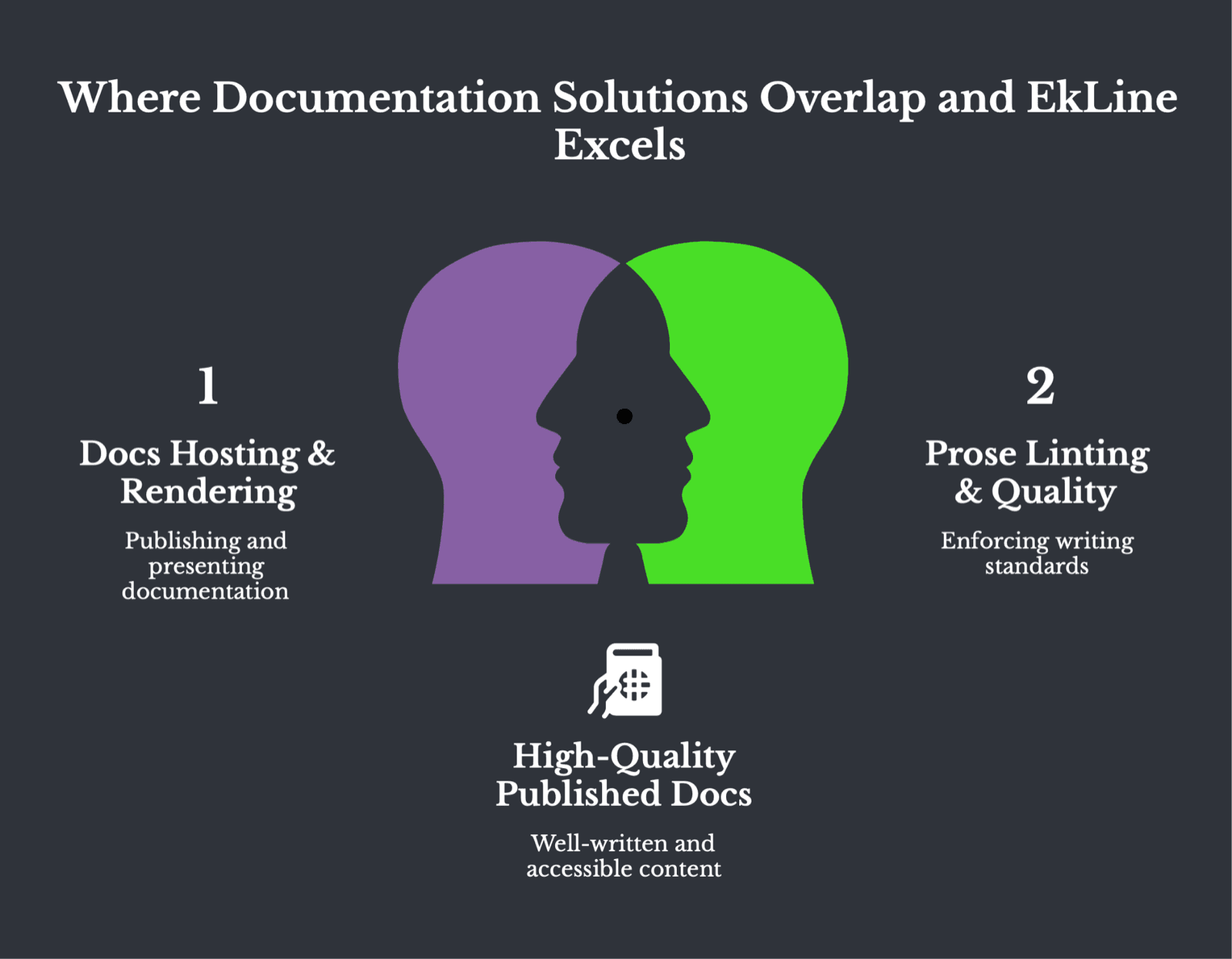
Compare category fit before feature count. A publishing platform, prose linter, writing assistant, internal knowledge base, technical writer, and documentation lifecycle system solve different jobs. A fair decision identifies the missing job first.
Objections and honest answers
EkLine is a strong fit when product changes, support questions, and review standards must feed a maintained knowledge base. It is not a docs host, and it does not publish autonomously. A human approves every output.
| Objection | Honest answer | Best supporting link |
|---|---|---|
| We already have a docs platform | Keep it. EkLine is platform agnostic and adds maintenance plus review without becoming the host. | Review Docs Reviewer |
| Engineers know the truth | Use engineers for approval and judgment while EkLine drafts the first update from source material. | P0 Security's documentation is created and maintained with EkLine |
| AI may hallucinate | Require cited sources, pull-request review, confidence classification, and human sign-off. | Review Docs Agent |
| Security review may slow rollout | Start with narrow repository and Slack scopes, then expand after controls are approved. | Review the trust center |
| We can hire a writer | A writer adds judgment, but product truth still changes inside code, support, and releases. | — |
P0 Security's documentation is created and maintained with EkLine provides a published customer reference.
30-day evaluation package
A bounded 30-day evaluation can include EkLine's 15-day free trial without turning the decision into a docs migration. The stated setup time is 20 minutes, and the trial promise is at least 15 knowledge-base improvements with no obligation to continue.
| Phase | Inputs and artifacts | Outcome |
|---|---|---|
| Before evaluation | a bounded page set, recurring support questions, recent releases, and priority buyer questions | baseline |
| During pilot | docs drafts, PR comments, reviewer edits, stale-page findings | workflow evidence |
| After 30 days | ticket trend, docs PR cycle time, engineering time, and AI answer accuracy | business evidence |
| Expansion decision | which source systems, teams, and clusters should be added next | rollout evidence |
Before approval, verify security and trust, pricing, Docs Reviewer, and Docs Agent against the buyer committee's open questions.
Match each concern to the right evidence
Security, commercial fit, review quality, source-aware drafting, and customer proof require different evidence. Treating one product page as proof for all 5 concerns weakens the decision.
| Buyer concern | Evidence source | What to verify |
|---|---|---|
| Will this pass security review? | trust center | permissions, controls, and enterprise readiness |
| What does this cost? | pricing | current plan shape and buying motion; no public per-seat or per-repo figure is assumed here |
| Can this improve review quality? | Docs Reviewer | quality checks, standards, and workflow fit |
| Can this draft from real product signals? | Docs Agent | source-aware documentation generation |
| Can this save engineering time? | P0 Security case study | measurable proof from a real customer |
Keep commercial and product claims separate. The pricing page establishes current commercial terms, the trust center establishes controls, product documentation establishes capabilities, and customer evidence establishes observed outcomes.
Where the category boundaries matter
A docs host can be the right choice when navigation, rendering, and publishing are the problem. A linter can be the right choice when prose rules are the problem. EkLine fits when the company wants to keep its host while adding source-aware maintenance and a pre-merge quality gate.
| Primary need | Best-fit category | When EkLine adds value |
|---|---|---|
| Host and render a docs site | publishing platform | add EkLine only if maintenance and review remain gaps |
| Enforce prose rules | linter or writing assistant | add EkLine when checks must include technical structure, links, and source changes |
| Capture internal notes | knowledge base | add EkLine for customer-facing documentation tied to product truth |
| Keep public docs current | documentation lifecycle automation | use Docs Agent plus Docs Reviewer with human sign-off |
The practical choice is to keep the current workflow, add review automation to the existing docs stack, or test EkLine on a bounded surface where stale docs, repeated support questions, and engineering interruptions are already visible.
Doing nothing also has a cost: stale examples continue to compound, support keeps answering private questions, and engineers keep re-entering documentation work after releases. A controlled evaluation makes that cost visible without committing to migration.
The next step is a decision owner, an approved scope, and a dated review. Teams ready to test can book an EkLine walkthrough and use the 15-day trial to verify fit.
What does EkLine actually automate?
For EkLine vs ReadMe: api docs platform vs docs automation layer, separate detection, drafting, review, and publishing. EkLine automates the first 3 parts within defined source and approval boundaries. Publishing remains a customer decision.
| Trigger or layer | Verified behavior | Human checkpoint |
|---|---|---|
| 1. Pull request merged | EkLine reads beyond the PR summary into code, classifies documentation impact as low, medium, or high confidence, and can raise a docs PR | The engineer who shipped the change or another named owner reviews the draft |
| 2. Slack or support signal | An @ekline mention or recurring support question can become a drafted documentation change | A human checks product accuracy, audience fit, and whether private information belongs in public docs |
| 3. Continuous audit | A scheduled sweep checks AI-search readiness, information-architecture drift, broken cross-references, and missing tutorials | The team reviews one focused PR from the audit |
| Docs Reviewer | CI/CD checks cover style, grammar, terminology, structure, links, and a documentation quality score before merge | The team decides whether each rule warns or blocks |
| Output | A source-cited, style-aware docs PR is assigned to a human | Nothing publishes without team sign-off |
This operating model matters because fluent text is not the same as current documentation. The system must see the event that changed product truth, identify the affected page, prepare a reviewable update, and preserve an approval record. If the source event cannot be observed or no reviewer owns the page, automation has no trustworthy path to completion.
EkLine is also platform agnostic. It does not require a team to move its docs site. The verified platform set includes README, Notion, Confluence, Mintlify, GitBook, ReadMe, and SharePoint, while verified source systems include GitHub, GitLab, Slack, Jira, and Zendesk. That distinction keeps a maintenance decision from becoming an unnecessary hosting migration.
Which controls should a buyer verify?
| Control | Verified EkLine position | Buyer verification step |
|---|---|---|
| Publication | Human in the loop on every output | Name the approver and test accept, edit, and reject paths |
| Source grounding | Sources are cited on drafted updates | Trace a sample claim back to code, ticket, or approved documentation |
| Voice and terminology | Customer style guides and terminology configure the output | Test product names, prohibited terms, examples, and audience language |
| Access | SOC 2 Type 2 compliant, scoped GitHub and Slack access, isolated per customer | Review repository scope, invited Slack channels, and internal security requirements |
| Host independence | Works with the customer's existing documentation platform | Confirm the write-back or PR path for the current repository and host |
The Slack boundary is especially concrete: the bot reads only channels it is explicitly invited to. The broader principle is least-necessary access. Start with the repositories, channels, and documentation destinations needed for the evaluation, then expand only after reviewers trust the source trail and output quality.
How should the evidence be interpreted?
| Evidence type | Verified proof | What it establishes |
|---|---|---|
| Public customer implementation | P0 Security's documentation is created and maintained with EkLine | Evidence that the workflow operates on a real documentation program |
| Trial | 15 days, 20-minute setup, and at least 15 improvements | A bounded evaluation promise, not a guarantee for every future operating period |
These figures are evidence, not universal guarantees. Update volume depends on release cadence and documentation surface. Engineering capacity depends on how much first-draft work engineers perform today. Ticket deflection depends on whether recurring questions become findable, accurate public guidance. AI-answer citation gains depend on crawlable, specific, maintained source content.
Keep the attribution boundary equally strict. 4x is the current general update-volume claim. Nearly 10x belongs only to Socure's public statement about documentation PRs versus its own prior monthly average. A case-specific result should not become a platform-wide promise.
6 metrics for comparing EkLine and ReadMe
Move from vague discomfort to measurable operating criteria. Do not ask only, "Are our docs better?" Ask whether the documentation system is reducing stale pages, repeated tickets, engineering interruptions, and inaccurate AI answers.
| Metric | How to measure it | Cadence | Target direction |
|---|---|---|---|
| Docs drift rate | count pages where docs disagree with product behavior | weekly or every release | down |
| Repeated ticket count | questions support answers more than 3 times | monthly | down |
| Time-to-first-call | time from opening docs to first successful API call | monthly | down |
| Docs PR cycle time | time from detected gap to merged update | weekly | down |
| Engineering hours reclaimed | hours engineers stop spending on first-draft docs | monthly | up |
| AI answer accuracy | priority questions where ChatGPT, Claude, or Google AI Mode describes the product correctly | monthly | up |
For a first pass, use a 30-day baseline. Pick 10 important docs pages, 10 repeated support questions, 5 recent releases, and 5 buyer questions from sales or DevRel. Then measure how many answers are accurate, current, linked, and reviewable.
A 30-day evaluation plan for documentation workflow fit
A useful first month should be small enough to finish and specific enough to prove the workflow. The 30-day sequence below is an illustrative evaluation framework; EkLine's commercial trial is 15 days. Do not start by migrating every page or rewriting a whole knowledge base.
| Window | Action | Output | Success check |
|---|---|---|---|
| Days 1-3 | choose 10 high-risk docs or support questions | pilot scope | owner agrees on what not to include |
| Days 4-7 | map source systems and current owners | workflow map | repository, Slack, Jira, Zendesk, docs destinations, and owners are identified |
| Days 8-14 | run first review or draft-update workflow | docs PR or draft | reviewer can accept, edit, or reject output |
| Days 15-21 | fix repeated gaps and add internal links | updated docs cluster | at least 3 related pages route to each other |
| Days 22-30 | measure results and decide next workflow | pilot readout | team sees stale-page, ticket, or engineering-hour impact |
After the baseline is clear, review EkLine pricing to decide whether the next step is product evaluation, proof, or a narrower workflow guide.
Choose EkLine or ReadMe based on the job you need done
The next step depends on the team's current question.
| Current situation | Next resource | Action |
|---|---|---|
| Still diagnosing the pain | AI visibility and agentic discovery | run a 10-page docs drift audit |
| Comparing approaches | how to keep API references in sync with code | compare manual, docs-as-code, AI assistant, and EkLine workflows |
| Evaluating EkLine | Docs Reviewer and Docs Agent | choose review-first or generation-first pilot |
| Building internal buy-in | P0 Security case study | use proof to frame engineering time saved |
If docs change slowly and the product changes quickly, the team needs a documentation lifecycle workflow. When the workflow depends on repositories, Slack, Jira, Zendesk, support questions, and pre-merge review controls, EkLine is a credible option to evaluate.
External references
- Official product reference: ReadMe.
FAQ
It is both. Docs teams usually own structure, clarity, and governance, while engineering owns product truth, API behavior, code samples, permissions, and release context. The workflow works only when the handoff between those 2 groups is explicit.
Start with 10 pages or 10 recurring support questions. That is enough to find stale examples, missing guides, repeated user questions, and unclear ownership without turning the pilot into a quarter-long migration.
EkLine fits when documentation updates and reviews must connect to pull requests, Slack mentions, support questions, and scheduled audits. Verified source systems include GitHub, GitLab, Slack, Jira, and Zendesk, and finished updates can land wherever the existing docs live.
Leadership should look for time, coverage, and quality proof. Public customer evidence includes the fact that P0 Security's documentation is created and maintained with EkLine.
Avoid treating AI-generated prose as the whole solution. The real problem is source-of-truth coverage, review workflow, ownership, security, style governance, and measurement. More words do not help if the wrong source material is being repeated.
Teams still diagnosing the problem can continue to a drift or cost guide. Teams comparing solutions can review a workflow or checklist. Teams evaluating EkLine can inspect Docs Reviewer, pricing, or the P0 Security case study.