What is a marketing mix model, and does your team need one?
A plain-language guide to marketing mix models: what they are, how they work, who owns them, what changed in 2026, and whether a B2B team has the data to run one.
- Written by
- Lucas Suárez (opens in a new tab)
- Published on
- Read time
- 11 min

Your CFO wants to know which marketing spend works. You have a last-touch report you half trust, a "how did you hear about us" field, and buyers who used an AI assistant during their research before they reached your site. None of those answers the budget question on its own.
A marketing mix model is built to answer that question.
TL;DR
- An MMM fits weekly spend per channel against an outcome and splits that outcome into baseline and the part media drove.
- Google's open-source MMM package, Meridian, asks for three years of weekly data for a national model. Teams with less should collect that history first, then run MMM.
- In 2026 Google's Meridian and the open-source PyMC-Marketing shipped major releases, and both added ways to calibrate with experiments.
- AI-assistant answers have no spend line, so we think they need their own measurement.
What is a marketing mix model?
Your marketing mix is everything you spend on to win customers: search ads, LinkedIn ads, events, sponsorships, email. A marketing mix model (MMM) is a statistical method that reads your history and works out how much each of those channels moved a result you care about, such as sign-ups or revenue. AI Digital defines it as "a statistical approach that quantifies how marketing activities and broader business factors influence revenue." The method is not new: it was born in packaged goods.
An MMM works from aggregated totals and never follows a single buyer. As NoGood puts it, "MMM does not track individual users or require personal data." The model reads totals: how much you spent in each channel each week, and how many sign-ups you got that week.
A simple example
This example uses made-up numbers. Say you run search ads, LinkedIn ads, and two conferences a year. You have three years of weekly records: spend per channel, and sign-ups per week. In some weeks LinkedIn spend went up. In some weeks search was paused. In two weeks a conference ran.
The model asks one question across all those weeks. When spend in a channel rose or fell, how much did sign-ups move, once you account for things that move sign-ups anyway, such as seasonality or a price change? Its answer has three parts:
- A share of sign-ups would have happened with no marketing at all. That share is the baseline.
- The rest is incremental, and the model splits it by channel.
- For each channel, you get its return per dollar and the point where more spend stops paying.
With those answers you can test a budget on paper before you spend it. What happens if you move part of the conference budget into search? An MMM lets you "simulate how different budgets would perform before any money is committed."
How MMM differs from attribution
Attribution tools follow individual buyers. They record the ad someone clicked and the pages they visited, then give credit to those touchpoints. MMM works from the top down, with totals. NoGood describes the difference this way: "If MMM is our wide angle lens, attribution is our zoom lens on one customer's path." Because it never tracks people, MMM can weigh offline channels such as sponsorships next to online ones, and it needs no cookies or consent banners.
Why MMM is worth a second look now
User-level tracking got weaker: since iOS 14.5, Apple requires apps to get permission through App Tracking Transparency before they track a user, and without it the advertising identifier "will be all zeros." The software got cheaper too, because Google, Meta, and PyMC Labs publish MMM packages as open source. That removes the license fee, though staff and time still cost money. Chrome is the exception: Google said it will keep offering users a third-party cookie choice.
How a marketing mix model works
Under the hood, an MMM is a regression over time: a statistical method that estimates how much each input moves an outcome. Google's Meridian lists its inputs: a KPI (the outcome you measure, such as sign-ups), "media spending per channel and time span," and control variables, the things that move both your KPI and your media spend, such as competition or Google search volume. The model then estimates three effects at once.
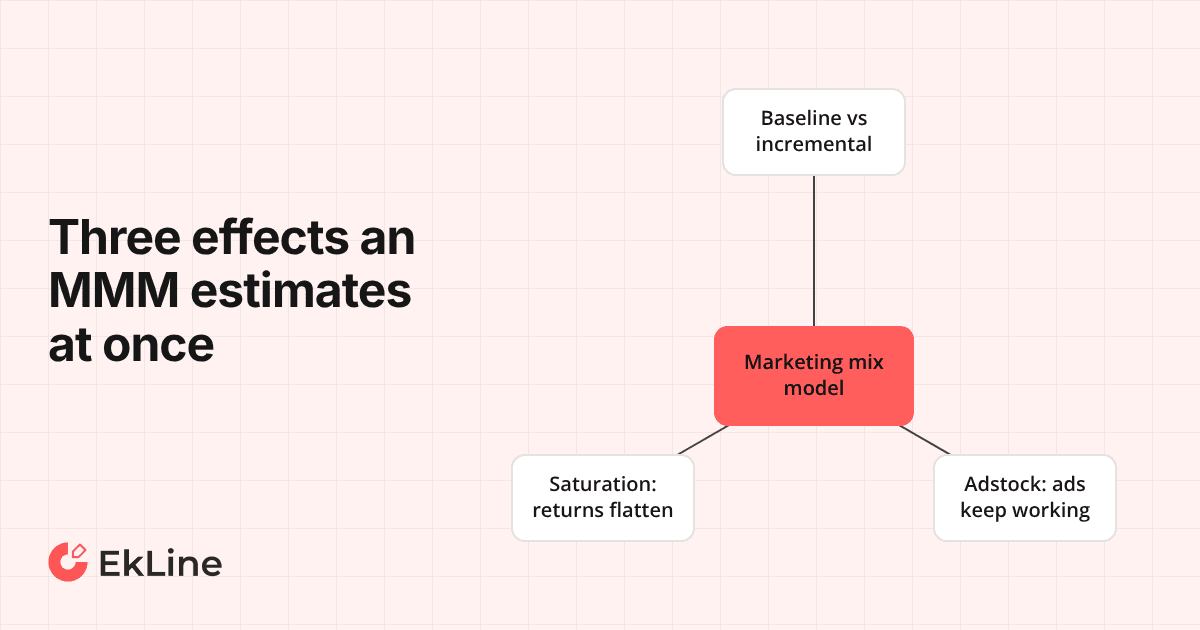
- Baseline and incremental results, as in the example above.
- Adstock. An ad keeps working after the week it ran, so the model carries part of each week's effect into later weeks.
- Saturation. Each extra dollar in a channel buys less than the one before, so the response curve flattens.
The output is each channel's contribution and return, plus where more spend stops paying. Dreamdata, a B2B attribution vendor, warns that MMM "reveals correlations but doesn't prove causation." That is why experiments now sit next to the model.
How teams use MMM, and who owns what
NoGood frames it this way: MMM sets quarterly budget envelopes and attribution tunes campaigns inside them. Improvado's guide splits the roles like this:
- Finance and the CFO approve the quarterly budget envelope.
- Finance and marketing science refresh the model together.
- Performance marketers make weekly shifts inside the envelope.
- Incrementality tests settle disputes between the model and attribution. These include geo holdouts and conversion lift studies, which hold back ads from some regions or some people and compare the results.
As the marketing leader, you bring the question and the decisions it should change. AI Digital's guide adds a warning: a model never tested against experiments is "an opinion with a confidence interval."
How MMM changes marketing decisions and daily work
The budget conversation moves from "which campaign got the last click" to "how much should each channel get next quarter, and where does it saturate." Google lists "Advanced scenario and projection planning" under Meridian-Powered Budgeting in Google Analytics 360.
Performance marketers still optimize with attribution, but tests become routine. Meridian can now be tuned with experiment results, such as tests from GeoX, its regional testing tool, which "strictly requires daily time-series data." Meridian also warns that too little variation in spend hurts national models. We think teams running MMM should plan spend changes as deliberate tests, because flat spend gives the model nothing to learn from.
What's new in 2026
| Date | Development | What it changes for you |
|---|---|---|
| Dec 19, 2024 | Meta's Robyn publishes v3.12.0, its last tagged release so far | No tagged release in almost two years; the repo is not archived |
| Feb 2, 2026 | IAB launches Project Eidos | A multi-year push toward MMM results you can compare |
| May 20, 2026 | Google says it is bringing Meridian into Google Analytics 360 | MMM inside Google Analytics 360; no ship date given |
| Aug 7, 2026 | PyMC-Marketing 1.0.0 | A stable API after two years of 0.x releases, so analysts can build on it |
| Aug 2026 | IAB publishes Measuring Visibility in the AI Era | A framework for brand presence in AI answers |
| Sep 2, 2026 | Meridian 2.0.0 | Your analysts can tune the model with your own experiment results |
| Oct 22 and Nov 9, 2026 | PyMC-Marketing 1.3.0 and 1.4.0 | More ways to tune the model with lift-test and ROAS results |
| Nov 5, 2026 | Meridian 2.2.0 | Calibration charts for reviewing the model |
Google says Meridian has passed one million downloads within 18 months of its debut. That is a vendor claim on an undated page. Meta's README still calls Robyn "experimental."
Where MMM is heading
Google is moving MMM inside its own analytics. It says predictive signals from Qualified Future Conversions will eventually feed into Meridian, and lists time-varying media effects on its future roadmap.
Calibration is also becoming a standard part of the model in both Meridian and PyMC-Marketing. And the industry wants comparable numbers. Project Eidos aims at "a modern, comparable approach to MMM built on standardized, privacy-ready inputs." The IAB also plans a forthcoming attribution framework. The IAB says that framework will cover attribution as more buyers find products through AI answers.
Is your team ready? MMM for B2B and developer tool companies
The strongest objection: we are too small and too B2B for MMM, and last-touch plus self-reported attribution is good enough. The objection has two parts. The first, that you lack the data, is largely right.
Meridian asks for at least two years of weekly data for geo-level models, three years for national models, and three years minimum with monthly data.
Take a single-country company with two years of weekly history. That is 104 data points. In Google's example national model, that is about four data points for each value the model estimates, and Google says: "This sample size is too low to estimate the model reliably."
Experiments have a floor too. GeoX needs at least 10 regions for the simplest test design, and for stratified designs the docs recommend 50 to more than 100. Long sales cycles and small deal counts widen the uncertainty further.
Use this readiness check:
- You have three years of weekly national data, or two years of weekly data by region.
- Your spend varies from week to week across several channels.
- You can run experiments with daily data across at least 10 regions.
- Your offline spend is above 30% of the total, or your sales cycles run over 30 days. This is Improvado's rule of thumb, which also requires at least 100 weeks of history.
If you can't tick most of these, the answer is "not yet." The other half of the objection holds up less well. Powered by Search, a B2B SaaS agency, argues that self-reported attribution "assumes that leads are better at remembering your marketing than they may be in reality," and is of little use taken alone. Pravin Kumar, who works on getting brands into AI answers (answer engine and generative engine optimization), describes a small-team setup that pairs one tracked model with a required "how did you hear about us" field, because tracking alone misses "an AI answer that never sends a referrer." That field still depends on buyers' memory.
What to measure in the meantime:
- Read tracked attribution and the self-reported field side by side.
- Log weekly spend per channel and your KPI now, so the history an MMM needs builds up.
- Run holdout or lift tests wherever your regions and volume allow.
- Measure AI-assistant answers as their own channel, starting with how much they vary.
The channel your MMM cannot credit
Forrester reports that 94% of business buyers report using AI during their buying process, from its 2025 survey of nearly 18,000 buyers.
We think the next step follows, though no study states it. An MMM credits what has a spend line. A recommendation from ChatGPT or Claude has no spend line, often sends no referrer, and changes from run to run. The IAB notes that "AI platforms do not produce deterministic outputs." So whatever an assistant's answer does for your pipeline lands in the model's baseline, unnamed.
How EkLine measures AI recommendations
The free AI report writes 15 questions a buyer would ask an AI assistant about products like yours. It asks each question 10 times on each of ChatGPT, Claude, Perplexity and Gemini, with web search on: 600 answers in all. Ten runs per question show how much answers vary, the kind of benchmark for normal variation that the IAB says to set before acting on period-over-period change.
Before, an assistant's influence sat unnamed in your baseline. After, you know for each buyer question whether assistants recommend you. Journeys grades every answer and marks each question "You win," "Split," or "You lose." When you re-run a collection, the report compares each buyer question with the collection's first run, so you see whether your changes moved the answers. Someone on your team starts each run.
EkLine measures what assistants say and cite about you. It does not estimate revenue or channel ROI, and it does not feed your MMM. Assistants reach you through public web search and the pages they open, so what you publish is what they can recommend.
Before you decide whether to build an MMM, find out what AI assistants tell your buyers today. Get your free AI report; each organization gets one.
FAQ
It can, with enough history. Meridian asks for three years of weekly data for a national model, and long B2B sales cycles and small deal counts widen the uncertainty. Teams with less should collect that history first.
Sources
- Apple Developer: User Privacy and Data Use
- Google: Update on Plans for Privacy Sandbox Technologies
- Google: Google Analytics 360 helps you turn data into decisions
- Google: The Next Era of Meridian
- Google: Enhanced budgeting tools in Google Analytics powered by Meridian
- Meridian changelog on GitHub
- Meridian: Collect and organize your data
- Meridian: Amount of data needed
- Meridian: GeoX FAQs
- PyMC-Marketing releases on GitHub
- Robyn repository on GitHub
- IAB: IAB Announces Project Eidos
- IAB: Measuring Visibility in the AI Era
- Forrester: The State Of Business Buying
- Pravin Kumar: Marketing attribution for a small B2B team
- Powered by Search: Self-reported attribution
- Improvado: Multi-Touch Attribution vs Marketing Mix Modeling
- AI Digital: What is Marketing Mix Modeling (MMM) and How It Works
- Dreamdata: Marketing Mix Modelling
- NoGood: Marketing Mix Modeling vs. Attribution
- EkLine: Get your first AI report
- EkLine: Journeys
- EkLine: Track results over time