Release Radar: each feature your customers can see gets its own checklist
Release Radar finds the features your team ships, gives each one a checklist of follow up work, and lets an agent start on it with one click.
- Written by
- Arun Bhalla (opens in a new tab)
- Published on
- Read time
- 3 min

A feature merges. You hear about it in standup, in a commit log, or not at all. So the changelog entry, the docs update and the announcement wait on someone remembering to do them.
One post on I'd Rather Be Writing puts it plainly: "technical writers are left out of the loop until the last minute."
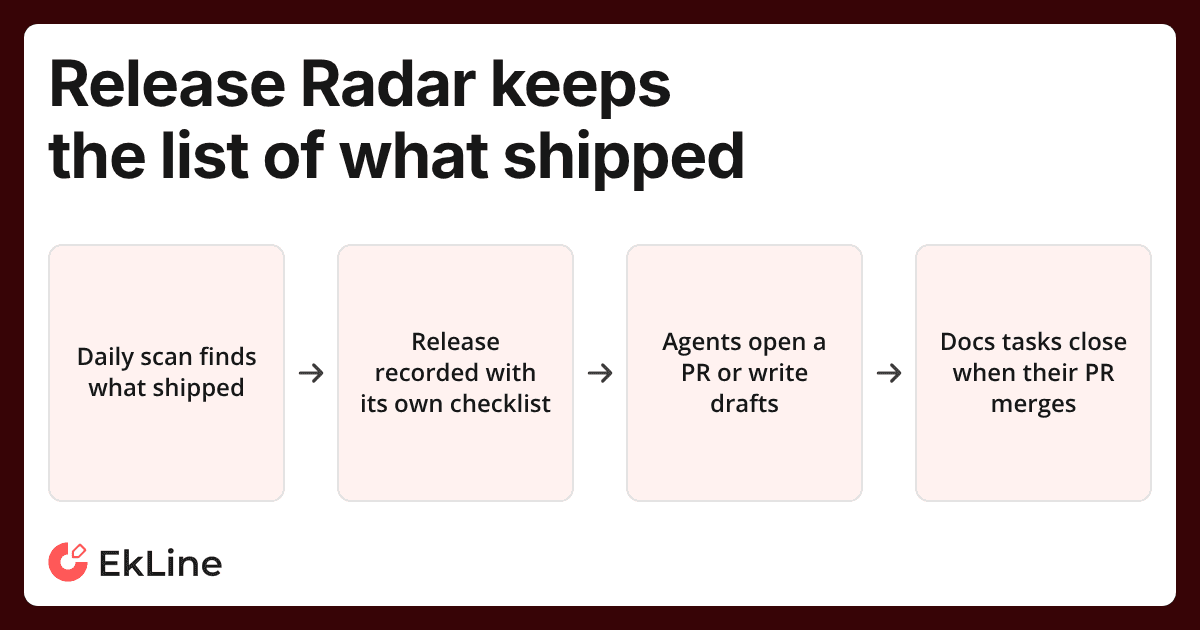
In our view, knowing what shipped is the hard part. Release Radar keeps that list for you in EkLine, gives each feature your customers can see its own checklist of follow up work, and lets an agent start on it with one click.
Where the list of what shipped lives today
Writers describe the workarounds: noisy standups and a Jira checkbox for doc updates. QGIS asks that feature pull requests carry a Changelog tag before they merge. PostHog built its own scanner, which checks merged pull requests across 26 repos for its changelog, and its handbook admits "sometimes it misses something it should have surfaced."
None of these, as described, tracks the docs update and the announcement for each feature in one place.
How Release Radar works
- It finds what shipped. Once a day, Release Radar looks at your merged pull requests and GitHub releases, plus Linear projects if you connect Linear. It records each feature a customer can see as a release and skips bug fixes and small changes.
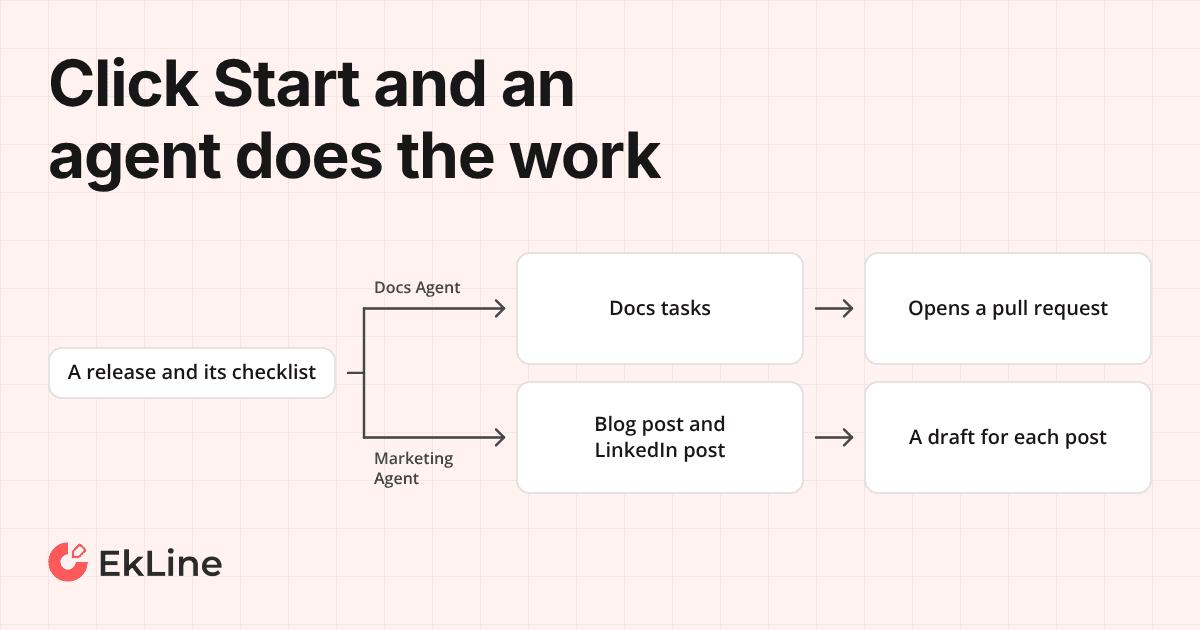
- Each release gets a checklist. By default that is a changelog entry, release notes, a docs update, a blog post and a LinkedIn post. Mark anything you don't need as Not needed.
- An agent does the work. Click Start, or Start all. The Docs Agent opens a pull request for the docs tasks, and the Marketing Agent writes a draft for each post. Your team reviews everything, and a docs task closes on its own when its pull request merges.
This post started that way. Release Radar found the Release Radar launch in our own repositories and put a blog post on its checklist.
Release Radar creates the tasks for you and ties the docs work to the pull request that does it, so nobody has to build the list by hand.
Try it
On the Tasks page in EkLine, an admin turns on the Look for new releases daily setting. The first scan starts right away and covers the last 30 days. The Release Radar guide covers setup. New to EkLine? Sign up and connect GitHub.