Your Support Tickets Are a Documentation Backlog in Disguise
Every repeated support ticket is a documentation gap you already have the answer for. Here is how to close the loop and stop solving the same problem twice.
- Written by
- Arun Bhalla (opens in a new tab)
- Published on
- Read time
- 6 min

P0 Security's engineering team was answering the same integration questions over and over. Customers would hit a gap in the docs, file a ticket, and an engineer would context-switch out of product work to write a response that should have been self-serve. Before they closed that loop, their docs repo averaged 2.7 commits per month across 13+ integration guides. After: 42 merged documentation PRs, 110 hours of authoring replaced by 10 hours of review.
The gap between what your support team knows and what your docs say is not a content problem. It is an operational one. Every ticket your team answers twice is a documentation update that never shipped.
The Pattern Nobody Talks About
Support platforms like Pylon, Intercom, Plain, and Thena have gotten very good at managing conversations. Tagging, routing, SLA tracking, AI summaries. What they have not solved is the feedback loop: when a ticket reveals a documentation gap, who updates the docs?
In most companies, the answer is "nobody, until a customer escalates." The support team resolves the ticket. The knowledge stays in Zendesk. The next customer with the same question files another ticket. Harvard Business Review research found that reducing customer effort is the single strongest driver of loyalty, yet most documentation teams operate reactively, fixing pages only after complaints accumulate.
Here is what the ticket lifecycle actually looks like in most organizations:
- Customer hits a documentation gap
- Customer files a support ticket
- Support agent writes a one-off answer
- Ticket closes
- Documentation stays unchanged
- Next customer hits the same gap
- Repeat from step 2
The cost compounds. The average B2B support ticket costs $18 to $35 to resolve, while self-service resolution costs $1 to $4. If 30% of your tickets are questions your docs should already answer, you are spending thousands per quarter on a problem that documentation updates would eliminate. Companies that systematically turn support interactions into documentation updates reduce ticket volume by 20 to 30% on the topics they address.
What "Closing the Loop" Actually Means
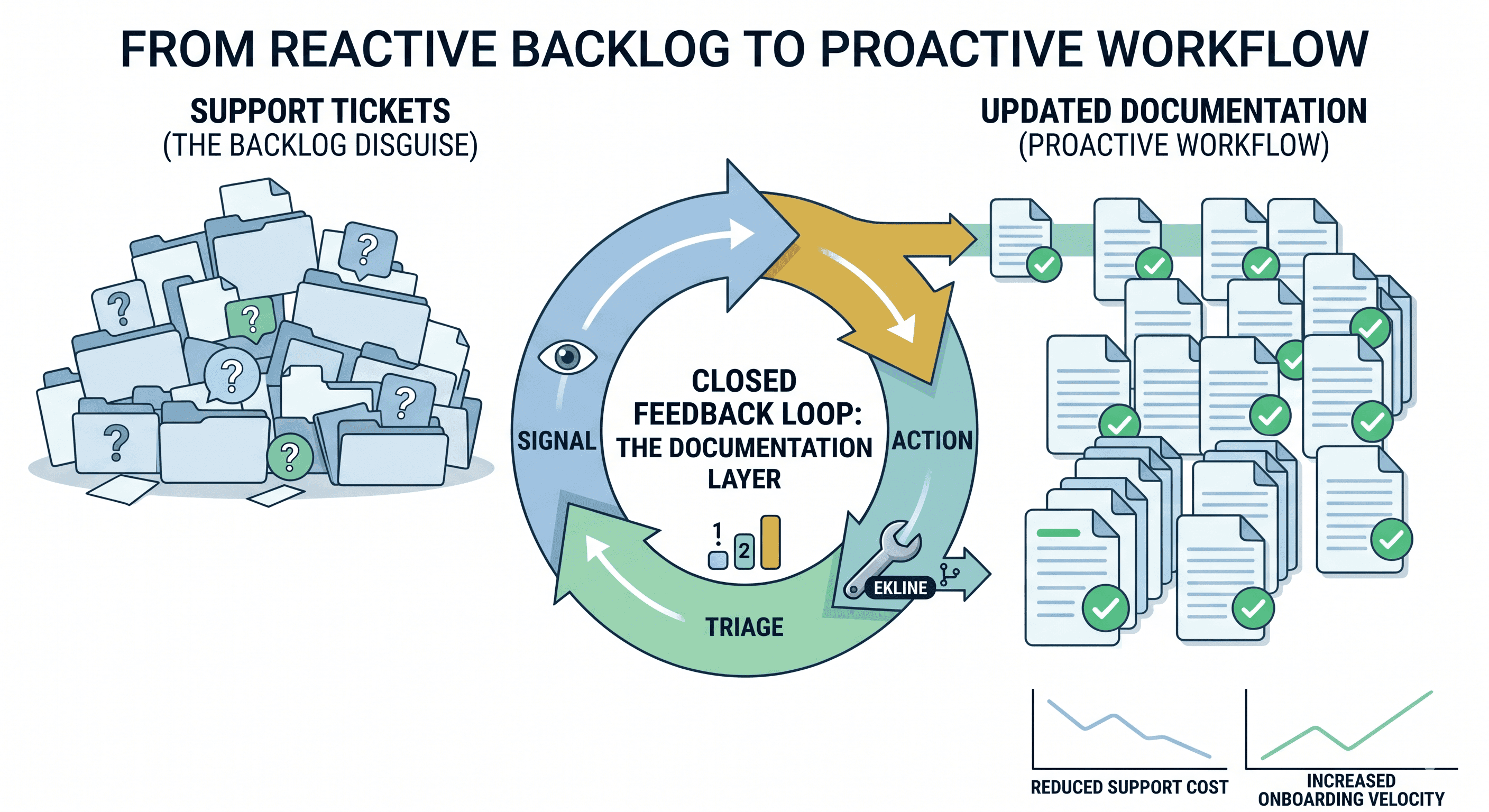
The support-to-docs loop has three components. Most teams have the first, some have the second, almost none have the third.
Component 1: Signal detection. Identifying which tickets point to documentation gaps. Pylon does this well for Slack-based support, surfacing conversation patterns across channels. Intercom and Plain offer similar tagging and clustering. The tooling exists.
Component 2: Prioritization. Not every ticket is a documentation gap. Some are bugs. Some are feature requests. Some are edge cases that affect one customer. The signal needs filtering: which questions repeat, which affect onboarding, which block self-serve adoption?
Component 3: Action. This is where it breaks down. Someone needs to take the support answer, restructure it for a public audience, verify it against the current product state, and ship it as a documentation update. That "someone" is usually nobody.
Here is a YAML workflow that connects the signal to the action:
# support-to-docs triage template
name: Documentation gap triage
trigger: support_ticket_tagged_docs_gap
steps:
 - classify:
     type: [missing_page, incomplete_steps, outdated_content, wrong_example]
     affected_page: "URL or path of the doc that needs updating"
     frequency: "How many times this question appeared in last 30 days"
 - prioritize:
     score: frequency * customer_tier_weight
     threshold: 3  # Act on anything asked 3+ times
 - action:
     if_missing_page: "Create new doc from support answer template"
     if_incomplete: "Add missing steps from ticket resolution"
     if_outdated: "Flag for engineering review and update"
     if_wrong_example: "Replace with verified working example"
The template is simple on purpose. The hard part is not the template. The hard part is making the action happen without adding work to engineers who are already behind on product development.
How P0 Security Closed the Loop Without Hiring a Writer
P0 Security had 13+ cloud integrations, each requiring step-by-step guides for configuring just-in-time access controls. Their documentation was sparse: 76 commits across 28 months. When docs were incomplete, customers filed support tickets, and engineers lost 3 to 4 hours per guide writing documentation from scratch.
The fix was not hiring a technical writer. It was inserting a documentation layer into the existing PR workflow. EkLine created documentation PRs alongside feature PRs. Engineers went from writing docs (3 to 4 hours each) to reviewing docs (15 minutes each). Six engineers rotated through reviews, contributing an average of 5 comments per reviewed PR, some reaching 14 to 16 comments of substantive technical feedback.
The result: documentation shipped with features instead of weeks after. The median time-to-merge for docs PRs dropped to under one day. The support team could point customers to current, accurate guides instead of writing one-off answers.
P0 Security's CTO, Greg Vishnepolsky, put it plainly: "On customer calls now, we can just say, 'look at our docs.' That's new for us." That shift, from engineers drafting answers to engineers verifying answers, is what closing the loop looks like in practice.
The Proactive Docs Advantage
Reactive documentation updates after a customer complains. Proactive documentation updates when the signal appears, before the next customer hits the same wall.
The difference matters for three reasons:
Support cost reduction. Every documentation update that prevents a future ticket pays for itself. If your average B2B ticket costs $22 and a single doc update prevents 5 tickets per quarter, the ROI is immediate and measurable. Deflecting 2,500 tickets delivers roughly 75% ROI from saved agent time alone.
Onboarding velocity. Customers who can self-serve through accurate docs reach value faster. P0 Security's customers went from relying on support for integration configuration to following step-by-step guides that shipped with each new integration. Faster integration. Fewer tickets. The same engineers who used to write 3-to-4-hour guides are now reviewing them in 15 minutes.
Answer engine visibility. AI referral traffic to websites grew 527% year-over-year through mid-2025. The content that gets cited is specific, structured, and fresh. Documentation that answers the exact question a customer asked in a support ticket is the exact content AI answer engines prefer to surface. Your support tickets are telling you what to publish.
Start This Week
Export your top 20 support tickets from last month. Group them by documentation page. If 3 or more tickets point to the same gap, that is your first update.
Take the support team's best answer for each cluster. Restructure it: direct answer first, steps below, context at the bottom. Publish it as a documentation update, not a blog post.
Then set up the tracking: tag tickets that could have been self-serve, count them monthly, and measure whether the documentation updates reduce ticket volume for those topics. You are looking for the trendline, not a single data point.
If your support tickets and documentation live in different systems with no feedback loop between them, EkLine closes that gap by turning documentation gaps into PRs that ship alongside your product.