Why Your Incident Runbook Lies to You at 3 a.m. (and How to Tell Before the Page Fires)
A runbook is a frozen snapshot of how your system used to work. The system keeps changing. The runbook does not. Here is the math of MTTR when the runbook lies, and how to catch the lie before the page fires.
- Written by
- Arun Bhalla (opens in a new tab)
- Published on
- Read time
- 8 min

A runbook is a strange thing.
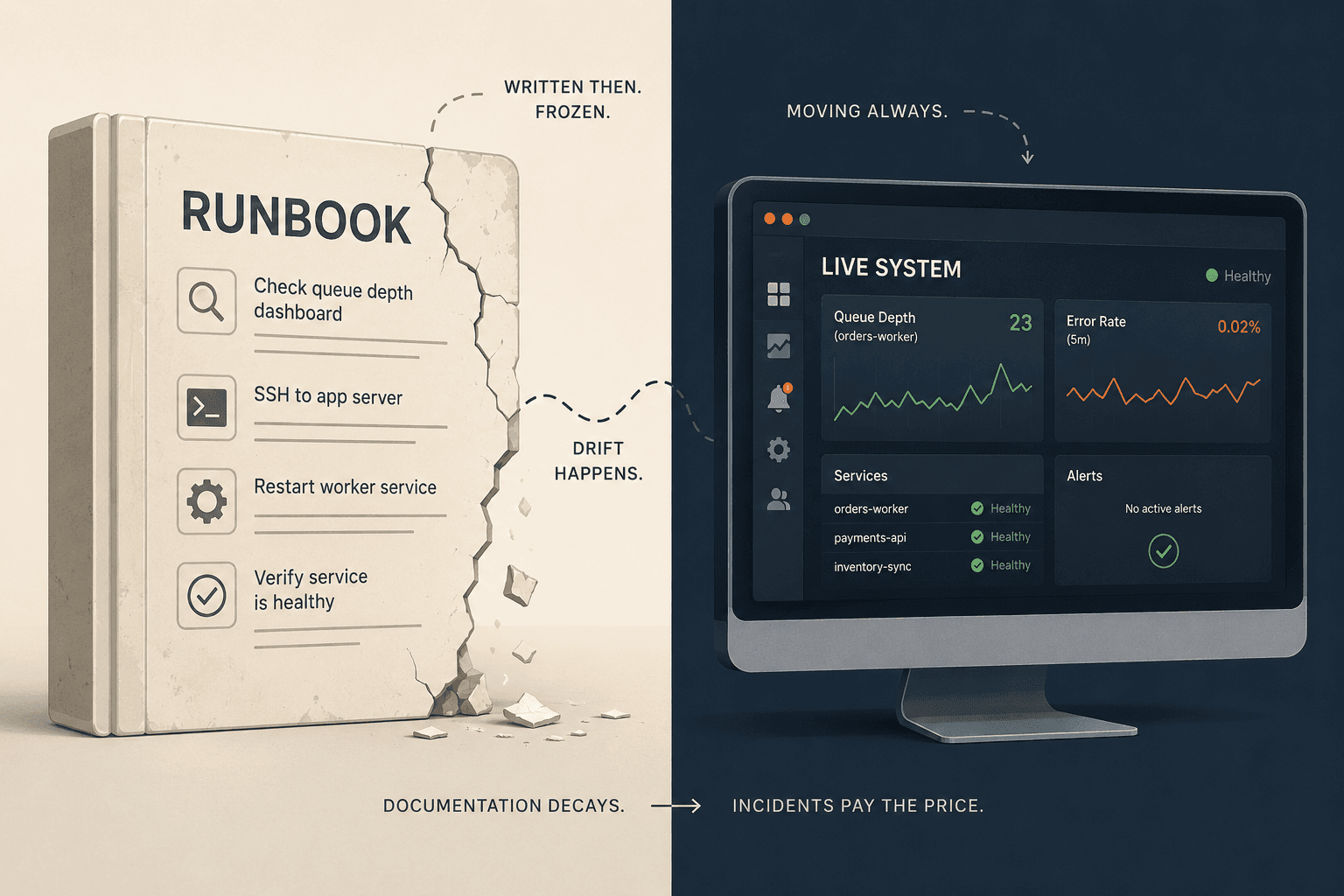
It looks like documentation, but it is really a frozen photograph. It captures how a system worked, what its alarms meant, and which buttons restored service, on the day someone had time to write it down. From that day onward, the system keeps moving. New services ship. Old services get rewired. Alert thresholds get tuned. Credentials get rotated. Region failover behavior gets updated to handle a quirk discovered in an outage three months ago.
The runbook does none of those things. It sits in a wiki, looking authoritative, growing wronger by the week.
At 11 a.m. on a Tuesday, this does not matter much. An on-call engineer can read the runbook, notice the parts that look stale, ask a teammate, check the actual config, and proceed.
At 3 a.m. on a Sunday, in the third hour of a P1 incident, with a customer escalation in Slack and an executive on a call, none of those checks happen. The on-call engineer reads the runbook and trusts it. Each instruction the runbook gets wrong is a wrong turn down a hallway with no lights. Each wrong turn adds time to recovery. Each minute of recovery adds money to the breach cost.
This post is about the math of that, and what to do about it.
A Runbook Is a Frozen System Talking to a Living One
The clearest way to think about a runbook is as one half of a conversation that has gone quiet on one side.
When a runbook is written, the system is in a known state. The author looks at the system, describes it, and writes down what to do when it breaks. That description is now frozen. The system, meanwhile, keeps talking. It deploys new code on Friday. It scales out a new region next quarter. It moves a database. It changes a default. It deprecates an API the runbook still tells you to call.
Months later, the runbook and the system are no longer in conversation. The runbook is still saying what it said. The system has moved on. An on-call engineer, opening the runbook during an incident, is reading one side of a conversation the other side stopped having.
Every line of the runbook now has a probability of being right. Some lines are still right because that part of the system has not changed. Some lines are partially right because the structure is the same but a name has changed. Some lines are flatly wrong because the entire path they describe no longer exists.
The on-call engineer cannot tell which is which without checking, and at 3 a.m. checking takes time the incident does not have.
The Math of MTTR When the Runbook Lies
Mean time to recovery, or MTTR, is the average time it takes to restore service after an incident begins. The IBM 2024 Cost of a Data Breach Report puts the global average breach lifecycle at 258 days, with the cost of a breach scaling sharply with how long it takes to identify and contain.
The same report finds that organizations with mature incident response and tested playbooks contain breaches significantly faster than organizations without. The difference is not whether the playbook exists. The difference is whether the playbook still describes the system on the day it is read in anger.
Consider the structure of an incident response. It looks roughly like this.
detect → triage → diagnose → mitigate → restore → verifyA runbook is consulted at the diagnose, mitigate, and restore steps. Each consultation produces an instruction. Each instruction either advances the response or sends the responder down a wrong path.
Suppose a runbook has thirty steps and three of them are stale. That is a ten percent error rate. If the average wrong step costs eight to fifteen minutes of investigation before the responder realizes the step does not match reality and pivots, three wrong steps add roughly twenty-four to forty-five minutes to the incident.
In an incident where the actual technical work would have taken twenty minutes, the docs have doubled or tripled the time to recovery. None of that time shows up as work. It shows up as elapsed time, customer impact, and breach cost.
This is the math of runbook drift. It is not loud. It is not catastrophic on any single line. It is a slow tax that the team only pays when the team can least afford it.
Why Runbooks Decay Faster Than Other Docs
A reference doc for a public API has a forcing function: customers complain when it is wrong. A tutorial has a forcing function: new users get stuck and tell support.
A runbook has neither. It is read by a small number of people, infrequently, under conditions where they cannot stop to file a doc bug. After the incident, the responder is exhausted. After the post-mortem, the responder is busy. The runbook stays wrong.
Three other forces accelerate the decay.
Runbooks describe state, not behavior. A reference doc describes what an API does, which is a behavior contract that changes only when the API changes. A runbook describes the current state of dashboards, alert names, queue topologies, and team ownership, all of which change continuously, none of which produce loud signals when they change.
Runbooks live where on-call engineers cannot easily edit them. The runbook is in a wiki. The system is in code. The two are maintained by different processes and often by different people. A platform team rewires a service and does not know which runbooks reference it.
Runbooks are written when nothing is broken. The author is calm, the system is healthy, and the description is therefore optimistic. It assumes the dashboard will be available, the alert will fire as documented, and the responder will have credentials. None of those assumptions hold reliably during an incident.
The result is a document that is most stale exactly when it is most needed.
What "Catching the Lie" Looks Like
A runbook does not announce that it has decayed. The decay is silent until the moment of failure. So the goal is not to detect drift after it bites. The goal is to make drift impossible to ignore before it bites.
Three practices, in order of leverage.
Tie runbook entries to live system facts. If the runbook says "check the queue depth on the orders worker," that line should reference the actual dashboard panel, by URL, with the actual query embedded. When the dashboard moves or the query stops returning data, the runbook breaks visibly. A runbook entry that does not reference any live system fact is an entry that decays silently.
Run game days against the runbook itself. A game day is a planned exercise where a team simulates an incident and follows the runbook end to end. The point is not to test the responder. The point is to test the runbook. Every step that does not work as written becomes a documentation defect. NIST SP 800-61 names tabletop exercises and functional exercises as part of mature incident response programs precisely because they surface the gap between documented response and actual response.
Treat runbook changes as code changes. A runbook should live in a repository, ship in a pull request, get reviewed, and be linked to the change that prompted it. If a service team rewires a queue, the same merge that ships the rewire should update the runbook entries that reference the queue. Runbooks that live outside the change process are runbooks that drift.
These three practices do not eliminate drift. Nothing eliminates drift, because the system never stops changing. They make drift expensive to introduce and cheap to spot.
The Compliance Surface
Runbook accuracy is not only an operational issue. It is also an audit issue.
SOC 2 Trust Services Criterion CC7.3 requires entities to evaluate security events to determine whether they could result in failures to meet the entity's objectives, and to respond accordingly. The "respond accordingly" surface is the runbook. An auditor sampling incidents will compare what the runbook said to do with what was actually done. Every divergence is evidence of control drift.
ISO/IEC 27001 Annex A control A.16.1 covers information security incident management. It requires documented procedures and evidence those procedures are followed. A runbook that does not match observed practice fails the evidence test.
NIST SP 800-61 goes further. It treats incident response documentation as part of the incident response capability itself, not as a separate artifact. By that framing, a stale runbook is not a documentation problem. It is a degraded incident response capability.
In every framework, the auditor is asking the same question: does the documented procedure match the actual procedure? When the answer is no, the finding is the same.
The One-Sentence Version
A runbook is a frozen snapshot of a system that keeps moving, which means every runbook is decaying from the day it is written, and the decay only matters during the incidents the runbook was written for. The job of a security or SRE team is not to keep runbooks from decaying. It is to make the decay loud enough to catch in advance.
That is what good runbook hygiene is. Not perfection. Just loud failure modes, surfaced in a quiet hour, instead of silent failure modes that surface at 3 a.m.
EkLine checks security and SRE documentation against the running system on every change, so drift surfaces in a pull request instead of an incident.