What Wrong API Docs Cost Identity Verification Teams
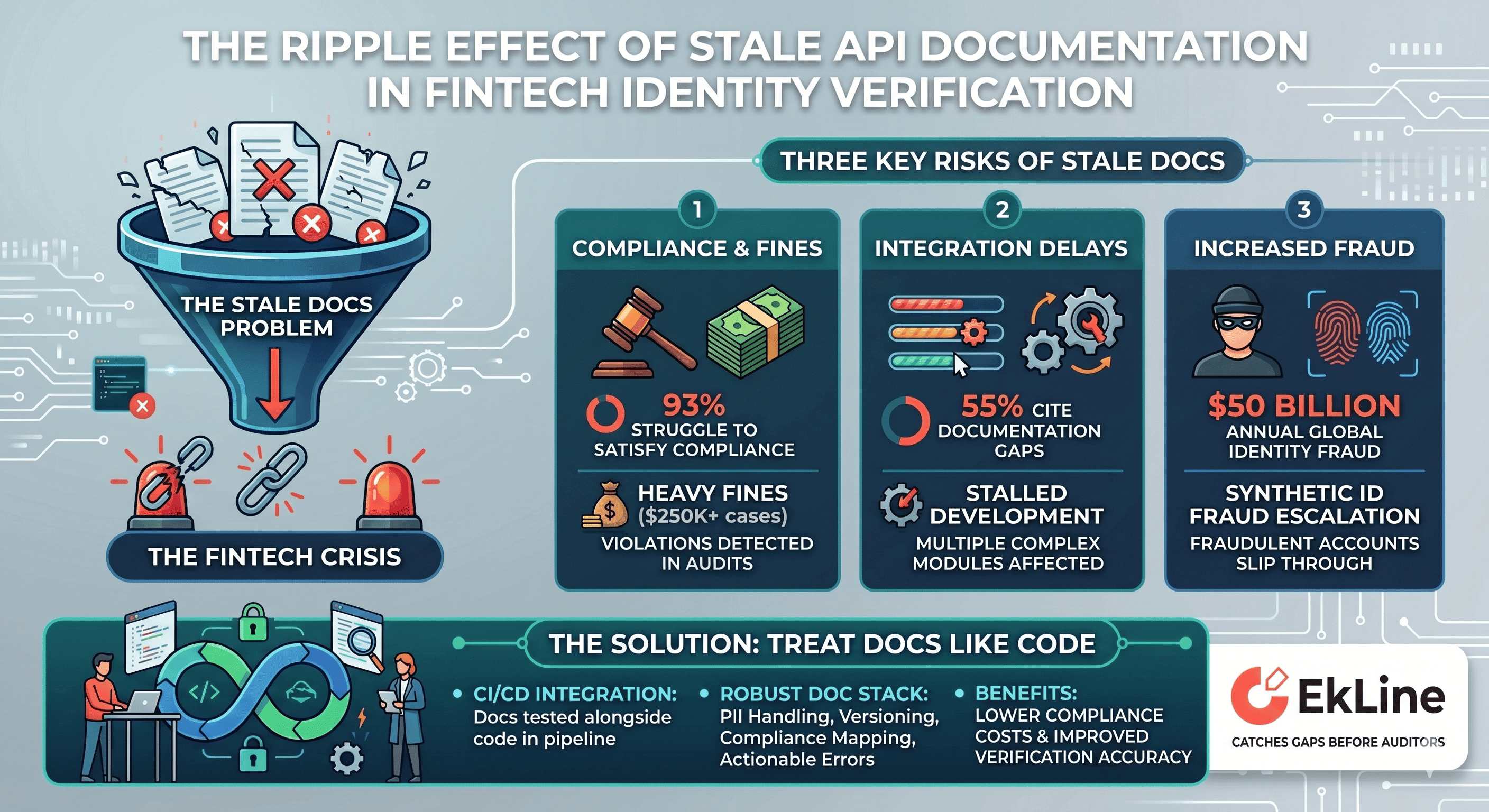
60% of fintechs paid $250K+ in compliance fines from documentation gaps. Here is what wrong API docs actually cost identity verification teams.
- Written by
- Lucas Suárez (opens in a new tab)
- Published on
- Read time
- 5 min

Sixty percent of fintechs paid at least $250,000 in compliance fines last year. The root cause in many of those cases was not a code bug or a missing policy. It was stale API documentation.
A modern identity verification platform exposes dozens of modules through a single API: document verification, synthetic fraud scoring, watchlist screening, decision engines. When the docs describing those modules fall out of sync with the actual API behavior, the consequences compound fast.
The $50 Billion Context
Global identity fraud costs now exceed $50 billion annually. Synthetic identity fraud alone accounts for $20 to $40 billion in global losses each year. In the first half of 2025, 8.3% of all digital account creations were flagged as suspected fraud.
Identity verification APIs are the front line against this. A modern verification platform lets teams call a single endpoint for KYC checks, fraud scoring, document verification, and watchlist screening. The defense only works if the integration is correct. And the integration is only as correct as the documentation guiding it.
Where Documentation Gaps Create Real Cost
1. Compliance Fines from Stale Docs
Ninety-three percent of fintechs struggle to satisfy compliance requirements. The gap between "we have docs" and "our docs match production" is where auditors find violations.
Consider a KYC verification endpoint. If the docs describe a deprecated request schema, a new integration partner may skip a required field, like a sanctions screening flag or a consent parameter. The API still returns a 200. The check still "passes." But the verification is incomplete, and the compliance record is now inaccurate.
PCI DSS requires documentation of data flows and security controls. KYC/AML regulations require auditable verification trails. When the documentation describing these flows does not match the running code, the audit trail has a hole in it.
{
 "modules": ["kyc", "fraud", "watchlist"],
 "config": {
   "consentObtained": true,
   "watchlistSources": ["ofac", "pep", "adverse_media"]
 }
}
If watchlistSources was recently expanded to require sanctions_consolidated but the docs still list the old three values, every integration built from those docs is running an incomplete screening. The code works. The check does not.
2. Integration Delays That Multiply
The Postman 2025 State of the API Report found that 55% of API teams cite documentation gaps as their top collaboration challenge. In identity verification, those gaps hit harder than most industries.
A typical identity verification integration touches multiple modules: identity resolution, fraud scoring, document verification, and decision logic. Each module has its own request parameters, response codes, and error states. When a developer hits an undocumented edge case in one module, the entire integration stalls.
Organizations using well-documented, API-driven verification processes reduced compliance costs by 47% and improved verification accuracy by 31%, according to the KYC Benchmark Report. The difference is not the technology. It is whether the team integrating the technology can trust what the docs say.
3. Fraud That Slips Through Undocumented Changes
Identity verification APIs evolve constantly. New fraud vectors emerge, scoring models get retrained, and risk thresholds shift. When those changes ship without corresponding documentation updates, downstream teams may not adjust their decision logic.
Consider a fraud-scoring module that analyzes multiple identity dimensions and surfaces a single risk score. The precision of that score depends on integrators correctly interpreting score ranges, reason codes, and threshold recommendations. If a model update shifts what a score of 0.7 means, but the docs still describe the old interpretation, fraud teams will make decisions on stale logic. The score did not change. The score's meaning did.
Financial services fraud losses reached $12.5 billion in 2024, a 25% increase over the previous year. Not all of that traces to documentation. But every undocumented API change creates a window where fraud scoring, decision routing, or compliance checks may operate on wrong assumptions.
The Documentation Requirements Stack
Identity verification APIs carry a heavier documentation burden than most fintech APIs. The minimum viable docs must cover:
- Authentication and scopes: Which API keys access which modules, and what permissions each scope grants
- PII handling: How personal data is encrypted in transit, masked in logs, and retained or purged per regulation
- Compliance mappings: Which endpoints satisfy which regulatory requirements (KYC, AML, OFAC screening)
- Versioning and deprecation: When endpoints change, what breaks, and how to migrate
- Error codes with remediation: Not just "400 Bad Request" but "missing required field: consentObtained, see migration guide v4.2"
Example: EkLine rule for identity verification docs
rules:
 - id: kyc-endpoint-versioning
   description: KYC endpoints must document version and deprecation date
   pattern: "/api/v[0-9]+/(kyc|verify|screening)"
   require:
     - version_header
     - deprecation_notice
     - migration_guide_link
When any layer in this stack drifts from the running code, the cost shows up in one of three places: a compliance finding, a failed integration, or a fraud event that should have been caught.
What a Fix Looks Like
The teams that avoid these costs treat documentation like they treat code: it gets tested in CI, it gets reviewed in PRs, and it gets flagged when it drifts from the source of truth.
Running documentation checks in the same pipeline that tests the API means a new endpoint parameter cannot ship without a corresponding docs update. A deprecated field cannot linger in production docs past its removal date. A compliance-critical module cannot change its behavior without a changelog entry.
This is not a tooling problem. It is a workflow problem. The documentation review needs to sit in the same pipeline as the code review, not in a separate wiki that gets updated "when someone has time."
The Bottom Line
Identity verification documentation is not a developer convenience. It is a compliance control, a fraud prevention layer, and an integration reliability guarantee.
When the docs are wrong, the integration is wrong. When the integration is wrong, the verification is incomplete. And when the verification is incomplete, the cost shows up as a fine, a fraud loss, or a partner who takes their integration timeline from weeks to months.
If your identity verification docs drift between releases, EkLine catches the gap before your auditor does.