How docs CI/CD reduces time-to-first-call (TTFC)
API developers often abandon a product if they encounter friction during onboarding, such as outdated guides or broken code. The critical metric for measuring this success or failure is Time-to-First-Call (TTFC)—the time elapsed between a developer opening the documentation and making their first su
- Written by
- Puneet Arora (opens in a new tab)
- Published on
- Read time
- 10 min

API developers often abandon a product if they encounter friction during onboarding, such as outdated guides or broken code. The critical metric for measuring this success or failure is Time-to-First-Call (TTFC)—the time elapsed between a developer opening the documentation and making their first successful API call.
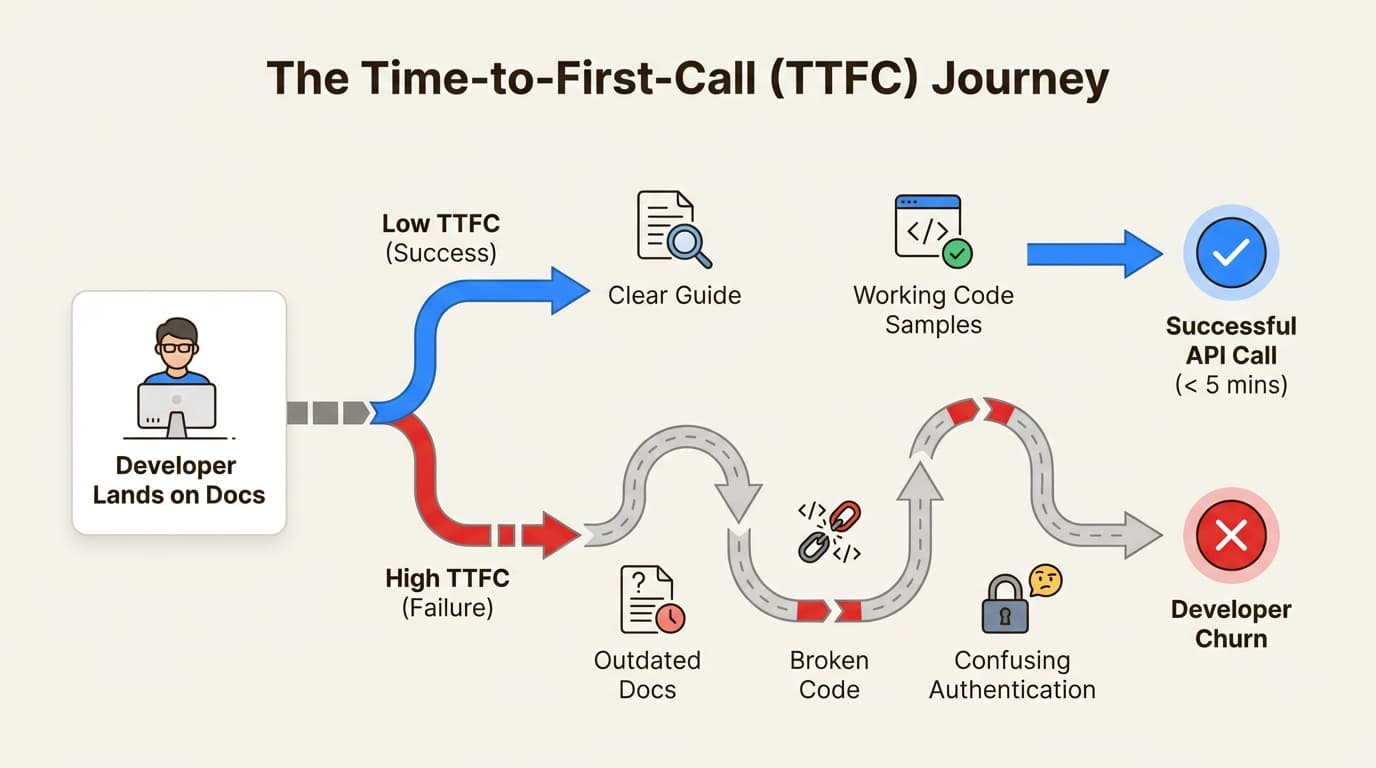
When a developer lands on a website to use an API, they are ready to build something and grab an API key. However, they can hit a wall if the getting-started guide is from last year, the code samples are broken, or the authentication instructions are confusing. This is where developer churn can begin.
This process is measured by one key metric: Time-to-First-Call (TTFC). It is a stopwatch that starts the moment a developer opens your docs and stops when they make their first successful API call. A low TTFC isn't just a positive indicator; it's a direct measure of onboarding and a significant sign of whether that developer will continue to use the product. As the teams at Postman map it out, the path is simple: developers browse, they sign up, and they try to make that first call. The question is how much friction exists in the process. This one metric is important because it’s arguably the most important API metric you can track for developer onboarding. A fast TTFC means developers get to that "aha!" moment quickly, see the value in what you're offering, and are much more likely to become active, long-term users. A slow TTFC, on the other hand, can lead to frustration and developers giving up. The best companies know this well. Twilio, for example, famously aims for a TTFC of "5 minutes or less", setting a high bar for what a great onboarding experience should be. A great onboarding experience can be visually represented as two distinct paths, one leading to success and the other to failure.
This is where applying the principles of CI/CD (Continuous Integration/Continuous Deployment) to your documentation can make a world of difference. A "Docs CI/CD" workflow is a systematic way to smooth out friction points, lower your TTFC, and turn a difficult onboarding process into a great developer experience.
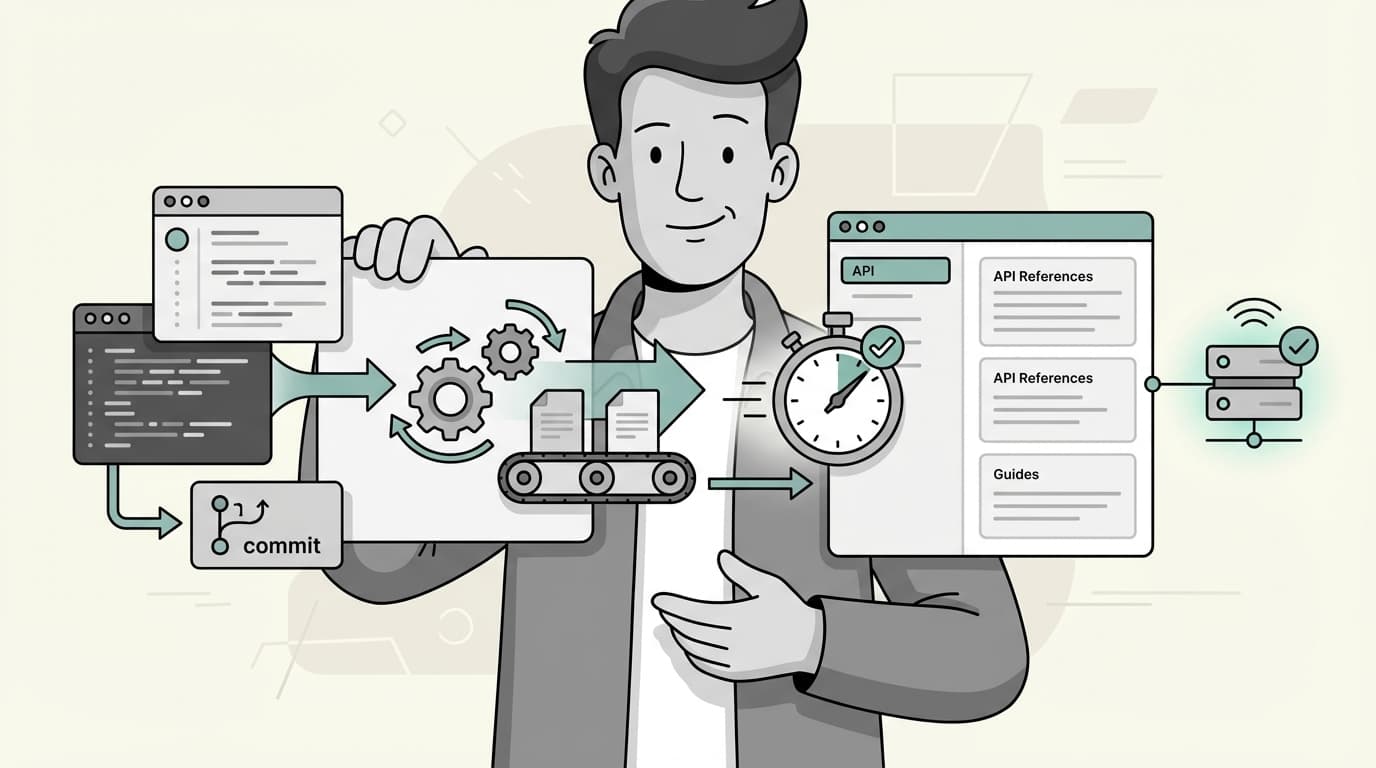
Docs CI/CD is about applying the "Docs-as-Code" philosophy" for documentation. Rather than having docs live in a completely separate world, they’re treated just like software: written in plain text formats like Markdown, stored in a Git repository, and managed through a CI/CD pipeline. This means the whole documentation lifecycle gets automated. When a developer makes a change, the pipeline automatically checks for quality, consistency, and accuracy before anything gets published. The goal is to make documentation a natural part of every release, not a tedious chore that gets tacked on at the end. By building documentation into the development process, you make sure it’s always accurate and genuinely helpful, which directly addresses the friction that causes a high TTFC.
The hidden costs of a high TTFC
A high TTFC isn't just a number on a dashboard. It can quietly undermine growth and create real problems across a company. The longer it takes a developer to get started, the more these issues can accumulate.
-
Developer friction and abandonment: Developers are busy and have plenty of other options. When they hit a roadblock because docs are outdated or code samples don't work, they may not have time to file a support ticket and wait. They might move on to a competitor with a smoother onboarding process. Every bit of friction is another reason for them to leave before they see the full value of a product.
-
Eroding trust and brand perception: We believe that "incorrect documentation is a bug, not a typo." When your docs are wrong, it can send a message that you don't pay attention to the details. This can break the trust you need to build with developers. If they can't trust your documentation, they may question the reliability of your API. This kind of perception can spread in developer communities, potentially damaging your brand's reputation.
-
Increased support load and engineering toil: Poor documentation can create a significant number of preventable support tickets. Your support team might end up answering the same basic setup and authentication questions repeatedly. These questions can get escalated to your engineering team, pulling them away from building new features to fix simple onboarding issues that clear documentation could have solved from the start. This isn't just inefficient; it's a drain on your most valuable team members.
Core strategies for reducing TTFC with Docs CI/CD
Building a Docs CI/CD pipeline is about creating an automated, intelligent system that makes great documentation easier to achieve. Here’s how you can do it.
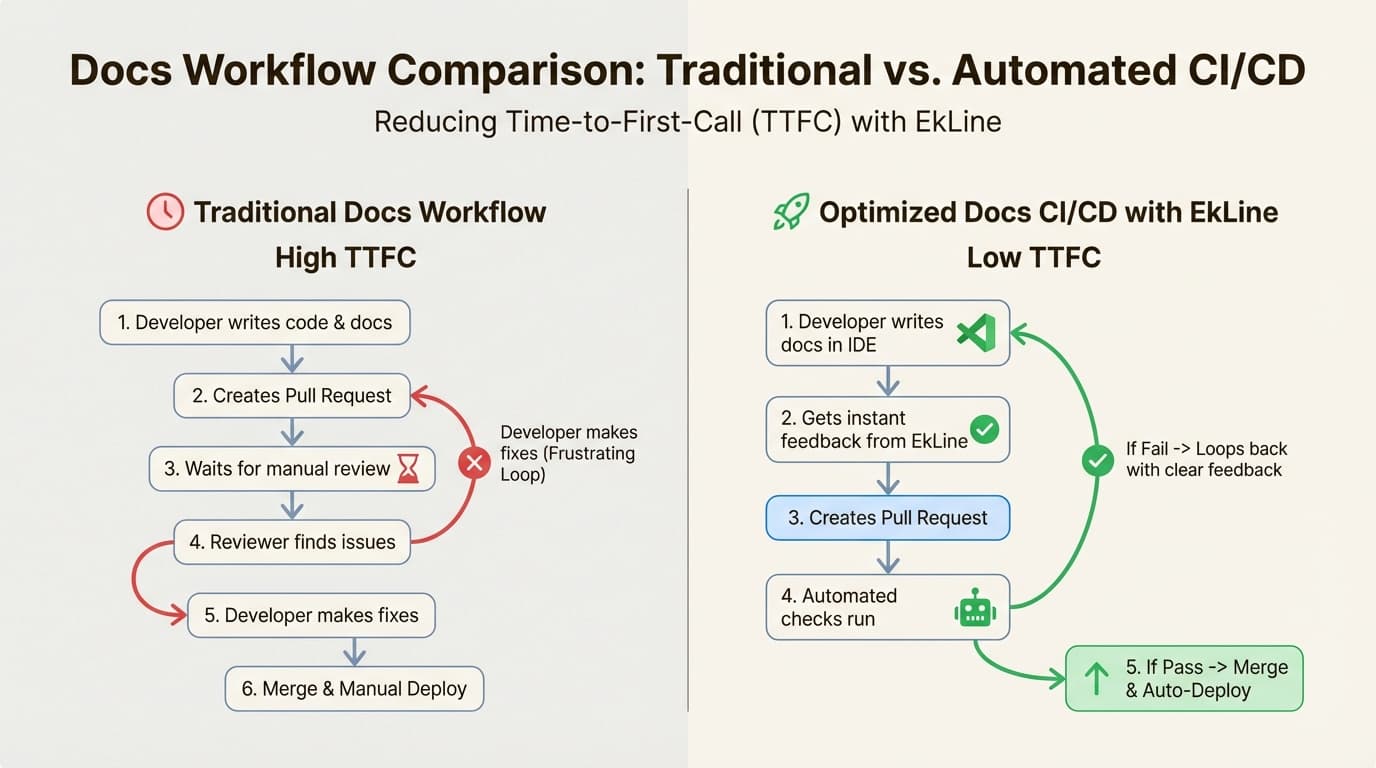
- Automate quality and consistency checks: Manual reviews can be slow, subjective, and create a bottleneck. A good Docs CI/CD pipeline automates these checks. It can automatically check every contribution for style guide adherence, grammar, tone, and even tricky terminology issues.
This is where tools like EkLine Docs Reviewer can help. By integrating directly into your GitHub pull requests, it acts as an automated gatekeeper for quality. Before documentation is merged, Docs Reviewer scans it for everything from passive voice and clunky phrasing to structural problems. It even handles broken link and email validation automatically, so developers never hit a frustrating 404 page. It’s like having a senior technical editor reviewing every change, but instantly.
- Integrate documentation into the developer workflow: The best time to catch a mistake is right when it's made. Providing feedback earlier is more efficient than waiting for a pull request to tell a developer they used the wrong term or forgot a parameter description. The fastest feedback happens right where developers spend their time: inside their code editor.
Bringing documentation checks directly into the IDE makes a huge difference. The EkLine VS Code extension, for example, gives your team real-time feedback as they write. It underlines issues in Markdown and other documentation files, just like a spell checker, and offers suggestions on how to fix them. With features like "Fix with EkLine AI," developers can resolve issues with a single click, stopping errors long before they ever become part of a pull request.
- Empower the whole team to contribute safely: Great documentation isn't just written by engineers. Product managers, support specialists, and developer advocates all have valuable knowledge to share. But they often hold back because the "docs-as-code" workflow can feel a bit intimidating.
An effective Docs CI/CD pipeline needs to bridge that gap. For instance, EkLine’s Google Docs integration (currently in beta) lets non-technical team members draft and edit content in a familiar environment, while still getting all the benefits of automated style and quality checks. This opens up the process, making it easy for everyone to contribute. As Alyssa Rock from The Good Docs Project put it, using EkLine allows contributors to "resolve style and grammar issues without maintainer intervention," which turned a "month-long process into a few hours."
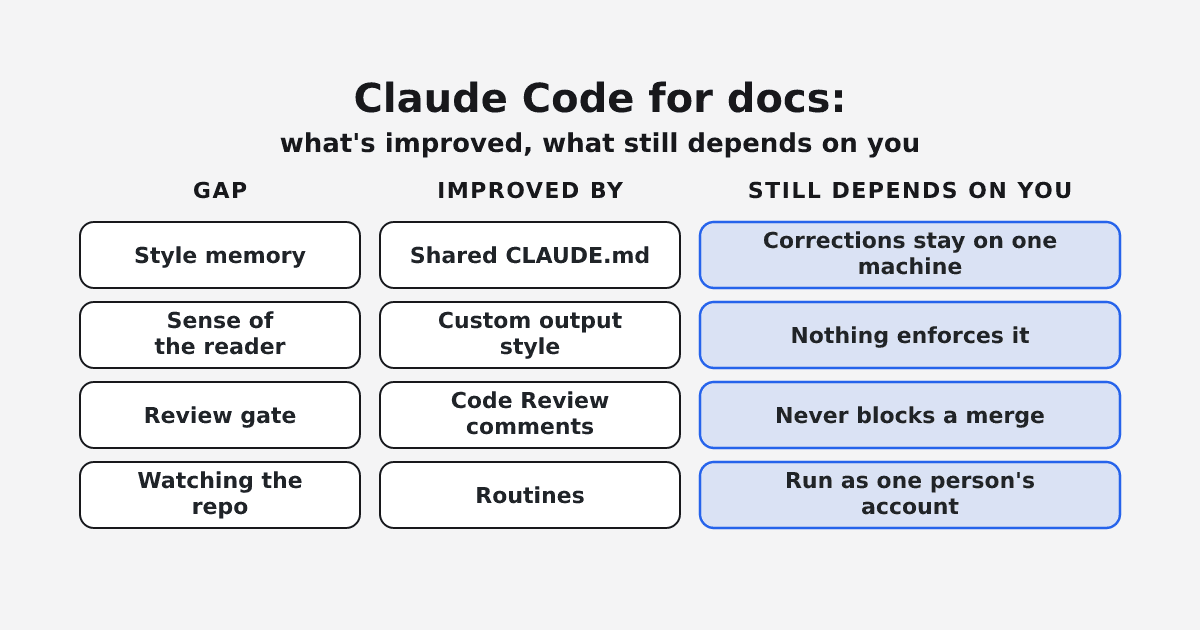
To see the difference, here's a look at the two workflows side-by-side:
The next frontier: Using AI to reduce TTFC
A solid Docs CI/CD pipeline is great for validating the quality of your documentation. The next step is using AI to help create and maintain it. This is how you close the gap between product changes and documentation updates for good, getting your TTFC as low as possible.
- From reactive checks to proactive creation: A common hurdle in documentation is often just getting started. Staring at a blank page and trying to write a clear guide for a new feature can be tough. AI-powered tools are changing this. They can take a simple prompt and generate a well-structured, style-guide-compliant first draft in seconds.
This is the idea behind EkLine Docs Agent. A developer can finish writing a new function, and instead of spending the next hour writing docs, they can simply point the agent at the code. Docs Agent will generate a complete API reference, with parameter descriptions, return values, and even code examples, all while following the style and terminology rules you’ve already set up. It turns documentation from a chore into a simple, automated step.
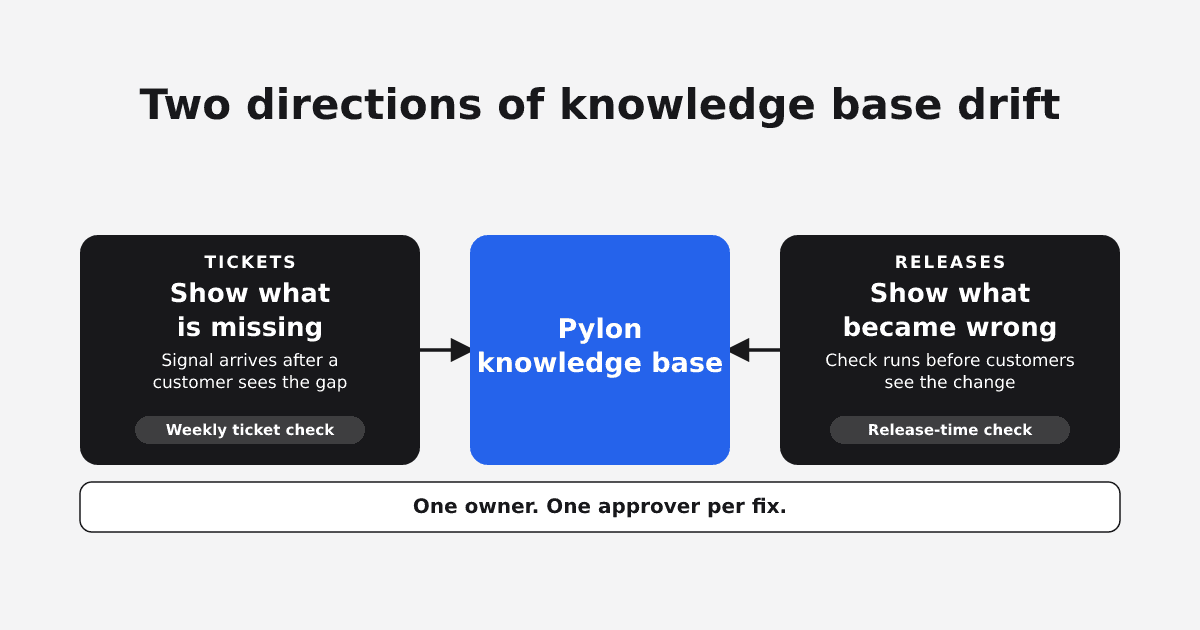
- Keeping documentation in sync with product changes: The other major cause of a high TTFC is "documentation drift," which is another way of saying your docs no longer match your product. It happens frequently. An engineer adds a new parameter to an API endpoint, and nobody remembers to update the docs. The next developer who comes along is left confused and frustrated.
AI agents can make this problem a thing of the past. The EkLine Docs Agent can be set up to monitor your codebase or your Jira board/Notion/Linear for changes. When it detects something new, like a modified API endpoint or a UI change, it doesn't just send a notification. It finds the exact pages in your documentation that are now out of date, drafts the necessary updates, and automatically opens a pull request with the suggested changes. What used to be a manual task of hunting down and updating content becomes a simple, two-minute review.
Improving the developer experience with quality documentation
Time-to-First-Call isn't just a metric; it's the pulse of your developer onboarding experience. For any company with a developer-facing product, getting it right is essential.
A slow, manual, and disconnected documentation process is almost always the main reason for a high TTFC, leading to developer frustration, churn, and a damaged brand.
The solution is a modern Docs CI/CD pipeline, backed by AI. By automating quality checks, integrating feedback directly into the developer workflow, and using AI to help create and maintain content, you can remove the friction points one by one. The result is a smooth, trustworthy, and efficient onboarding experience that helps you not only attract developers but also keep them, by getting them to that "hello world" moment faster than ever.
Automate your entire documentation lifecycle with EkLine
Your documentation shouldn't be an afterthought; it should be one of your biggest advantages. With EkLine, Inc., you can build an automated, intelligent Docs CI/CD pipeline that ensures your docs are always clear, consistent, and perfectly in sync with your product.
From automated style reviews in every pull request with Docs Reviewer to AI-powered content generation and updates with Docs Agent, EkLine helps you lower your Time-to-First-Call and deliver the world-class developer experience your users deserve.
Start your free trial today and see how easy it is to put your documentation on autopilot.
Frequently Asked Questions
The primary mechanism is automation. By automating style checks, link validation, and content updates, a Docs CI/CD pipeline removes the manual bottlenecks that cause documentation to become outdated. This ensures developers always have accurate information, allowing them to make their first API call much faster.
A lower TTFC directly improves developer satisfaction and retention. When developers can get started quickly, they perceive your product as more valuable and easier to use. This builds trust, reduces support tickets, and frees up your engineering team to focus on new features instead of troubleshooting basic onboarding issues.
Integrating checks directly into an IDE (like with the EkLine, Inc. VS Code extension) provides real-time feedback as developers write documentation. This catches errors instantly, long before a pull request is even created. This "shift-left" approach prevents mistakes from ever reaching the main repository, keeping docs accurate from the start and speeding up the entire process.
Absolutely. AI tools like EkLine Docs Agent go beyond just checking content; they help create and maintain it. AI can generate first drafts of API documentation from code, or automatically detect when a product change requires a documentation update and draft the new content. This dramatically shortens the time between a product release and updated docs.
The best first step is to adopt a "docs-as-code" approach. Start by storing your documentation in a Git repository alongside your code. Then, introduce an automated linter or style checker into your pull request process. Tools like EkLine Docs Reviewer can be integrated quickly to provide immediate value by automating quality gates.